
TL;DR:
- Properly certified copies are essential to prevent delays, rejections, and legal issues in official applications.
- Certification involves an authorized individual confirming a true match between original and duplicate documents.
- Proactive communication with institutions ensures correct certification types and smooth submission processes.
Submitting the wrong type of document copy to a government office, bank, or immigration authority can quietly derail an application you’ve spent weeks preparing. Many Ontario residents and small business owners discover this the hard way, often after missing critical deadlines. Most legal and administrative applications depend on properly certified documents, yet the assumption that a standard photocopy will work remains surprisingly common. Understanding what certified copies are, when you need them, and what happens without them can protect your time, money, and legal standing.
Table of Contents
- What is a certified copy and when are they required?
- Key documents that often require certified copies
- Why certified copies matter: Risks, rejections, and legal consequences
- Certified copies, notarized copies, and internal certification: Key differences
- Our take: Most rejections are preventable with clarity and preparation
- Get certified copies without the hassle: How our solutions can help
- Frequently asked questions
Key Takeaways
| Point | Details |
|---|---|
| Photocopies are often rejected | Most Ontario institutions require certified copies for legal, financial, and regulatory submissions. |
| Certification prevents delays | Using certified copies avoids application holdups, rejections, and potential legal issues. |
| Know which documents count | Vital records, government IDs, and business documents are the most common certification targets. |
| Get the right certification type | Understand when you need a certified, notarized, or internally certified copy for your purpose. |
What is a certified copy and when are they required?
A certified copy is not simply a photocopy of an original document. It is a reproduction that has been reviewed by an authorized individual who confirms, in writing, that the copy is a true and accurate reproduction of the original. That authorized person stamps or signs the copy with their credentials, making it legally acceptable for official use in place of the original document.
What is a certified copy matters because institutions do not just want a reproduction of your documents. They want assurance that the copy has not been altered or fabricated. A plain photocopy carries no such guarantee. In Ontario, the individuals legally authorized to certify copies typically include lawyers, notaries public, and commissioners for oaths.
Government agencies, banks, immigration authorities, courts, and universities routinely require certified copies rather than plain photocopies, as certification provides the authenticity assurance these institutions need to process applications with confidence. Without that signature and stamp, your documents may be returned without review.
Here is a snapshot of common situations where certified copies are required in Ontario:
| Situation | Typical document needed |
|---|---|
| Immigration application | Passport, birth certificate, marriage certificate |
| Opening a bank account | Government-issued ID, proof of address |
| University admission | Academic transcripts, diplomas |
| Court proceedings | Affidavits, legal agreements, identity documents |
| Real estate transactions | Title documents, corporate records |
| Professional licensing | Degrees, training certificates, identification |
| Employment verification | Education records, foreign credentials |
Each of these situations carries real consequences if you arrive with an uncertified copy. A university admissions office may simply refuse to process your application. A court may not admit your document into the record. An immigration officer may flag your file for further review, which can add months to the process.
Key documents that often require certified copies
With an understanding of who needs certified copies and why, let’s break down which documents you are most likely to need certified in different real-world situations.
For individuals in Ontario, the most frequently certified documents include government-issued photo ID, passports, birth certificates, marriage or divorce certificates, immigration status documents, and educational records such as diplomas or transcripts. Each of these may be required in multiple contexts, from proving identity to establishing qualifications.

For small business owners, the list includes certificates of incorporation, business licenses, shareholder agreements, articles of incorporation, and professional certifications or trade licenses. When dealing with regulators, financial institutions, or foreign business partners, a plain copy of your incorporation documents simply will not hold up.
Common for Ontario individuals and small businesses are ID and passports, birth and marriage certificates, degrees and transcripts, and corporate records and incorporation documents, which are used in contexts ranging from immigration and banking to real estate, employment, and professional licensing.
Here is a practical breakdown by category:
| Document category | Individuals | Small businesses |
|---|---|---|
| Identity documents | Passport, driver’s license, PR card | Director ID, business registration |
| Vital records | Birth, marriage, death certificates | Not typically applicable |
| Education records | Diplomas, transcripts, credentials | Trade certificates, professional licenses |
| Financial documents | Bank statements (rare) | Articles of incorporation, financial records |
| Legal documents | Court orders, name change documents | Shareholder agreements, contracts |
The certification of documents process itself is straightforward once you know what you need, but getting the details right before you start saves significant back-and-forth.
Pro Tip: Before booking an appointment with a notary or commissioner, contact the institution requesting your certified copy and ask them to specify in writing which documents they require and exactly how they need to be certified. Different institutions sometimes have different standards for what counts as acceptable certification, and you want to match their expectations precisely.
It is also worth noting that some certified copy requirements vary by destination. A document being sent internationally may need additional authentication, such as an apostille, beyond standard Ontario certification. Always verify whether the document’s destination affects the type of certification you need.
Common documents individuals and businesses frequently need certified include:
- Passports and government-issued photo identification
- Birth, marriage, and death certificates
- University and college diplomas and official transcripts
- Permanent resident cards and immigration documents
- Certificates of incorporation and business registration documents
- Professional trade certificates and licenses
- Court orders and legal name change documents
- Foreign credentials submitted for recognition in Canada
Why certified copies matter: Risks, rejections, and legal consequences
After listing the kinds of documents requiring certification, let’s examine why getting it wrong can cause significant setbacks.
The consequences of submitting uncertified copies go well beyond a polite request to resubmit. In many regulated processes, an uncertified document is treated as though it was never submitted at all. Your file may be closed, and you may need to start the process over from the beginning.
Application delays, outright rejections, and potential legal penalties are common outcomes of uncertified submissions, particularly in immigration and regulatory matters, where a significant majority of legal disputes and administrative applications hinge on proper certification. These are not rare edge cases. They happen to unprepared applicants regularly.
Consider what this looks like in practice. An Ontario small business owner submits a plain photocopy of their incorporation documents to a provincial regulatory body when applying for a professional license. The application is rejected and a resubmission deadline is set, but the business owner is traveling for work and misses it. The licensing window closes. Revenue is delayed by months.
“Proper document certification is not a formality. It is a legal safeguard that protects both the applicant and the institution receiving the documents. Without it, even strong applications can fall apart on a technicality.”
Here are the most common real-world consequences of submitting uncertified copies:
- Delayed processing: Your application is set aside until properly certified documents are received, which can push timelines back by weeks or months.
- Application rejection: In regulated processes with strict deadlines, missing the certification requirement can result in a full denial rather than a simple request to resubmit.
- Financial loss: Reapplication fees, legal fees, and lost revenue during delays all add up quickly, especially for business-related filings.
- Legal scrutiny: Submitting unauthenticated documents in court or immigration proceedings can raise questions about the integrity of your entire application.
- Loss of status or standing: Immigration applicants who miss certification requirements may face consequences that affect their residency or work permit status.
You can also explore the broader legal impact for Ontario businesses when certified copy requirements are not met carefully. A legal opinion on certified copies further reinforces that the authentication of documents is a foundational element in most formal proceedings.
Pro Tip: Before submitting any application, call or email the institution and ask specifically whether certified copies are required and who they will accept as the certifying authority. Get that confirmation in writing. This one step eliminates almost all risk of a certification-related rejection.
Certified copies, notarized copies, and internal certification: Key differences
Now that you understand the consequences of uncertified copies, let’s clear up the confusion between certified, notarized, and internally certified documents.
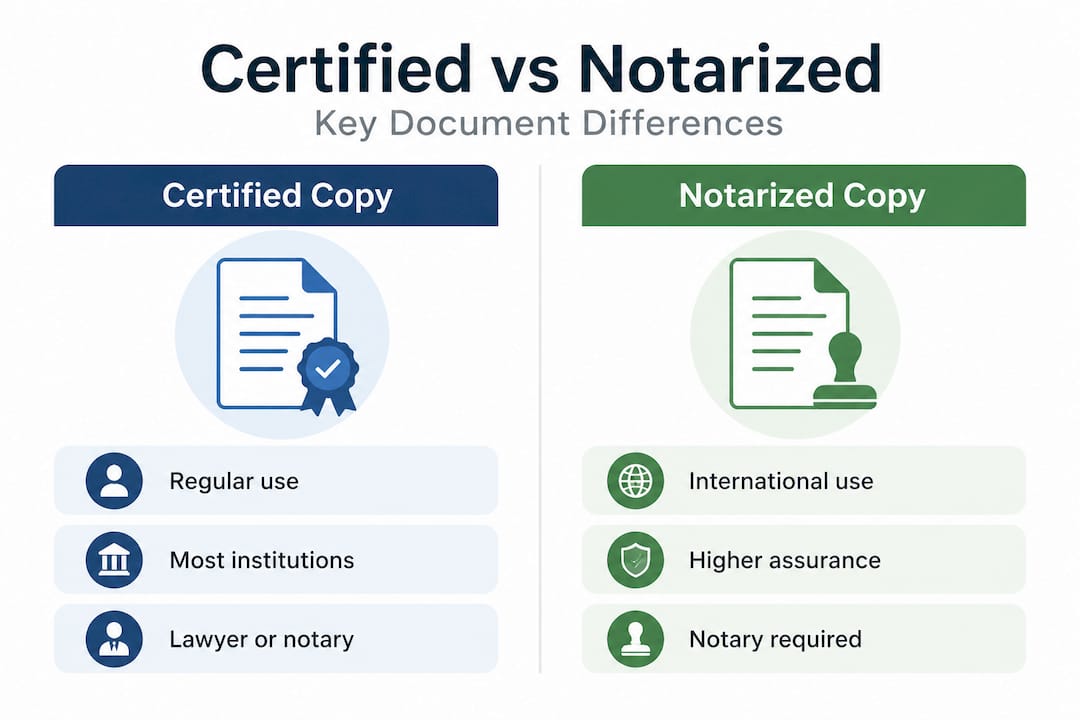
These three terms are often used loosely, and the confusion between them is a real source of problems for applicants. A certified copy confirms that a reproduction matches the original. A notarized copy goes a step further: a notary public not only confirms the copy is accurate but also uses their official seal and professional authority to authenticate it for use in more formal or sensitive contexts, including overseas submissions.
The distinction between certified vs notarized copy differences matters because submitting the wrong type can trigger the same rejection risks as submitting no certification at all. Knowing which one you need before you proceed is essential.
Internal certification by a bank or company is a third, more limited category. A bank teller or branch manager can certify a document for the bank’s own records or internal processes. However, when that document needs to go to an external institution, such as a government agency or foreign university, internal bank certification almost never meets the requirement.
Banks may certify internally, but external use requires a notary or lawyer, and confirming institution requirements in advance is essential to avoid rejection. This is a commonly misunderstood rule that catches many applicants off guard.
Here is a clear comparison of the three types:
| Type | Who issues it | Accepted for internal use | Accepted for external/regulated use |
|---|---|---|---|
| Certified copy | Lawyer, notary, commissioner | Yes | Yes, in most Ontario contexts |
| Notarized copy | Notary public | Yes | Yes, including overseas and high-stakes uses |
| Internal certification | Bank staff, company officer | Yes, within that institution | Rarely accepted by external parties |
To determine which type of certification you actually need, work through these steps:
- Identify the receiving institution and its country or jurisdiction
- Ask for written confirmation of their document requirements
- Check whether they require the certification to come from a specific authority (such as a notary vs. a commissioner)
- Confirm whether the document will be used internationally and whether additional authentication is needed
- Review a guide to notarized copies if you are unsure which format applies to your situation
This structured approach takes about 15 minutes and can save you days or weeks of delay.
Our take: Most rejections are preventable with clarity and preparation
To wrap up, here is our perspective on why so many certified copy problems are completely avoidable.
After working with many Ontario residents and small business owners through document certification, the pattern is clear. Most delays and rejections have very little to do with complex regulations or unusual circumstances. They happen because someone assumed their situation was standard when it was not.
Certification requirements are not uniform across institutions. A government ministry, a bank, a foreign consulate, and a professional licensing body can each have different expectations for what constitutes an acceptable certified copy. Assuming that what worked for your neighbor’s immigration application will work for your business license application is a reasonable instinct, but it is often wrong.
The good news is that the fix is simple. Proactive communication with the receiving institution eliminates nearly all of this risk. One email or phone call, asking specifically what format and authority they require for certified copies, gives you exactly the information you need to get it right the first time.
Preparation also means understanding that certified copy requirements are not a bureaucratic obstacle. They exist because institutions need to trust the documents they receive. When you provide properly certified documents, you are signaling that you are a prepared and credible applicant. That matters in competitive contexts like licensing, immigration, or court proceedings.
We have also seen clients waste money by over-certifying documents. Getting a notarized copy when a simple certified copy would suffice costs more and takes longer than necessary. Matching the right certification to the right audience is as important as getting certified at all.
Pro Tip: Always request written confirmation of exactly what certification is required, including who the authorizing party must be, and then follow through precisely with those instructions. Keep that written confirmation in your records in case of any dispute.
Get certified copies without the hassle: How our solutions can help
When you want to guarantee your documents won’t be held up by process errors, working with professional notaries is the simplest path.
At The Online Notary, we make it straightforward for Ontario residents and small business owners to get documents certified quickly, reliably, and without leaving home. Our online process is designed to match the Ontario notary services that institutions actually accept, so you do not have to guess about format or authority.

Whether you need a certified copy of your passport for an immigration application, your degree for a professional licensing body, or your incorporation documents for a banking relationship, we handle the certification process from start to finish. We also help you understand public notary requirements so you are always submitting exactly what is asked for. Skip the confusion and the back-and-forth. Get it done right the first time.
Frequently asked questions
Who can certify a copy of a document in Ontario?
In Ontario, lawyers, notaries public, and commissioners for oaths are commonly authorized to certify copies for official use. Government agencies, banks, and courts typically require certification from one of these recognized authorities.
Is a certified copy the same as a notarized copy?
No. A notarized copy involves special authentication by a notary public and is typically required for overseas or high-stakes documents. A regular certified copy may suffice for many standard Ontario uses.
What happens if I submit an uncertified photocopy?
Your application could be delayed, rejected, or result in legal penalties, particularly for regulated matters. Application delays and outright rejections are common outcomes when certification requirements are not met.
Can Canadian banks certify copies for external use?
Most banks can certify documents for their own internal use, but external organizations typically require certification from a notary or lawyer. Banks that certify internally do not usually meet the standards required by government agencies or foreign institutions.
How do I know if a certified copy is required for my situation?
Check directly with the requesting institution or authority, as requirements differ depending on the process, destination, and document type. Getting this confirmation in writing before you proceed is always the safest approach.