
Choosing the right type of document copy in Ontario can make or break your application. Many people assume a certified copy and a notarized copy are basically the same thing. But nearly every government office and legal service treats them very differently and some institutions in Ontario will outright reject documents if you get it wrong. One slip could mean delays or rejected paperwork, especially since remote notarization is still prohibited for most documents in Ontario as of 2025. If you think any official-looking stamp will do, get ready for a surprise.
Table of Contents
- What Is A Certified Copy In Ontario
- How Notarized Copies Work In Ontario
- Certified Copy Vs Notarized: Key Differences
- When To Use Certified Or Notarized Copies
Quick Summary
| Takeaway | Explanation |
|---|---|
| Certified copies verify document accuracy only | They confirm the copy matches the original but do not authenticate the content itself. |
| Notarized copies add layers of legal credibility | Notarization includes verifying signer identity, which strengthens the document’s authenticity for legal use. |
| Use certified copies for straightforward needs | Ideal for applications like academic transcripts where only document verification is required. |
| Choose notarized copies for complex transactions | Necessary for legal agreements and real estate transactions that demand enhanced verification. |
| Always verify specific requirements with institutions | Each organization may have different guidelines for document acceptance that must be followed. |
What Is a Certified Copy in Ontario
A certified copy represents an official duplicate of an original document that has been verified as authentic and accurate by a recognized authority. In Ontario, certified copies play a crucial role in various legal and administrative processes, providing a reliable method for individuals and businesses to present document evidence without risking damage or loss of original records.
Understanding the Certification Process
The certification process involves a professional carefully comparing the copy with the original document to confirm its complete accuracy. According to Ontario Land Registry, a certified copy contains an official endorsement or certificate confirming it is a true representation of the original document. This means the certification does not guarantee the original document’s inherent authenticity, but rather verifies the copy matches the original exactly.
Professionals who can provide certified copies include notaries public, lawyers, commissioners for taking affidavits, and specific government officials. These professionals examine the original document side by side with the photocopy, meticulously checking every detail to ensure absolute conformity.
Key Characteristics of Certified Copies
Certified copies have several distinctive features that distinguish them from standard photocopies. Wikipedia’s legal documentation research highlights that these documents typically include:
- Official Stamp: A clear, official stamp or seal from the certifying professional
- Signature: The certifier’s signature verifying the document’s accuracy
- Date of Certification: The specific date when the copy was verified
These documents are frequently required for critical processes such as passport applications, legal proceedings, property transactions, and academic credential verifications. For individuals seeking comprehensive guidance through this process, our detailed certification guide offers step-by-step insights into document certification in Ontario.
While certified copies provide an important service, they are not universal. Some institutions or processes might require additional authentication methods or original documents. Always confirm specific requirements with the requesting organization to ensure your certified copy meets their exact standards.
How Notarized Copies Work in Ontario
In Ontario, the notarization process is strictly regulated and requires personal appearance and verification. According to the Law Society of Ontario, a notary public plays a crucial role in witnessing document signatures, administering oaths, and certifying true copies of original documents. When creating a notarized copy, the notary public carefully compares the photocopy with the original document, examining every detail to ensure complete accuracy.
The key distinction in the notarization process is the official endorsement. A notary public will attach a specific certificate or stamp to the document, which includes their official seal, signature, and the date of certification. Official Documents Services in Ontario emphasizes that this process provides an additional layer of legal credibility beyond a standard certified copy.
Legal Requirements and Restrictions
Notarization in Ontario comes with specific legal constraints. As of 2025, remote or virtual notarization is not permitted for most documents. Individuals must appear in person before a notary public to have their documents notarized. For those seeking comprehensive guidance on the notarization process, our detailed notarization guide offers step-by-step insights into document authentication.
The professionals authorized to provide notarization services include:
- Lawyers who are commissioned as notaries public
- Specific government officials
- Commissioned notary publics
Notarized copies are particularly important for documents requiring international recognition, such as academic transcripts, passport applications, and legal agreements. The notary public’s seal and signature provide an additional layer of authentication that many institutions and international bodies require.
It is crucial to understand that notarization does not guarantee the content of the document is true or accurate. Instead, it confirms that the person signing the document did so willingly and that the copy is a true representation of the original. Always verify the specific requirements of the institution or organization requesting the notarized document to ensure compliance with their exact standards.
Certified Copy vs Notarized: Key Differences
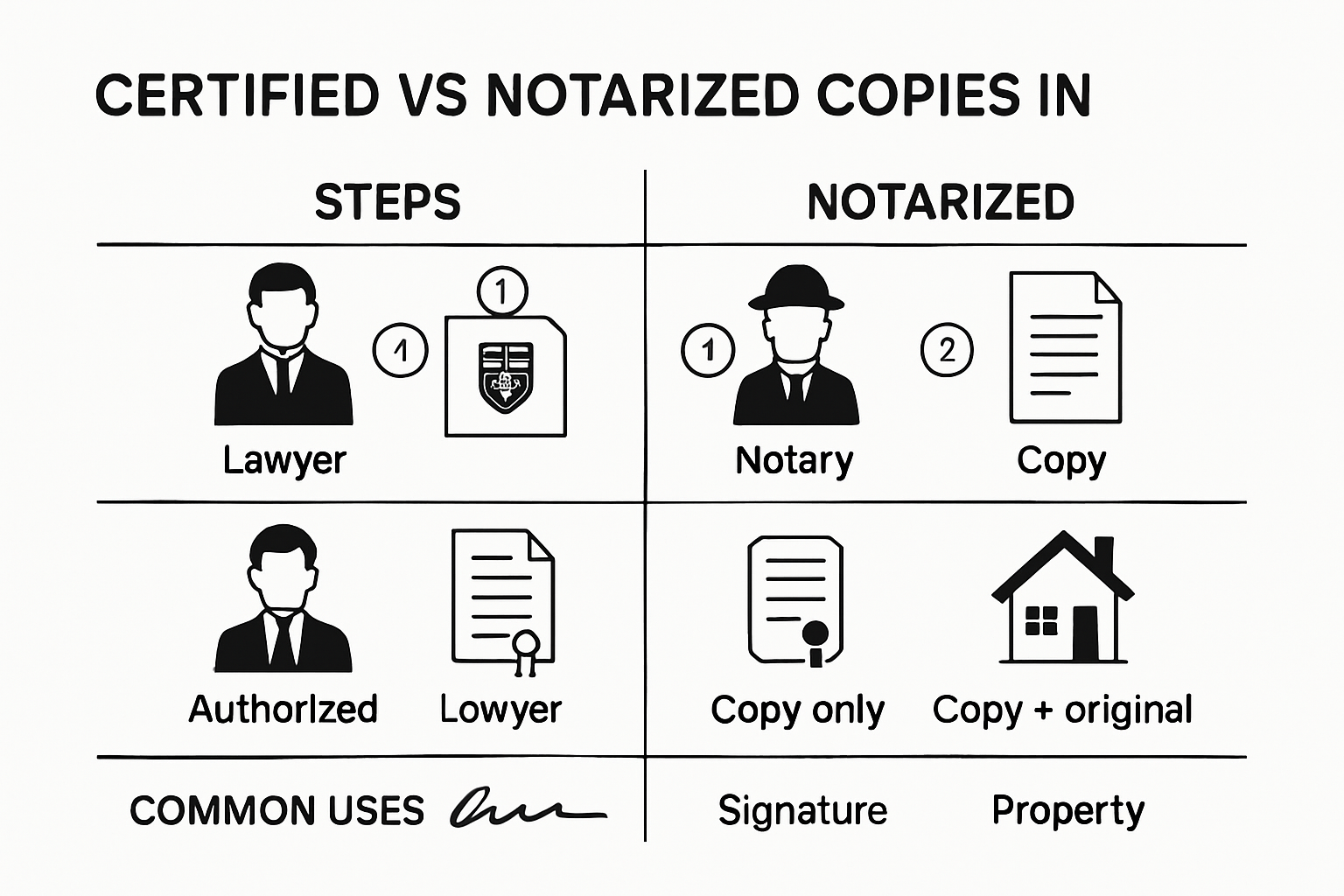
Understanding the nuanced differences between certified and notarized copies is crucial for individuals navigating legal and administrative document requirements in Ontario. While both methods provide document authentication, they serve distinct purposes and involve different verification processes.
To help clarify the core distinctions, the following table summarizes the main differences between certified copies and notarized copies in Ontario:
| Feature | Certified Copy | Notarized Copy |
|---|---|---|
| Verification Focus | Document accuracy (matches original) | Document accuracy + signer identity & intent |
| Who Can Provide | Notary, lawyer, commissioner, government official | Notary public, lawyer-Notary, specific government official |
| Process Involves | Comparison with original | Comparison + witnessing signing and verifying identity |
| Legal Recognition | Widely accepted for domestic admin/legal needs | Required for legal, real estate, and many international transactions |
| In-person Requirement (2025) | Often required, may vary | Mandatory; remote notarization not permitted |
| Example Use Cases | Transcripts, ID, property records, background checks | Real estate, affidavits, contracts, power of attorney, international |
Verification Scope and Authentication
The primary difference lies in the level and nature of document verification. According to Legal Information Ontario, a certified copy confirms the photocopy matches the original document exactly, whereas a notarized copy involves additional verification of the document’s signatories and their intent.
In a certified copy, the professional simply confirms the photocopy is an accurate reproduction of the original document. Notarization, however, goes a step further. Canadian Legal Resource Center explains that notarization includes witnessing the signature, verifying the identity of the person signing, and confirming they are signing willingly.
Professional Authorization and Process
Both certified and notarized copies require professional involvement, but the authorized professionals differ. Certified copies can be issued by various professionals including government officials, lawyers, and commissioners. Notarization is more restrictive, typically performed only by lawyers, notaries public, and specific government-appointed officials.
The authentication process also varies significantly. Certified copies focus on document accuracy, while notarization emphasizes the authenticity of the signing process. For a comprehensive understanding of these distinctions, our document authentication guide provides detailed insights into Ontario’s specific requirements.
Legal Recognition and Use Cases
The legal recognition of certified and notarized copies can differ depending on the specific institution or purpose. Certified copies are often sufficient for academic transcripts, property records, and internal organizational documents. Notarized copies carry more weight for international documents, legal agreements, and transactions requiring additional verification of identity and intent.
Key considerations when choosing between certified and notarized copies include:
- Purpose of the document
- Specific institutional requirements
- Complexity of the transaction
- International vs. domestic use
While both methods provide document authentication, they are not interchangeable. Always confirm the exact requirements with the requesting organization to ensure you obtain the correct type of document verification. Selecting the appropriate method can save time, prevent potential legal complications, and ensure smooth processing of your important documents.
When to Use Certified or Notarized Copies
Choosing between certified and notarized copies depends on specific document requirements, legal contexts, and institutional guidelines. Understanding when to use each type of document authentication can save time, prevent potential legal complications, and ensure smooth processing of important paperwork.
To make it easier to see which documents typically require a certified copy versus a notarized copy, here is a summary table:
| Scenario / Document Type | Certified Copy Suitable? | Notarized Copy Suitable? |
|---|---|---|
| Academic Transcripts | Yes | Yes |
| Employment Background Check | Yes | No |
| Property Record Documentation | Yes | No |
| Insurance Claim | Yes | No |
| Government Application | Yes | Sometimes |
| Real Estate Transactions | No | Yes |
| Legal Agreements / Contracts | No | Yes |
| Power of Attorney | No | Yes |
| International Business Docs | Sometimes | Yes |
| Affidavits / Sworn Statements | No | Yes |
Scenarios for Certified Copies
Certified copies are ideal for situations requiring straightforward document verification. According to Notarize Vaughan, these are typically used when submitting documents like academic transcripts, passports, or personal identification where the institution needs proof of an authentic document without requiring additional signature verification.
Common scenarios for certified copies include:
- Academic credential submissions
- Employment background checks
- Property record documentation
- Insurance claim processes
- Government application submissions
For individuals seeking detailed guidance through the certification process, our comprehensive certification guide provides step-by-step insights into document authentication requirements.
Scenarios for Notarized Copies
Notarized copies become necessary in more complex legal and transactional contexts. De Palma Paralegal emphasizes that notarization serves critical functions in scenarios requiring enhanced authentication and identity verification.
Typical situations demanding notarized copies include:
- Real estate transactions
- Legal agreements and contracts
- Power of attorney documents
- International business documentation
- Affidavits and sworn statements
Critical Considerations for Document Authentication

The choice between certified and notarized copies is not always straightforward. Some key factors to consider include:
- Institutional Requirements: Always confirm the specific documentation needs of the requesting organization
- Legal Jurisdiction: Different contexts may require different levels of document authentication
- International vs. Domestic Use: Cross-border documents often need more rigorous verification
It is crucial to recognize that remote commissioning and notarization have distinct regulations in Ontario. As Pravo Law points out, while remote commissioning is permitted for certain documents, remote notarization remains prohibited, requiring in-person verification.
Preparing the correct type of document copy can significantly impact the efficiency of your application or transaction. When in doubt, consult with a legal professional or the specific institution to ensure you meet all required authentication standards.
Frequently Asked Questions
What is the difference between a certified copy and a notarized copy in Ontario?
A certified copy verifies that a duplicate matches the original document, while a notarized copy not only verifies the accuracy of the copy but also confirms the identity of the signer and their willingness to sign.
When should I use a certified copy instead of a notarized copy?
Use a certified copy for straightforward document verification needs, such as academic transcripts or government applications, where additional signer verification is not required.
Can certified copies be used for legal documents in Ontario?
Yes, certified copies can be acceptable for certain legal documents, but many legal transactions, such as real estate deals and contracts, require notarized copies for additional authenticity.
What are the professionals authorized to provide certified and notarized copies in Ontario?
Certified copies can be provided by notaries, lawyers, commissioners for taking affidavits, and certain government officials. Notarized copies must be done by a notary public or a lawyer commissioned as a notary.
Take the Uncertainty Out of Certified and Notarized Documents in Ontario
Are you worried about your paperwork getting rejected because you misunderstood the tricky difference between a certified copy and a notarized copy? The article above explains that getting it wrong can lead to frustrating delays, extra costs, or even denied applications. Whether you need a statutory declaration, affidavit, or another critical legal document, accuracy and compliance are essential for your peace of mind.

Stop risking your time and opportunity. Trust theonlinenotary.ca to simplify the process and help you get your Ontario documents certified or notarized the right way the first time. Explore our full list of online notary solutions for affidavits and other vital paperwork. Secure your next steps today and avoid common legal pitfalls with the support of experienced online notary professionals.
Recommended
- How to Notarize Documents in Ontario: Easy 2025 Guide – The Online Notary CA
- Can Anyone Notarize a Document in Ontario? 2025 Guide – The Online Notary CA
- Notary Public vs Lawyer in Ontario: Key Differences for 2025 – The Online Notary CA
- Certification of Documents in Ontario: 2025 Guide for Individuals & Businesses – The Online Notary CA