
TL;DR:
- Most Ontario businesses waste hours each month on outdated notarization processes that involve in-person visits. Remote commissioning of affidavits and statutory declarations has been legal since 2020, offering a fast, secure, and fully binding online alternative. Adopting online notarization streamlines workflows, reduces costs, and enhances compliance, especially for routine business documentation.
Most Ontario businesses lose hours every month to a process that hasn’t changed in decades. Employees take time off, travel to a notary’s office, wait in line, and then repeat the cycle every time a new document needs signing. What many business owners don’t realize is that remote commissioning of affidavits and statutory declarations has been fully legal in Ontario since 2020, and the process is just as binding as walking into an office. This guide breaks down exactly how online notarization works, which business documents it covers, and why forward-thinking Ontario SMBs are building it into their daily operations right now.
Table of Contents
- Why Ontario businesses are moving notarization online
- How online notarization works for Ontario businesses
- Key business use cases for online notary
- Security, compliance, and record-keeping in online notarization
- The overlooked benefits of remote notarization for Ontario SMBs
- Get started with trusted online notary services
- Frequently asked questions
Key Takeaways
| Point | Details |
|---|---|
| Remote notarization is legal | Ontario allows online notary for affidavits and statutory declarations for businesses. |
| Simple online process | Identity verification and document signing are completed over a secure video session. |
| Saves time and resources | SMBs avoid travel and paperwork delays, speeding up key business tasks. |
| Secure and compliant | Digital records and secure delivery meet strict legal requirements and ease audits. |
| Fits remote operations | Online notary services are ideal for distributed or hybrid business teams in Ontario. |
Why Ontario businesses are moving notarization online
Traditional notarization was designed for a paper-heavy world. You’d print a document, schedule an appointment, show up in person, sign in front of a commissioner, and then wait for a physical copy to be returned or mailed. For a business processing multiple documents every week, that model is a serious time drain.
The good news is that the regulatory environment has caught up with how modern businesses actually operate. Ontario’s O. Reg. 431/20 makes remote commissioning of affidavits and statutory declarations legally permitted for SMBs, removing the need for in-person appointments entirely. This regulation didn’t just create a workaround during a crisis. It established a permanent, recognized framework for remote notarization that businesses can confidently rely on.
Despite this, a surprising number of Ontario’s small and medium businesses haven’t made the switch. Many still schedule in-person visits out of habit or simply because they weren’t aware the law changed. That’s an unnecessary cost in both time and money.
Here are the most common document types Ontario SMBs notarize, many of which are now eligible for remote processing:
- Statutory declarations (for business and employment purposes)
- Affidavits for corporate or legal proceedings
- Vendor and supplier contracts requiring legal attestation
- Non-disclosure agreements (NDAs)
- Corporate resolutions
- Invitation letters and support letters for immigration or travel
- Solemn declarations for regulatory compliance
These aren’t obscure documents. They’re the kind of essential business documents that move through every growing business on a regular basis. Every week those documents are processed slowly is a week your operations are slightly less efficient than they could be.
“Remote commissioning allows Ontario businesses to swear affidavits and statutory declarations without meeting in person, with the same legal weight as traditional notarization. The only requirement is a proper video connection and government-issued ID.”
If you want a head start on understanding how this applies to your business, our guide on what you need to know about online notary services in Ontario breaks it down clearly. You can also explore fast and secure notary services built specifically for Ontario business needs.
How online notarization works for Ontario businesses
Once you recognize the flexibility of online notary services, understanding the process helps you see how simple and robust it is. Many business owners assume remote notarization involves complicated software or lengthy setup. In practice, it takes less time than driving to a commissioner’s office.
Here’s exactly how the process works, step by step:
- Submit your document electronically. You send the document to the online notary service before your session. This gives the commissioner time to review it and prepare.
- Book your video session. You schedule a time that works for you, often the same day or the next business day.
- Join the video call. The session takes place over a real-time audio and video connection. This is a strict legal requirement under O. Reg. 431/20, which specifies that the commissioner must verify your identity via a government-issued photo ID shown on camera, and a modified jurat must note the remote method and locations of both parties.
- Review and swear. You review the document live with the commissioner and either swear an oath or make a solemn declaration, depending on the document type.
- Sign electronically. You apply your electronic signature. The commissioner applies theirs.
- Receive your document. A digitally certified copy is emailed to you securely, often within minutes of the session ending.
- Record is kept. The commissioner retains a record of the transaction as required by provincial regulations, which protects both parties.
The table below shows how online notarization compares to traditional in-person notarization on key criteria:
| Criteria | Traditional notarization | Online notarization |
|---|---|---|
| Time to appointment | 1 to 3 days (often longer) | Same day or next day |
| Travel required | Yes | No |
| Document delivery | Physical pickup or mail | Instant digital delivery |
| Identity verification | In-person ID check | Live video ID check |
| Legal validity | Full | Full (under O. Reg. 431/20) |
| Audit trail | Paper based | Digital, encrypted record |
| Availability | Business hours only | Flexible scheduling |
Understanding the online notarization steps in detail helps you prepare your team to handle these processes confidently and without delays.
Pro Tip: Before your video session, make sure the document is completely filled out except for the signature. Signing before the session can invalidate the notarization. Always sign in front of the commissioner during the call.
One area where online notarization adds real operational value is in the context of employment disputes and compliance. If your business faces an employment claims process, sworn affidavits need to be processed quickly. Remote notarization removes a critical bottleneck from that workflow.
Key business use cases for online notary
Now that you know the process, let’s pinpoint where online notary services offer concrete advantages for your business operations. The benefits aren’t just theoretical. They show up in specific, recurring business situations that Ontario SMBs face every month.
Vendor and supplier agreements. When you onboard a new supplier or formalize a contract that requires legal attestation, waiting days for an in-person notarization can delay the start of that relationship. Online notary removes that friction entirely.
Sworn officer affidavits. Corporate officers and directors sometimes need to swear affidavits for regulatory filings, bank requirements, or legal proceedings. Remote commissioning, which applies to affidavits and statutory declarations commonly used by SMBs, means your executives don’t need to take time out of their day for an office visit.
Staff statutory declarations. Employees sometimes need to make statutory declarations related to their employment, immigration status, or benefit claims. With a hybrid or remote workforce spread across Ontario, coordinating in-person notarizations is a logistical nightmare. Online notary solves this cleanly.

Proof of relationship and invitation letters. Businesses sponsoring foreign workers or supporting visa applications for staff often need notarized invitation letters or proof of relationship documents. These are handled cleanly and quickly online.
Here’s a comparison of common use cases and the value online notary delivers in each:
| Business scenario | Document type | Key benefit of online notary |
|---|---|---|
| New vendor onboarding | Affidavit or contract | Same-day completion, no delays |
| Immigration support | Invitation letter | Fast turnaround for time-sensitive cases |
| Regulatory filing | Statutory declaration | No office visits for executives |
| Employment dispute | Sworn affidavit | Quick, legally defensible documentation |
| Corporate governance | Corporate resolution | Easy coordination across locations |
| Compliance declarations | Solemn declaration | Consistent, auditable process |
Understanding the purposes for statutory declarations specifically helps you recognize just how many routine business processes already involve this document type.
There’s also a risk management angle worth noting. Digital records of notarized documents are harder to lose or misplace than physical copies. For businesses that need to demonstrate compliance in an audit or legal proceeding, a clean digital trail is far more reliable. You can also explore our resource on essential documents for SMBs to see which of your regular documents qualify for remote processing.
For businesses operating under Ontario employment law, where sworn statements and statutory declarations frequently come into play, the efficiency gains from online notarization can directly reduce legal costs.
Security, compliance, and record-keeping in online notarization
Knowing where online notary excels is powerful, but ensuring your business meets all compliance obligations and stays secure is essential before you adopt these tools. This is where a lot of business owners pause. They wonder whether remote notarization is truly as secure as sitting across from someone in person.
The answer is yes, and in some ways, it’s more secure.
Here’s what makes online notarization legally defensible and operationally secure:
- Real-time identity verification. Every session requires live video and the presentation of government-issued photo ID. The commissioner must visually confirm your identity before proceeding. This is strictly enforced.
- Modified jurat language. The completed document includes a modified jurat that records both the remote method and the locations of the signer and the commissioner, creating an automatic documentation of the remote process.
- Encrypted digital delivery. Your notarized document is delivered via secure digital channels, not handed over in an open office or mailed in an envelope that could be intercepted.
- Mandatory record-keeping. A record of each transaction must be kept by the commissioner. This isn’t optional. It’s a provincial legal requirement that protects your business in any future dispute.
- Controlled access. Digital documents can be restricted to authorized recipients only, which is harder to achieve with physical copies that can be photocopied or misplaced.
Pro Tip: Always request a copy of the notarized document in PDF format with embedded metadata. This creates a richer digital record that confirms the date, time, and nature of the session, which can be invaluable in a compliance review.
Statistic callout: Businesses that transition to digital documentation workflows report significantly fewer compliance errors and a reduced risk of document loss compared to those relying on paper-based systems. Digital records also make it considerably faster to locate and submit specific documents when audits or legal matters arise.
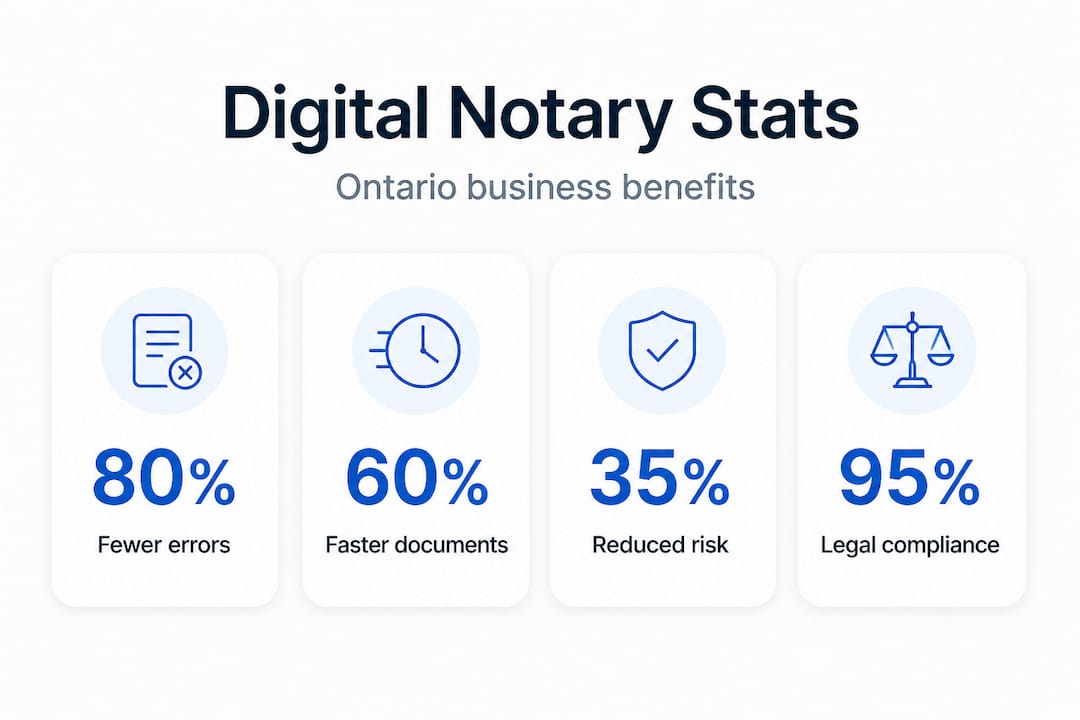
Staying current with digital record requirements in Ontario is especially important for businesses in regulated industries. The combination of legally compliant remote notarization and secure digital storage is a straightforward way to strengthen your compliance posture without adding administrative burden.
For a broader look at the regulatory and practical advantages, our breakdown of public notary service benefits in Ontario covers what businesses need to know about staying on the right side of provincial requirements.
The overlooked benefits of remote notarization for Ontario SMBs
With the critical details in hand, it’s worth sharing the practical upsides we’ve seen from businesses leaning into online notarization—not just for legal compliance, but for genuine business transformation.
Here’s our honest take: too many Ontario businesses treat online notary as a convenience feature rather than a strategic tool. They use it once during a rush, then default back to scheduling in-person appointments. That’s a missed opportunity.
The real value of remote notarization isn’t just time savings on individual documents. It’s what happens when you systematize it. When your team knows they can get a statutory declaration notarized today without blocking out half a workday, they stop deprioritizing legal documentation. Compliance tasks that used to get pushed to next week get handled now. That cultural shift has a measurable impact on how efficiently your business operates.
We’ve also seen distributed teams genuinely transformed by remote notarization. A business with employees across Ontario, some working remotely, would previously need to physically coordinate document signing across multiple locations. That’s expensive and slow. Online notary collapses that problem entirely.
The businesses benefiting most from online notarization are the ones that have made it a default process, not a backup. They’ve built it into their onboarding flows, their vendor management systems, and their compliance calendars. Documents get notarized faster, records are cleaner, and legal bottlenecks stop halting operations.
If you’re still on the fence, reading about why choose online notary in Ontario from a practical business perspective often tips the decision. The businesses that adopted this approach early have a quiet competitive advantage in how quickly they can close deals, onboard partners, and respond to legal requirements.
The businesses that wait are paying a cost they can’t easily see: slower transactions, more scheduling friction, and a compliance culture that treats legal documentation as a burden rather than a routine task.
Get started with trusted online notary services
If you’re ready to make online notarization part of your SMB’s everyday toolkit, here’s where to get started.
Managing legal documents doesn’t have to slow your business down. Whether you need affidavits notarized, statutory declarations processed, or invitation letters certified, getting it done online is faster, just as legally valid, and far less disruptive to your operations.

Explore our full range of trusted online notary services designed specifically for Ontario businesses. From affidavits to solemn declarations, we handle the documents your business needs with speed and legal precision. You can also browse our resource on essential business notary tools to identify which of your routine documents can be moved to a fully remote workflow starting today. Book a session or get in touch to ask about your specific document needs.
Frequently asked questions
Are online notary services legal for Ontario businesses?
Yes, remote notary services are fully legal for affidavits and statutory declarations under O. Reg. 431/20, with the same legal standing as in-person notarization.
What types of business documents can be notarized online in Ontario?
Common documents include affidavits, statutory declarations, corporate resolutions, invitation letters, and NDAs, with remote commissioning applying specifically to affidavits and statutory declarations for SMBs.
How is identity verified in an online notary session?
The commissioner verifies your identity using a government-issued photo ID shown live on a real-time video call, and a record of the session is kept as part of the legal process.
Do online notarized documents have the same legal standing as paper ones?
Yes, affidavits and statutory declarations notarized remotely under O. Reg. 431/20 carry identical legal weight to documents notarized in person in Ontario.
How fast can businesses get a document notarized online?
With remote services, most documents can be notarized the same day you request the session, eliminating the scheduling delays typical of in-person appointments.