
Figuring out how to become a public notary in Ontario sounds simple at first glance. Here is something most people miss. Lawyers and paralegals pay just $145 for a lifetime notary appointment but non-lawyers face a much tougher process and need to prove their job actually requires it. These sharp differences could change the way you think about notarial roles and who really has easy access to this key legal authority.
Table of Contents
- Who Can Become A Public Notary In Ontario
- Application Process And Required Documents
- Duties And Responsibilities Of Ontario Notaries
- Tips For Businesses Needing Notary Services
Quick Summary
| Takeaway | Explanation |
|---|---|
| Lawyers and paralegals have the simplest path to notarization. | They can apply directly with their legal credentials and pay a $145 fee for lifetime appointment. |
| Non-lawyers must prove notarial necessity through employment. | They need a letter from their employer justifying the need for notarization in their job roles. |
| Public notaries must maintain high ethical standards. | Notaries should remain impartial, verify identities thoroughly, and ensure signatories are not under duress. |
| Businesses can choose in-house or external notary services. | Evaluating document volumes and costs can guide companies to the right notarial solution for their needs. |
| Best practices for notarization should be followed. | Businesses should maintain organized records and be aware of when notarization is required to ensure legal compliance. |
Who Can Become a Public Notary in Ontario
Becoming a public notary in Ontario involves specific professional pathways and rigorous requirements. The process differs significantly for lawyers, paralegals, and other professionals seeking this important legal authorization.
Professional Licensing for Lawyers and Paralegals
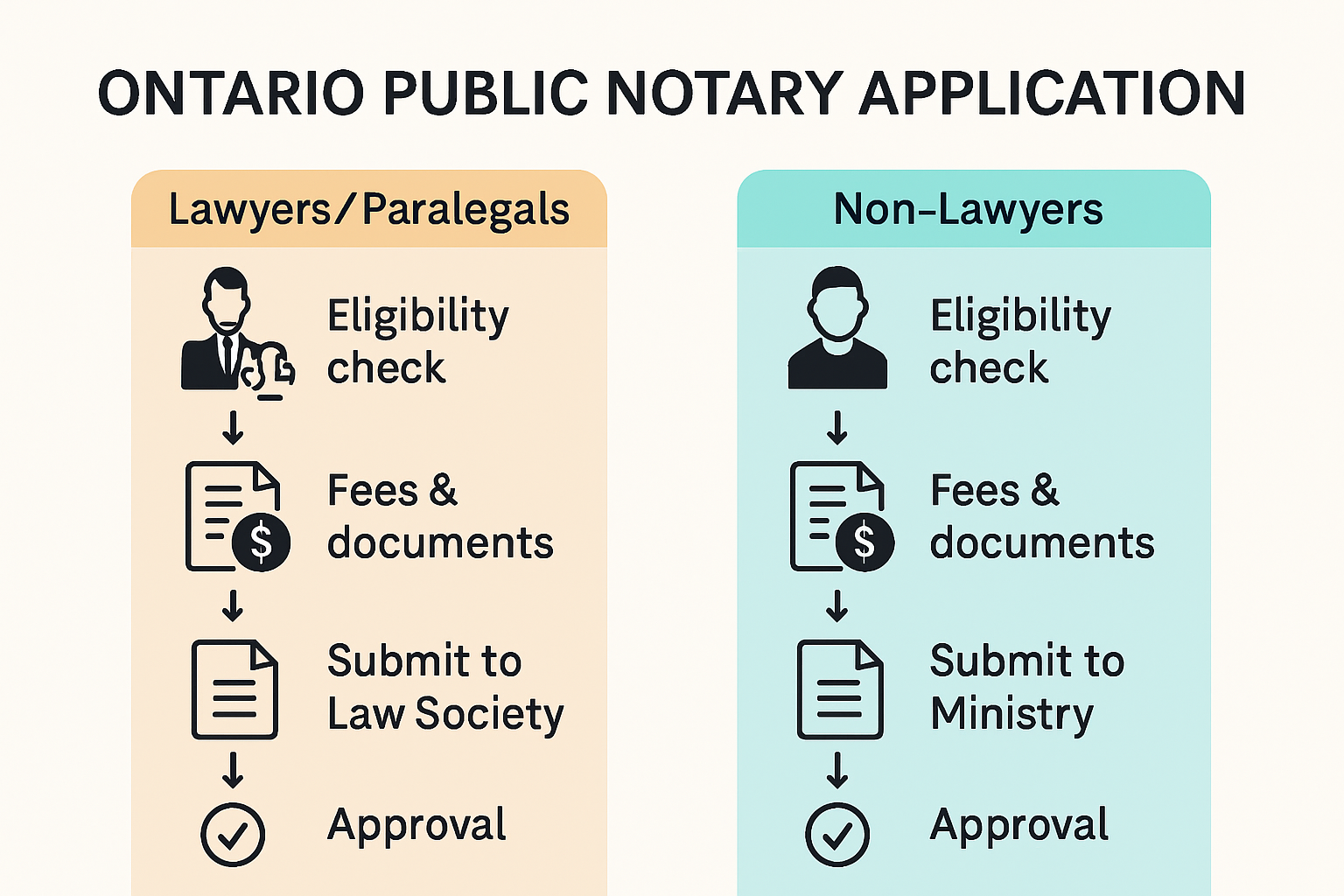
In Ontario, the most straightforward path to becoming a public notary is through professional legal credentials. Lawyers and paralegals licensed by the Law Society of Ontario have a direct route to notary public status. These legal professionals can apply for a lifetime appointment by submitting an application to Official Documents Services and paying a one-time fee of $145.
To qualify, these professionals must:
- Hold an active license from the Law Society of Ontario
- Be in good standing with their professional regulatory body
- Complete the required application process
- Pay the mandatory application fee
Non-Lawyer Notary Public Pathway
Here’s a comparison table summarizing the pathways and requirements for lawyers/paralegals versus non-lawyer professionals becoming notaries in Ontario:
| Requirement | Lawyers & Paralegals | Non-Lawyer Professionals |
|---|---|---|
| Eligibility | Licensed by Law Society of Ontario | Must prove notarial necessity via job |
| Application Fee | $145 (lifetime) | $110 |
| Application Form | Service request form | General application form |
| Additional Documentation | Active license, good standing | Letter from employer, proof to work in CA |
| Application Method | Online or mail | Email or mail |
| Fee Exemptions | Gov. lawyers/paralegals exempt | Gov. & First Nations employees exempt |
| Appointment Duration | Lifetime | Not specified |
Professionals outside the legal field can also become public notaries in Ontario, but the requirements are more complex. According to the Ministry of the Attorney General, non-lawyers can apply if notarizing documents is an essential part of their job responsibilities.
Key requirements for non-lawyers include:
- Being eligible to work in Canada
- Providing a formal letter of authorization from their employer
- Submitting the necessary application forms
- Paying the $110 application fee
- Demonstrating a professional need for notarial services
Additional Eligibility Considerations
Beyond professional credentials, candidates must meet several fundamental eligibility criteria. Applicants must be of legal age, possess a clean criminal record, and demonstrate professional integrity. The ability to understand legal documents, verify identities, and maintain strict confidentiality are crucial skills for public notaries.
Interested professionals can learn more about document authentication processes to better understand the responsibilities and expectations of a public notary in Ontario. The role requires meticulous attention to detail, thorough understanding of legal documentation, and unwavering commitment to maintaining the highest standards of professional conduct.
Application Process and Required Documents
Navigating the application process for becoming a public notary in Ontario requires careful attention to detail and thorough documentation. The process varies depending on whether you are a lawyer, paralegal, or professional from another field.
Application Submission for Lawyers and Paralegals
Lawyers and paralegals licensed by the Law Society of Ontario have a streamlined application process. They can submit their service request through two primary methods: online via the notary public portal or by mailing a completed service request form to Official Documents Services.
Key documentation and requirements include:
- Active license from the Law Society of Ontario
- Completed service request form
- Application fee of $145 (waived for government lawyers and paralegals)
- Payment methods accepted: cash, Visa, Mastercard, debit, certified cheque, or money order
Upon approval, applicants receive a Certificate of Appointment. They must also provide a specimen of their embossed seal and signature for authentication purposes.
Application Process for Non-Lawyer Professionals
According to the Ministry of the Attorney General, non-lawyers must follow a more comprehensive application procedure. These professionals need to demonstrate that notarizing documents is an integral part of their job responsibilities.
Required documents for non-lawyer applicants include:
- General application form
- Security check consent statement form
- Letter of authorization from employer
- Proof of eligibility to work in Canada
- Application fee of $110 (payable by cheque or money order to the Minister of Finance)
Applications can be submitted via email or traditional mail to the Ministry of the Attorney General. Government employees and First Nations band employees are exempt from the application fee.
Additional Documentation and Verification
Regardless of professional background, all applicants must provide comprehensive documentation that demonstrates their professional integrity and capability. This includes providing a clean criminal record, proving professional competence, and showing a clear understanding of the legal responsibilities associated with being a public notary.
Explore our comprehensive guide on document authentication to better understand the intricate details of the notarization process. Successful applicants must be prepared to maintain meticulous records, verify identities accurately, and uphold the highest standards of professional conduct throughout their notarial practice.
Duties and Responsibilities of Ontario Notaries
Public notaries in Ontario carry significant legal responsibilities that require precision, integrity, and a comprehensive understanding of document authentication processes. Their role extends far beyond simple signature witnessing and involves critical legal and administrative functions.
Core Notarial Functions
According to the Notaries Act, notaries public in Ontario have several statutory duties that form the foundation of their professional practice. These include attesting legal documents, administering oaths and affirmations, and certifying copies of critical documents. The primary objective is to provide an official, impartial verification of document authenticity and the voluntary nature of signatures.
Key responsibilities encompass:
- Verifying the identity of document signatories
- Ensuring parties understand the documents they are signing
- Witnessing and authenticating signatures
- Maintaining accurate records of notarial acts
- Preserving the confidentiality of sensitive information
Legal and Ethical Obligations
Below is a summary table outlining the key duties and ethical obligations of Ontario notaries as described in the article:
| Duty / Obligation | Description |
|---|---|
| Verify Identity | Confirm signer’s identity and legal capacity |
| Witness & Authenticate Signatures | Observe and officially attest signatures |
| Maintain Accurate Records | Keep organized record of all notarial acts |
| Ensure Voluntary Action | Confirm all parties sign willingly, without duress |
| Maintain Confidentiality | Protect sensitive personal and legal information |
| Refuse If Unsure/Coercion | Decline to notarize if confusion or coercion is suspected |
| Avoid Conflicts of Interest | Remain impartial and independent |
| Adhere to Legal Regulations | Comply with provincial and federal requirements |
The Ontario Ministry of the Attorney General emphasizes that notaries must maintain strict professional standards. They are required to act with complete impartiality, avoiding any conflicts of interest and ensuring that all parties are signing documents willingly and without duress.
Ethical considerations include:
- Refusing to notarize documents where signatories appear confused or coerced
- Maintaining professional independence
- Protecting the legal rights of all parties involved
- Adhering to provincial and federal regulations
- Preventing potential fraud through meticulous verification
Specialized Notarial Documentation
Notaries play a crucial role in authenticating various critical documents, ranging from international legal papers to personal identification verification. Learn more about the nuanced role of notaries in navigating complex documentation requirements.
Specialized documentation typically includes:
- Affidavits and statutory declarations
- Immigration and travel documents
- Property transfer documents
- Educational and professional certification copies
- Powers of attorney
Notaries must approach each document with the highest level of professional scrutiny, understanding that their signature and seal carry significant legal weight. They are essentially providing an official government-recognized guarantee of a document’s authenticity and the voluntary nature of its execution.
Tips for Businesses Needing Notary Services
Businesses operating in Ontario require efficient and reliable notary services to authenticate critical documents and ensure legal compliance. Navigating the notarization process can be complex, but with strategic planning, organizations can streamline their document authentication procedures.
Choosing the Right Notary Services
According to the Ontario Ministry of the Attorney General, businesses have multiple options for obtaining notary services. Companies can either hire an in-house notary public or utilize external professional services. The most effective approach depends on the organization’s specific document authentication needs and frequency of required notarizations.
Key considerations for selecting notary services include:
- Volume of documents requiring notarization
- Complexity of documents
- Frequency of international or interprovincial transactions
- Budget constraints
- Turnaround time requirements
- Confidentiality and security protocols
Strategic In-House Notarization
For businesses with frequent notarization needs, establishing an in-house notary can be a cost-effective solution. Licensed lawyers and paralegals in Ontario can apply to become notaries public through Official Documents Services. The process involves submitting a service request and paying a $145 fee, after which they receive a Certificate of Appointment.
Advantages of in-house notarization include:
- Immediate document authentication
- Reduced external service costs
- Enhanced confidentiality
- Greater control over document processing
- Consistent quality of notarial services

Best Practices for Document Authentication
Businesses must approach document notarization with meticulous attention to detail. Understanding when notarization is required can help organizations maintain legal compliance and prevent potential complications.
Essential best practices include:
- Maintaining organized document records
- Verifying the identity of all signatories
- Ensuring all documents are complete before notarization
- Keeping digital and physical copies of notarized documents
- Training staff on proper notarization procedures
- Staying updated on current legal requirements
By implementing a strategic approach to notary services, businesses can ensure smooth, legally compliant document authentication processes. Careful planning and understanding of notarial requirements will help organizations navigate complex legal documentation with confidence and efficiency.
Frequently Asked Questions
What are the requirements to become a public notary in Ontario?
To become a public notary in Ontario, you need to either be a licensed lawyer or paralegal, or if you are a non-lawyer, you must provide proof from your employer that notarization is necessary for your job. Additionally, you must be of legal age, possess a clean criminal record, and demonstrate professional integrity.
How much does it cost to apply for a notary appointment in Ontario?
Lawyers and paralegals pay a one-time fee of $145 for a lifetime notary appointment. Non-lawyer professionals must pay a fee of $110 to apply, though some government employees may be exempt from this fee.
What documents are needed for non-lawyer professionals to apply as a notary?
Non-lawyer applicants need to submit a general application form, a letter of authorization from their employer, proof of eligibility to work in Canada, and a security check consent statement form, along with the application fee.
What are the core responsibilities of public notaries in Ontario?
Public notaries in Ontario are responsible for verifying the identity of signatories, witnessing and authenticating signatures, administering oaths, maintaining accurate records of notarial acts, and ensuring that all parties involved understand the documents they are signing.
Need Fast, Reliable Notarization in Ontario? You Have a Solution
Struggling with Ontario’s strict notary requirements can feel overwhelming, especially if you are not a lawyer or paralegal. The article explains the complicated application process, high standards for identity verification, and the hassle of gathering supporting documents. For businesses and individuals, the need for accurate notarization of affidavits, statutory declarations, or invitation letters is urgent. Waiting weeks for traditional notary appointments or missing key documentation can lead to stress, legal delays, or lost opportunities.

At The Online Notary, you avoid these headaches and get your documents notarized quickly online from anywhere in Ontario. Our platform specializes in core notarial services including affidavits and statutory declarations, letting you securely complete the process without leaving your office or home. You benefit from fast turnaround, transparent pricing, and certified notaries who understand Ontario’s exact requirements. Visit our secure notary services page now to make your next document notarization simple and stress-free.
Recommended
- Can Anyone Notarize a Document in Ontario? 2025 Guide – The Online Notary CA
- How to Notarize Documents in Ontario: Easy 2025 Guide – The Online Notary CA
- When Is a Notary Required in Ontario? Essential 2025 Guide – The Online Notary CA
- How to Verify Notary in Ontario: Step-by-Step Guide 2025 – The Online Notary CA