Certified copies in Ontario might sound straightforward and routine. Yet over 90 percent of legal disputes involving document authenticity hinge on whether a certified copy is properly issued and verified. Most people focus on the rubber stamp or the signature, but the real impact comes from understanding exactly when, why, and how these copies are required—because one small mistake with certification can delay court cases, jeopardize property transfers, or block international transactions entirely.
Table of Contents
- Understanding Certified Copies In Ontario
- Key Documents Requiring Certified Copies
- Steps To Obtain A Certified Copy Legally
- Best Practices For Businesses In Ontario
Quick Summary
| Takeaway | Explanation |
|---|---|
| Certified copies are legally valid reproductions. | A certified copy is an authenticated duplicate of an original document, verified by a qualified professional for legal credibility. |
| Key documents requiring certification include IDs and legal papers. | Personal, legal, and financial documents, such as birth certificates and wills, often necessitate certified copies for validation. |
| Follow specific steps to obtain certified copies. | Prepare original documents, choose a certification method, and navigate the official process to ensure proper authentication. |
| Businesses must prioritize document management. | Companies should implement protocols for document protection to mitigate risks associated with sensitive information handling and certification. |
| Stay informed on international certification requirements. | For cross-border transactions, obtain necessary certifications and understand varying requirements based on destination countries. |
Understanding Certified Copies in Ontario
Certified copies play a crucial role in legal and administrative processes across Ontario, serving as officially verified duplicates of original documents. These documents provide a reliable method of presenting critical information when the original cannot be submitted directly.
What Exactly Is a Certified Copy?
A certified copy is an exact reproduction of an original document that has been authenticated by a qualified professional who confirms its accuracy and completeness. In Ontario, these copies are typically endorsed with an official seal or signature, verifying that the document is a true representation of the original. Official Document Services in Ontario recognizes these copies as legally valid for various administrative and legal purposes.
The process of certification involves a professional carefully comparing the copy against the original document, ensuring every detail matches precisely. This meticulous verification gives certified copies significant legal weight. For instance, when dealing with birth registrations, the Office of the Registrar General provides detailed, legal-sized certified copies that include all registration details and a raised seal for verification.
When Are Certified Copies Required?
Certified copies become essential in numerous scenarios where original documents cannot be submitted or risked. Common situations include court proceedings, immigration applications, property transactions, and international document authentication. Government agencies, educational institutions, and legal entities often require these authenticated duplicates to ensure document integrity.
For individuals and businesses in Ontario, understanding certified copy requirements is critical. Whether you need to verify land interests, submit documentation for legal processes, or authenticate documents for international use, certified copies provide a reliable solution. Learn more about document certification in Ontario to navigate these complex administrative requirements effectively.
To help you quickly identify which documents commonly require certified copies in Ontario, here’s a summary table outlining key types across personal, legal, and international contexts.
| Document Type | Examples | Typical Use Cases |
|---|---|---|
| Personal Identification & Civil | Birth, marriage, death certificates, academic transcripts | Legal proceedings, immigration, employment, licensing |
| Legal & Financial | Wills, property deeds, powers of attorney, affidavits | Real estate, court cases, estate settlement, loans |
| Financial Documents | Tax returns, investment certificates, corporate registrations | Business transactions, financial agreements |
| Immigration & International | Passports, immigration papers, work permits | International applications, overseas employment |
| Business/Corporate | Contracts, compliance paperwork | Cross-border operations, government compliance |
The key distinction between a simple photocopy and a certified copy lies in the professional verification. While anyone can make a photocopy, only authorized professionals can create a certified copy that carries legal credibility. This crucial difference ensures that certified copies serve as trustworthy representations of original documents across various official contexts in Ontario.
Key Documents Requiring Certified Copies
In Ontario, numerous critical documents require certified copies to ensure legal validity and proper authentication across various personal, professional, and governmental contexts. Understanding which documents need certification can help individuals and businesses navigate administrative processes more efficiently.
Personal Identification and Civil Registration Documents
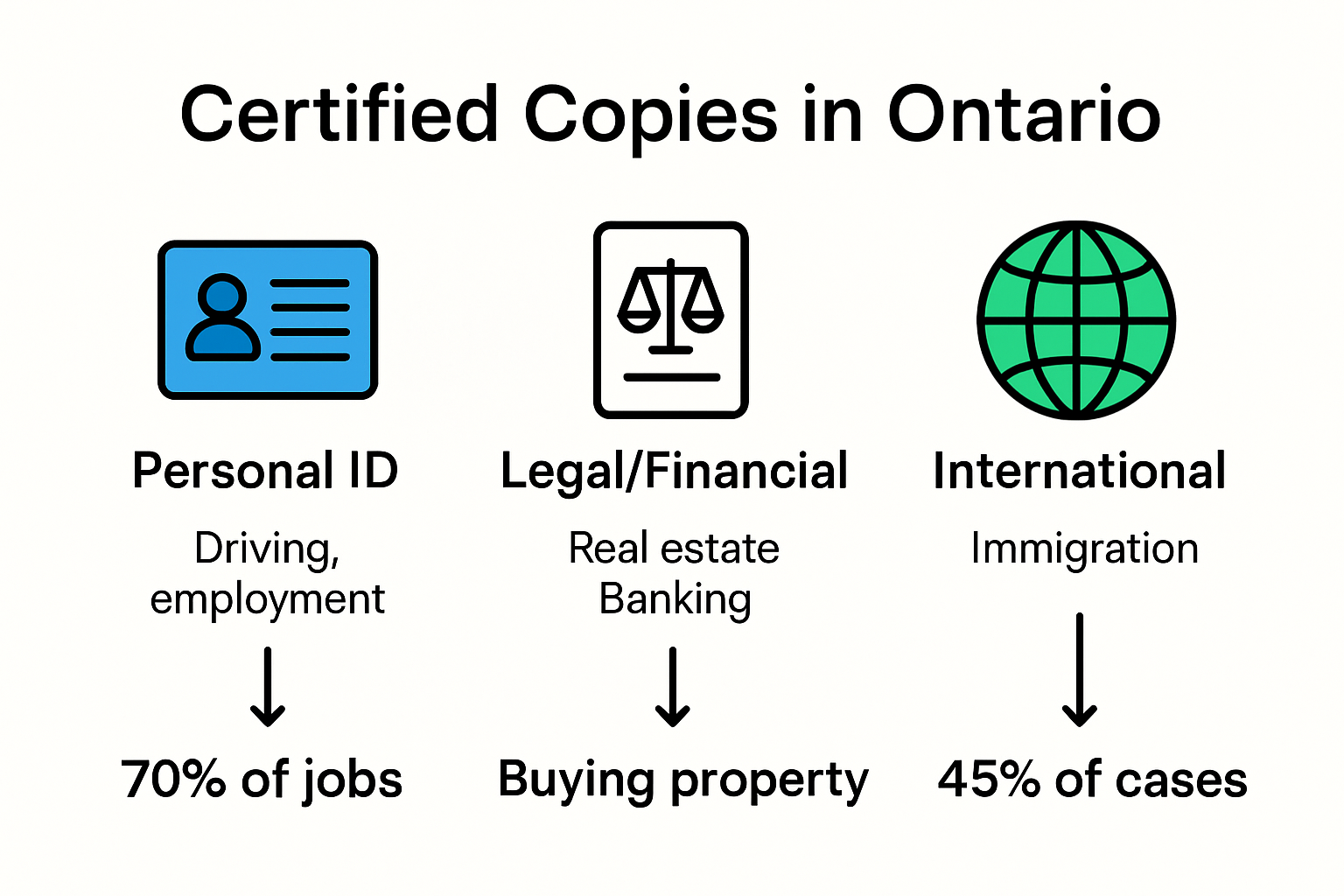
Certain personal documents are paramount when seeking certified copies. Birth certificates, marriage certificates, and death certificates from the Office of the Registrar General often require certified reproduction for legal proceedings, immigration applications, passport services, and inheritance claims. These documents serve as fundamental proof of identity and significant life events.
Educational credentials also frequently demand certified copies. Academic transcripts, diplomas, and professional certifications must be authenticated when applying for jobs, pursuing further education, or seeking professional licensing. Universities and professional regulatory bodies typically require these documents to be exact, verified reproductions that confirm an individual’s academic and professional achievements.
Legal and Financial Documents
Complex legal and financial transactions necessitate certified document copies. Wills, property deeds, powers of attorney, and affidavits require meticulous verification to prevent fraud and ensure legal standing. Real estate transactions, court proceedings, and estate settlements rely heavily on certified copies that accurately represent original legal instruments.
Financial documents such as tax returns, investment certificates, and corporate registration papers also demand certification. Certification of Documents in Ontario becomes crucial when presenting evidence for business transactions, loan applications, or international financial agreements. These certified reproductions provide a reliable record that financial institutions and government agencies can trust.
Immigration and International Documentation
For individuals navigating immigration processes or dealing with international documentation, certified copies are indispensable. Passport copies, immigration papers, work permits, and international educational credentials must be precisely authenticated. The Global Affairs Canada recommends obtaining certified copies to facilitate smooth processing of international documentation.
Businesses operating across borders also rely on certified copies for contracts, corporate documents, and compliance paperwork. These authenticated reproductions ensure that critical information remains intact and verifiable, regardless of geographical boundaries or administrative jurisdictions.
Steps to Obtain a Certified Copy Legally
Obtaining a certified copy in Ontario requires careful navigation through specific legal procedures. Understanding the precise steps ensures that your documents are authenticated correctly and meet official requirements.
Preparing Your Original Documents
Before initiating the certification process, gather all necessary original documents. These must be complete, legible, and in good condition. According to ServiceOntario, documents intended for official use must be original or certified true copies from the issuing authority. Photocopies are typically not acceptable for certification.
Each document type may require different preparation. For instance, birth certificates from the Office of the Registrar General must be original or official government-issued copies. Educational transcripts should be sealed and directly sent from the institution. Gather all supporting identification, such as government-issued photo ID, to verify your identity during the certification process.
Choosing a Certification Method
Ontario offers multiple avenues for obtaining certified copies. Professional notaries, lawyers, and certain government offices can provide certification services. Learn more about document certification processes to understand the most appropriate method for your specific document.
The authentication process varies depending on the document type. For documents intended for international use, Global Affairs Canada recommends specific verification procedures. Government-issued documents often require authentication at ServiceOntario locations, where trained professionals can verify and certify your documents.
Cost is an important consideration. Authentication fees typically range from $16 to $30 per document, depending on the type and complexity. Payment methods include cash, credit cards, and certified cheques. Always check current fees and accepted payment methods before your appointment.
Navigating the Official Certification Process
When seeking a certified copy, schedule an appointment with a qualified professional. Bring your original document, a valid government-issued photo ID, and be prepared to pay the required fee. The certifying professional will carefully compare the copy to the original, ensuring every detail is accurately reproduced.
For birth, marriage, and death certificates, contact the Office of the Registrar General directly. Processing times vary, but standard requests typically take 5-10 business days. Some urgent services may be available for additional fees. Online and in-person application methods are both acceptable, providing flexibility for different needs.
Documents for international use require additional steps. An apostille or authentication stamp might be necessary, which can be obtained through specific government services. Carefully follow the guidelines for the country where the document will be used, as requirements can differ significantly.
Here is a step-by-step table outlining the official process to obtain a certified copy in Ontario, including key actions and important considerations for each phase.
| Step | Action/Requirement | Key Considerations |
|---|---|---|
| 1. Prepare Original Docs | Gather all original documents, ensure clarity and condition | Originals often mandatory; Photocopies not accepted |
| 2. Gather Supporting ID | Bring government-issued photo identification | Verify your identity during certification |
| 3. Choose Certification | Select an authorized certifying professional or agency | Notary, lawyer, or government office |
| 4. Attend Appointment | Present documents and ID in person | Be ready to pay the required fee |
| 5. Official Verification | Certifier compares copy with original, endorses and stamps | Ensures every detail matches and is legally credible |
| 6. Additional Steps | For international use, obtain apostille/authentication stamp | Confirm destination country requirements |
| 7. Retain Records | Keep certified copies and receipts securely | Important for future transactions or audits |
Remember that certification is a serious legal process. Providing false information or attempting to certify fraudulent documents can result in significant legal consequences. Always work with reputable, licensed professionals who can guide you through the proper certification procedures.
Best Practices for Businesses in Ontario
Businesses in Ontario must navigate complex document certification requirements with precision and care. Understanding and implementing best practices for document management and authentication can significantly reduce legal risks and streamline administrative processes.
Document Management and Protection
Protecting sensitive business documents is paramount. When a notary is required, businesses must ensure that all confidential information is appropriately handled. The Government of Canada recommends carefully redacting personal information and maintaining strict protocols for document reproduction and storage.
Digital document management has become increasingly important. According to Library and Archives Canada, businesses should implement robust digitization processes that create legally admissible records. This involves creating documented, auditable processes for converting physical documents to digital formats, ensuring their integrity and legal standing.
International Document Authentication
For businesses operating across borders, document authentication is critical. The Ontario government provides specific guidelines for authenticating documents intended for international use. This process involves carefully verifying documents that will be used in foreign jurisdictions, particularly those requiring certification for legal, commercial, or administrative purposes.
Key considerations include preparing documents in acceptable formats, obtaining necessary translations, and securing appropriate authentication stamps or apostilles. Businesses must be particularly attentive to the specific requirements of the destination country, as authentication processes can vary significantly between different international jurisdictions.
Compliance and Risk Management
Effective document certification requires a comprehensive approach to compliance and risk management. Businesses should develop clear internal protocols for document handling, including specific procedures for obtaining and maintaining certified copies. This includes establishing a systematic approach to document verification, storage, and retrieval.
Professional training is essential. Employees responsible for document management should receive thorough training on certification requirements, privacy protection, and legal implications. Online notary services can provide additional support and guidance for businesses navigating complex certification processes.
Risk mitigation involves more than just following procedural guidelines. Businesses must stay informed about changing regulations, maintain meticulous records, and be prepared to demonstrate the authenticity of their documents at any time. This proactive approach helps prevent potential legal complications and ensures smooth operational processes.

Ultimately, successful document certification in Ontario requires a combination of careful attention to detail, understanding of legal requirements, and a commitment to maintaining the highest standards of document integrity and protection.
Frequently Asked Questions
What is a certified copy?
A certified copy is an exact reproduction of an original document that has been authenticated by a qualified professional, verifying its accuracy and completeness for legal and administrative purposes.
When is a certified copy required in Ontario?
Certified copies are required in various situations, such as court proceedings, immigration applications, property transactions, and international document authentication, where original documents cannot be submitted directly.
What types of documents typically require certified copies?
Common documents requiring certification include personal identification documents (like birth and marriage certificates), legal documents (such as wills and property deeds), and financial documents (like tax returns and corporate registrations).
How do I obtain a certified copy in Ontario?
To obtain a certified copy, gather your original documents, choose a qualified certifying professional (like a notary or lawyer), and follow the official certification process to ensure proper authentication.
Simplify Ontario Certified Copies With Secure Online Notary Services
Struggling with the stress and uncertainty of certified copy requirements in Ontario? Missing a properly authenticated affidavit, statutory declaration, or invitation letter can put your entire process at risk. The pressure to meet legal standards and avoid costly delays is real. Trusting only traditional methods often means extra trips, longer waits, and still not being sure if your certified document meets official guidelines.

There is a smarter way to achieve certified copies you can rely on. The experts at theonlinentoary.ca deliver secure, professional online notary services for Ontario residents. With fast legal certification for affidavits, invitation letters, and statutory declarations, you stay in control and move forward with confidence. Get started now for clear steps, personal support, and trusted results. For everything you need to know about document certification or to start your process today, visit our homepage or learn more about our online notary solutions.
Recommended
- Certification of Documents in Ontario: 2025 Guide for Individuals & Businesses – The Online Notary CA
- How to Notarize Documents in Ontario: Easy 2025 Guide – The Online Notary CA
- Can Anyone Notarize a Document in Ontario? 2025 Guide – The Online Notary CA
- When Is a Notary Required in Ontario? Essential 2025 Guide – The Online Notary CA