Getting official paperwork in order can feel overwhelming and full of red tape. Yet over 80 percent of legal and government applications in Ontario require certified copies for acceptance. Most people assume these are just fancy photocopies with a stamp, nothing special. But that common belief could leave your application stalled or even rejected because certified copies play a much bigger and more specific role than you might expect.
Table of Contents
- Understanding Certified Copies And Their Uses
- Step-By-Step Process For Obtaining Certified Copies
- Requirements And Documents Needed In Ontario
- Common Questions About Certified Copies In Ontario
Quick Summary
| Takeaway | Explanation |
|---|---|
| Certified copies are verified duplicates. | They are exact reproductions of original documents confirmed by authorized officials, ensuring their authenticity for legal use. |
| Gather necessary documents before applying. | Prepare your original document, government ID, proof of purpose, and any specific application forms to facilitate the certification process. |
| Choose your certification method wisely. | Options include in-person, online, or mail certification; select based on convenience, document type, and urgency. |
| Understand the specific requirements. | Each type of document has unique needs for verification; checking guidelines will prevent delays in obtaining certified copies. |
| Consult a professional if unsure. | When in doubt, reach out to a notary or government representative to clarify the process and requirements for your specific documents. |
Understanding Certified Copies and Their Uses
Certified copies play a crucial role in legal and administrative processes, serving as authenticated duplicates of original documents. These official replicas provide a reliable way to submit document evidence without risking damage or loss of primary records. Learn more about document authentication.
What Exactly Are Certified Copies?
A certified copy is a complete reproduction of an original document that has been verified and endorsed by an authorized official. According to Cornell Law School, these documents carry legal weight and are recognized as accurate representations of the original. The certification process involves a professional confirming the document is a true and exact duplicate, typically by adding an official seal, stamp, or signature.
The key characteristics of a certified copy include:
- Complete Reproduction: An exact match to the original document
- Official Verification: Endorsed by a recognized authority
- Legal Validity: Accepted in formal proceedings and administrative contexts
Common Uses of Certified Copies
Certified copies serve multiple critical functions across various sectors. The Social Security Administration highlights that these documents are essential for protecting original records while providing necessary documentary evidence. Individuals and organizations rely on certified copies for numerous purposes, including:
- Legal Proceedings: Submitting documentary evidence in courts
- Government Applications: Passport renewals, immigration processes
- Educational Registrations: Verifying academic credentials
- Financial Transactions: Opening bank accounts, applying for loans
Professionals across different fields understand the importance of obtaining certified copies. Unlike standard photocopies, these documents carry an official guarantee of authenticity. This means government agencies, educational institutions, and financial organizations will accept them as legitimate representations of original documents.
The verification process ensures that the certified copy is a precise and accurate duplicate. An authorized individual carefully compares the copy with the original document, confirming every detail matches exactly. This meticulous approach provides confidence to anyone receiving the certified copy that they are reviewing a true representation of the original record.
While the specific requirements for certification can vary, the fundamental purpose remains consistent: to provide a reliable, legally recognized duplicate of an important document. Whether you need to submit academic transcripts, prove your identity, or complete a complex administrative process, certified copies offer a secure and accepted method of document reproduction.
Step-by-Step Process for Obtaining Certified Copies
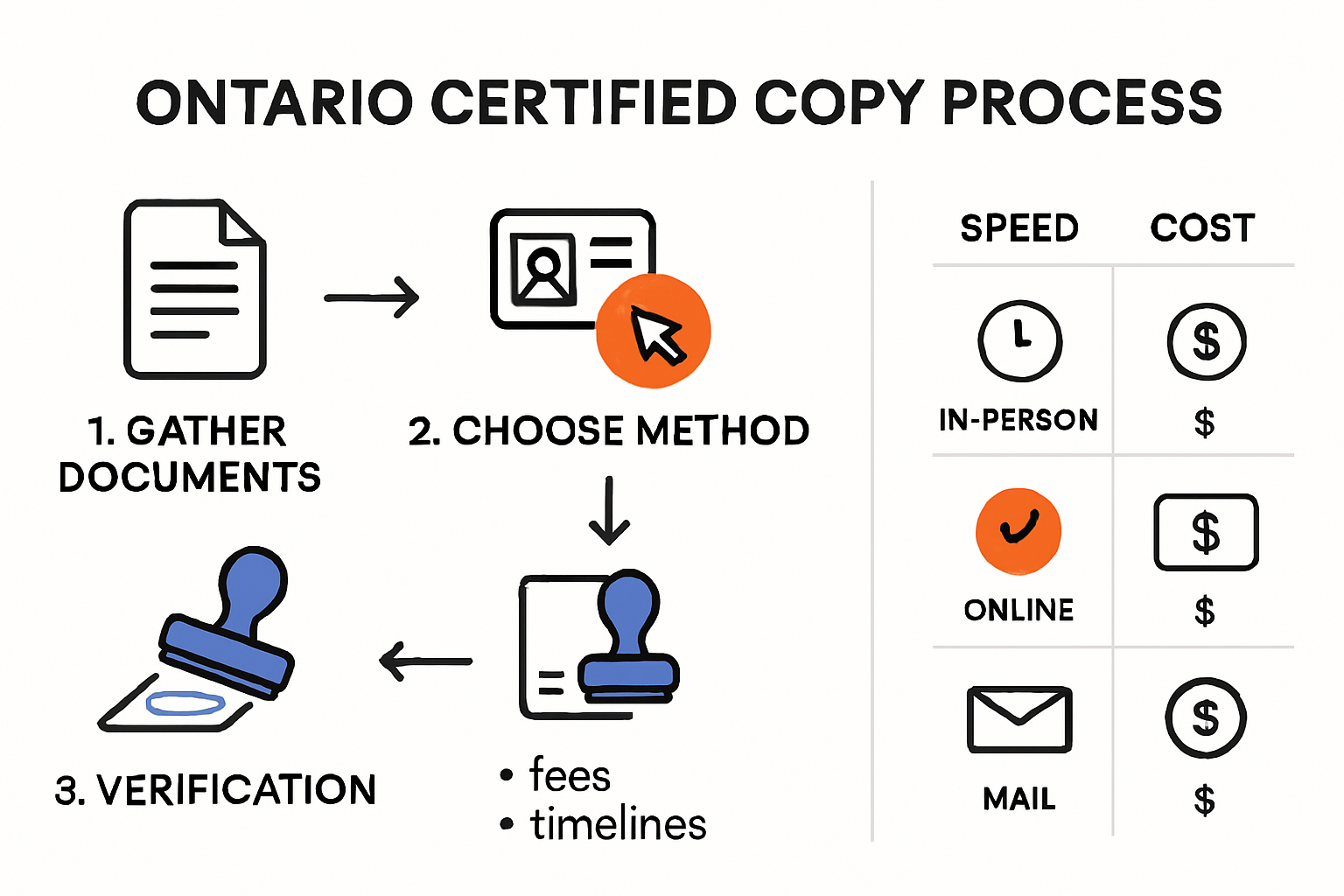
Obtaining certified copies in Ontario requires careful preparation and following specific procedures. The process involves several key steps that ensure your documents are properly authenticated and legally recognized. Learn more about document certification details.
Gathering Required Documentation
Before initiating the certification process, you must collect all necessary original documents. According to Ontario’s official government guidelines, different types of documents require unique verification approaches. Typically, you will need to prepare:
- Original Document: The primary document requiring certification
- Valid Government Identification: A current photo ID
- Proof of Purpose: Documentation explaining why you need the certified copy
- Application Forms: Specific forms relevant to your document type
Each document type demands specific supporting materials. Birth certificates, marriage certificates, and academic transcripts might have slightly different requirements. Carefully review the specific guidelines for your particular document to ensure you have all necessary paperwork.
The following checklist table outlines typical documents required when applying for a certified copy in Ontario, and whether they are required for most applications:
| Document Type | Commonly Required? |
|---|---|
| Original Document | Yes |
| Government Photo ID | Yes |
| Proof of Purpose | Sometimes |
| Specific Application Forms | Sometimes |
| Proof of Address | Sometimes |
| Supporting Documentation | Sometimes |
Certification Methods and Options
Ontario provides multiple avenues for obtaining certified copies. The Ontario government authentication resources outline three primary methods:
- In-Person Certification: Visit a government service center or authorized notary public
- Online Application: Submit digital requests for certain document types
- Mail-Based Certification: Send documents through registered postal services
Each method carries unique advantages. In-person certification offers immediate verification, online applications provide convenience, and mail-based options work well for those unable to visit physical locations. The choice depends on your specific document, urgency, and personal circumstances.
Here is a summary table comparing the three primary certification methods available in Ontario, outlining their key characteristics and benefits:
| Certification Method | Key Features | Best For |
|---|---|---|
| In-Person | Immediate verification, official stamp/seal | Urgent requests, physical original required |
| Online Application | Convenient, available for select documents | Remote applicants, digital processes |
| Mail-Based Certification | Can submit without visiting in person | Those unable to travel to a service center |
When obtaining a certified copy, expect to pay standard processing fees. These vary depending on the document type and certification method. Some institutions offer expedited services for an additional charge, which can be beneficial if you need the document quickly.
The verification process involves a trained professional comparing your original document against the copy, ensuring every detail matches precisely. They will then add an official seal, stamp, or signature confirming the document’s authenticity. This meticulous approach guarantees that your certified copy will be accepted by government agencies, educational institutions, and legal entities.
Remember that not all documents can be self-certified. Complex or sensitive documents often require professional verification. If you are unsure about the certification process for your specific document, consulting with a notary public or government service representative can provide clarity and guidance.
Timelines for obtaining certified copies can range from a few days to several weeks, depending on the document type and certification method chosen. Planning ahead and understanding the specific requirements will help ensure a smooth and efficient certification process.

Requirements and Documents Needed in Ontario
Obtaining certified copies in Ontario requires careful preparation and understanding of specific documentation requirements. Different types of documents demand unique approaches to verification and authentication. Discover the key steps for document certification.
Acceptable Identity and Source Documents
The foundation of obtaining a certified copy lies in presenting the right documentation. According to Ontario’s official identity document guidelines, applicants must provide comprehensive proof of identity and document ownership. Acceptable documents typically include:
- Primary Identification: Government-issued photo ID (driver’s license, passport, permanent resident card)
- Supporting Documentation: Birth certificates, marriage certificates, immigration papers
- Proof of Address: Utility bills, bank statements, government correspondence
Each document type requires specific verification. For instance, vital records like birth and marriage certificates have unique requirements. Some documents may need additional authentication, especially if they are intended for use outside of Canada.
Special Considerations for Document Authentication
Certain documents require extra steps for certified copies. Ontario’s Official Documents Services outlines specific guidelines for documents intended for international use. Key considerations include:
- Vital Statistics Documents: Birth, marriage, and death certificates require official verification
- Court-Issued Documents: Require specific seals and signatures from judicial authorities
- Business Registry Documents: Need precise authentication from official sources
For documents related to deceased individuals, additional documentation becomes crucial. Specific requirements exist for next of kin or executors seeking to obtain certified copies, including providing death certificates or funeral director statements.
The authentication process varies depending on the document’s purpose. Personal documents like birth certificates typically require different verification methods compared to professional or legal documents. Some documents may need multiple levels of certification, especially when used for international purposes.
Professionals and individuals must pay close attention to specific requirements. Minor errors or missing documentation can significantly delay the certification process. It is advisable to contact the relevant government department or a certified notary public to confirm exact requirements for your specific document.
Processing times and fees vary based on document type and certification method. Some documents can be certified quickly, while others may require weeks of processing. The complexity of authentication depends on the document’s origin, intended use, and specific provincial regulations.
Remember that each document tells a unique story of identity and legal status. Proper preparation and understanding of certification requirements ensure your documents are accurately and efficiently processed. Taking time to gather the correct documentation will save you potential delays and complications in your certification journey.
Common Questions About Certified Copies in Ontario
Navigating the world of certified copies can be complex, with numerous questions arising about their purpose, validity, and process. Learn more about document certification details.
Understanding Certified Copy Basics
People often wonder about the fundamental nature of certified copies. According to Official Documents Services, a certified copy is a reproduction of an original document that has been endorsed to confirm its accuracy. This means the copy itself is verified, not necessarily the authenticity of the original document.
Frequently asked questions include:
- What makes a copy ‘certified’?: An official seal, signature, or stamp from an authorized professional
- Who can create a certified copy?: Typically notaries public, government officials, or specific authorized professionals
- How long is a certified copy valid?: Validity varies depending on the document type and intended use
Legal Implications and Acceptance
The legal standing of certified copies is crucial for many administrative and legal processes. Certified copies serve as important evidence in various scenarios, from court proceedings to government applications. Ontario’s Official Documents Services provides specific guidelines for document authentication.
Key considerations include:
- International Use: Some documents require additional authentication for use outside Canada
- Specific Purpose Requirements: Different institutions may have unique certification standards
- Expiration and Renewal: Some certified copies have limited validity periods
It is important to understand that a certified copy does not guarantee the content of the original document is true. It merely confirms that the copy is an exact reproduction of the original document presented for certification.
Cost is another common concern. Fees for certified copies vary depending on the document type, certification method, and the authority providing the service. Some government services offer standard fees, while private notaries might charge different rates.
Time frames for obtaining certified copies can range from immediate (in-person certification) to several weeks for mailed or complex document requests. Planning ahead and understanding the specific requirements for your document type can help manage expectations and prevent delays.
Professionals recommend keeping original documents safe and using certified copies for most administrative purposes. This approach helps preserve important original records while providing the necessary documentation for various processes.
Remember that each document and certification scenario is unique. When in doubt, consult with a professional notary or the specific government department handling your document type. Proper guidance can save time, money, and potential complications in your certification journey.
Frequently Asked Questions
What are certified copies and why are they necessary?
Certified copies are official reproductions of original documents that are verified and endorsed by authorized officials. They are required for legal and governmental applications to ensure authenticity without submitting original documents.
How do I obtain a certified copy in Ontario?
To obtain a certified copy, gather your original document, valid government ID, proof of purpose, and any relevant application forms. You can then choose to have it certified in person, online, or by mail, depending on your convenience and the specific document type.
What identification is needed to get a certified copy?
You will need government-issued photo identification, such as a driver’s license or passport, to verify your identity when applying for a certified copy. Additional documents may also be required depending on the type of certification.
Are certified copies valid for use outside of Canada?
Yes, certified copies can be valid for use outside of Canada, but some may require additional authentication depending on the requirements of the country where they will be used. It’s essential to check the specific guidelines for document use outside Canada.
Fast, Stress-Free Certified Copies with Online Notary Services
Are you worried about delays, missing documents, or unclear certification requirements? Getting a certified copy in Ontario can quickly become overwhelming with confusing steps and strict verification rules. The article highlights how certified copies are critical for legal processes and government applications, but the paperwork and long waits can drain your time and energy. Our solution helps you move forward with confidence and avoid mistakes that could cause rejections or costly delays.

Experience a seamless process from the comfort of your home. With The Online Notary, you can easily upload your documents and have them certified by a licensed notary without lining up at government offices. Whether you need affidavits, statutory declarations, or other notarized documents for Ontario, get the professional support you need now. Visit our website here to start your fast online certification. Secure your certified copy quickly and correctly so you can meet your deadlines and protect your original records. Why wait for weeks when you can have your documents notarized online today?
Recommended
- Certification of Documents in Ontario: 2025 Guide for Individuals & Businesses – The Online Notary CA
- How to Notarize Documents in Ontario: Easy 2025 Guide – The Online Notary CA
- Can Anyone Notarize a Document in Ontario? 2025 Guide – The Online Notary CA
- How to Get Documents Notarized Online in Ontario 2025 – The Online Notary CA