
TL;DR:
- Many people mistakenly believe they can notarize vital records like birth certificates in Ontario, but only government registrars can certify these documents. Proper preparation, including bringing valid photo ID and understanding the specific notarization type required, is essential for a smooth process. Online notarization services now offer convenient, regulated options that ensure correct documentation and compliance with provincial law.
If you’ve ever tried to get a birth certificate notarized and been turned away, you’re not alone. Many people arrive at a notary’s office with the wrong documents or incomplete information about the notarization process. Knowing which vital documents for notarization actually require a notary’s seal can save you serious time, money, and frustration. Whether you’re an individual managing a power of attorney or a business owner closing a contract, this Ontario-specific guide gives you the clarity you need to walk in prepared.
Table of Contents
- Key Takeaways
- Vital documents for notarization: what the law requires
- Common vital documents that require notarization in Ontario
- Documents you cannot notarize in Ontario (and what to do instead)
- How to prepare your documents for notarization
- At-a-glance reference: important notarized documents in Ontario
- My take on navigating Ontario’s notarization process
- Get your documents notarized online in Ontario
- FAQ
Key Takeaways
| Point | Details |
|---|---|
| Notarization confirms identity and intent | A notary verifies who you are and that you signed voluntarily, creating a legally enforceable record. |
| Birth certificates cannot be notarized | Only government registrars can certify official vital records; notaries must refuse these documents. |
| Powers of attorney are top priority | These are among the most commonly notarized documents in Ontario, required for legal and financial decisions. |
| Bring valid government-issued photo ID | Expired or non-photo identification will disqualify you from completing notarization. |
| Online notarization is legally valid in Ontario | Ontario law permits remote notarization, making access far faster for individuals and businesses. |
Vital documents for notarization: what the law requires
Notarization is not simply a rubber stamp. The process verifies identity, confirms a signer is acting voluntarily, and applies an official seal that gives the document legal weight. In Ontario, notaries are either lawyers or notaries public authorized under provincial law, and each type of notarial act serves a specific legal function.
There are three main types of notarial acts you’ll encounter:
- Acknowledgment: The signer confirms they signed the document voluntarily. The signature does not need to happen in front of the notary, but the notary must verify identity.
- Jurat: The signer must sign in the notary’s presence and take an oath affirming the document is truthful. This applies most commonly to affidavits.
- True copy certification: The notary certifies that a copy of a document is a faithful reproduction of the original.
Identification is non-negotiable. Acceptable government-issued photo IDs include a valid driver’s license, passport, or similar credential. Expired IDs will get you turned away. Ontario follows strict standards here, and understanding when a notary is required under provincial law helps you show up ready.
Pro Tip: If you’re unsure whether your document requires a jurat or an acknowledgment, call the receiving institution before your appointment. Courts, banks, and government offices each have specific requirements.
Common vital documents that require notarization in Ontario
This is where a lot of people discover gaps in their knowledge. The most frequently notarized documents in Ontario span personal, financial, real estate, and business categories. Here’s a breakdown of what you’re most likely to need:
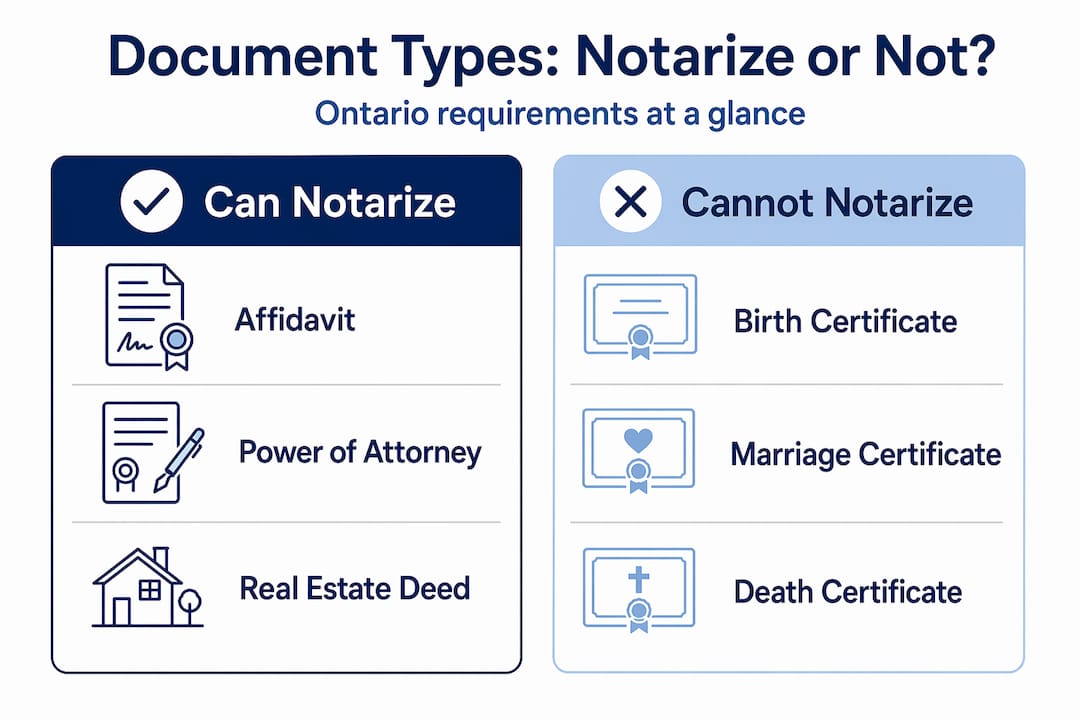
- Powers of attorney (POA): Continuing and healthcare POAs are among the most critical documents to notarize. They authorize another person to act on your behalf if you become incapacitated. Financial institutions and medical facilities almost always require a notarized copy.
- Affidavits and sworn statements: An affidavit is a written statement you swear under oath. Courts, government agencies, and immigration authorities commonly require notarized affidavits.
- Real estate documents: Deeds, mortgages, and transfer documents typically require notarization before financial institutions or land registry offices will accept them.
- Business contracts and loan agreements: Commercial loan documents and partnership agreements frequently need notarization to become enforceable.
- Medical and government forms: Consent forms for medical procedures involving minors, as well as certain government benefit applications, often require notarized confirmation.
Leases, wills, and trusts occupy a slightly different category. Notarizing them is sometimes optional, but doing so increases legal enforceability and can prevent costly disputes during probate or enforcement proceedings.
Pro Tip: For businesses that regularly execute contracts or loan agreements, setting up a standing relationship with an online notary reduces turnaround time significantly and keeps deals moving.

For a structured look at which specific documents need notarization in Ontario, especially those involving banks and government agencies, reviewing official guidance is a smart first step.
Documents you cannot notarize in Ontario (and what to do instead)
Here’s a misconception that costs people real time. Many individuals show up expecting a notary to certify their birth certificate, marriage certificate, or death certificate. A notary cannot do this, and legally must refuse.
Only government registrars or county recorders can certify official copies of vital records. These documents are issued and controlled by the state, not authenticated by a third-party notary. The distinction matters because a notarized copy of a birth certificate carries no legal validity. The institution requesting it will reject it outright.
| Document type | Who certifies it | Notes |
|---|---|---|
| Birth certificate | Provincial registrar (e.g., ServiceOntario) | Must order an official copy directly |
| Death certificate | Provincial registrar | Certified copies issued through vital statistics office |
| Marriage certificate | Provincial registrar | Notary cannot certify these; order official copy instead |
| Diploma or transcript | Issuing institution | School or university provides certified copies |
| Notarized affidavit | Notary public or commissioner | Fully within notary’s authority |
If an institution overseas or in another province asks for a “certified copy” of your birth certificate, what they usually want is an official copy ordered directly from ServiceOntario, sometimes followed by an apostille. Trying to substitute a notarized photocopy creates problems rather than solving them.
How to prepare your documents for notarization
Preparation is what separates a smooth notarization appointment from a wasted trip. Follow these steps before you book your appointment:
- Confirm the type of notarization required. Ask the institution or court exactly what they need. A jurat, an acknowledgment, and a true copy certification are different services, and the wrong one means starting over.
- Gather valid photo identification. Bring at least one current government-issued photo ID. If your document involves multiple signers, everyone needs to present their own valid ID.
- Review the document for completeness. A notary must refuse documents with blank spaces that could be filled in after signing, missing pages, or obvious alterations. Fill everything in before you arrive.
- Do not sign the document yet. For jurats, you must sign in the notary’s presence. Signing beforehand disqualifies the document. For acknowledgments, you may have already signed, but confirm this with your notary.
- Check whether an apostille is needed. If your document is going to another country, an apostille or authentication may be required after notarization to validate the notary’s authority internationally. This involves a separate process through Global Affairs Canada or the relevant provincial authority.
- Book a qualified notary. In Ontario, anyone cannot notarize a document. The person must be a lawyer, notary public, or commissioner of oaths depending on the document type.
Pro Tip: If you’re notarizing documents for bank use, check our guide on notarized documents for Ontario banks first. Banks have specific formatting expectations that can cause rejection even when the notarization itself is valid.
At-a-glance reference: important notarized documents in Ontario
Use this table as a quick reference when deciding whether your document needs a notary and what to bring.
| Document type | Typical use | Notarization required? | ID or witness needed |
|---|---|---|---|
| Continuing power of attorney | Authorizes financial decisions | Yes, mandatory | Valid photo ID for grantor |
| Healthcare power of attorney | Authorizes medical decisions | Yes, mandatory | Valid photo ID, two witnesses |
| Affidavit | Sworn statement for court or government | Yes, jurat required | Valid photo ID |
| Real estate deed or mortgage | Property transfer, financing | Yes, mandatory | Valid photo ID |
| Business loan agreement | Commercial financing | Yes, typically required | Valid photo ID for all signers |
| Will or trust | Estate planning | Often optional | Highly recommended to notarize |
| Lease agreement | Residential or commercial tenancy | Optional | Recommended for high-value leases |
| Consent form (minor travel, medical) | Travel or medical authorization | Usually required | Valid photo ID of parent or guardian |
This table reflects the most commonly encountered official notarized paperwork in Ontario. The “optional” entries carry a practical lesson: choosing not to notarize something you legally could have usually costs far more in disputes later than the notarization fee itself.
My take on navigating Ontario’s notarization process
I’ve seen the same mistakes made over and over by people who came in prepared for the wrong appointment. Someone arrives with a photocopy of their birth certificate, confident it can be certified, only to find out it cannot be. Another person has their affidavit already signed, which voids the jurat entirely. These aren’t rare edge cases. They happen constantly, and they all share the same cause: assumptions borrowed from other provinces or countries that simply don’t apply in Ontario.
What I’ve learned from working with Ontario clients is that local nuance matters more than people expect. Ontario distinguishes between commissioners of oaths and notaries public, and not every notarial act falls within each role’s authority. In many U.S. states, a notary public has broader powers than a commissioner of oaths in Ontario. Treating them as equivalent leads to documents being rejected by courts or registrars.
My honest observation is that online notarization has done more to solve the preparation problem than any checklist ever has. When clients work with a virtual notary, the platform typically walks them through requirements before the session. That pre-screening catches the most common errors before they waste anyone’s time. It is not a perfect system, but it gets people to the right appointment, with the right documents, far more often than walking into an unfamiliar office and hoping for the best.
— Ken
Get your documents notarized online in Ontario
If you’ve read this far, you already know more about vital document notarization than most people who show up to their first appointment. Theonlinenotary takes that knowledge and puts it into action.

Theonlinenotary provides 24/7 online notarization services built specifically for Ontario law, covering powers of attorney, affidavits, statutory declarations, solemn declarations, real estate documents, business contracts, and more. You don’t need to take time off work or drive across town. The entire process happens remotely, with a qualified Ontario notary who knows exactly what each institution requires. If you need support with a specific document type, the detailed guide on types of affidavits in Ontario is a strong starting point before your session.
FAQ
What are the most common vital documents for notarization?
The most commonly notarized documents in Ontario include powers of attorney, affidavits, real estate deeds, mortgages, business loan agreements, and consent forms. Many of these are legally required to be notarized before courts, banks, or government agencies will accept them.
Can a notary certify a birth certificate in Ontario?
No. Notaries cannot certify copies of vital records like birth, marriage, or death certificates. Only provincial registrars, such as ServiceOntario, can issue certified copies of these official documents.
What ID do I need to bring to a notarization appointment?
You must bring a current, government-issued photo ID such as a passport or driver’s license. Expired IDs or documents without photos do not meet the legal standard for notarization in Ontario or most other jurisdictions.
Do I sign my document before or during the notarization?
It depends on the type of notarial act. For a jurat, you must sign in the notary’s presence after taking an oath. For an acknowledgment, you may have already signed, but the notary must still verify your identity before completing the act.
When does a notarized document need an apostille?
If a notarized document will be used in another country, it may require an apostille or additional authentication to verify the notary’s authority internationally. This process is separate from notarization and typically involves Global Affairs Canada or a provincial authority.
Recommended
- What needs notarization in Ontario? Essential 2026 guide – The Online Notary
- Document types for notarization in Ontario: what you need – The Online Notary
- Notarization for Canadian citizenship: Ontario applicants’ guide – The Online Notary
- Guide to Documents Requiring Notarization in Ontario – The Online Notary