
TL;DR:
- Most Ontario business agreements do not require notarization, which is only necessary in specific cases like cross-border or court filings. Notarization authenticates signer identity and signature integrity, providing evidence but not affecting enforceability for routine contracts. Proper pre-appointment planning, especially regarding authorizations and foreign authentication steps, prevents costly delays and re-execution.
Many Ontario business owners assume notarization is legally required for every contract they sign. That assumption creates unnecessary costs and delays. In reality, notarization for business agreements is situational. It becomes critical in specific scenarios like cross-border transactions, court filings, and public procurement, while remaining optional in most everyday commercial dealings. This guide cuts through the confusion. You will learn exactly when business contracts notarization is required, how the process works in Ontario, how to handle representative signers, and what international use of notarized documents actually demands.
Table of Contents
- Key takeaways
- What notarization actually does in business agreements
- When notarization for business agreements is required
- How the notarization process works in Ontario
- Notarizing agreements signed by corporate representatives
- Cross-border notarization, apostilles, and international acceptance
- My take on notarization strategy for Ontario businesses
- How Theonlinenotary simplifies business agreement notarization
- FAQ
Key takeaways
| Point | Details |
|---|---|
| Notarization is not universally required | Most business agreements are legally binding without notarization, but specific contexts demand it. |
| Cross-border use changes everything | Documents used internationally typically need notarization plus apostille or consular legalization. |
| Representative signers need extra prep | Officers signing for a company must bring corporate resolutions or a power of attorney to the notary. |
| Remote notarization is available in Ontario | Online notarization options exist and work well for dispersed signers, with some international limitations. |
| Confirm requirements early | Check what the receiving party or foreign authority needs before scheduling notarization to avoid rework. |
What notarization actually does in business agreements
Notarization is not a magic stamp that makes a contract more enforceable in every situation. What it actually does is authenticate three things: the identity of the person signing, their willingness to sign without coercion, and the authenticity of the signature itself. A notary public verifies these elements, then applies a seal or certificate to confirm they were present and satisfied.
From a legal standpoint, most business contracts are fully binding without notarization. Two parties agree, sign, and the contract holds. What notarization adds is evidentiary weight. If a dispute reaches court, a notarized document carries a presumption of authenticity that an unnotarized one does not. That distinction matters enormously when the stakes are high.
Common notary documents for businesses include:
- Real estate purchase agreements and commercial leases
- Loan and financing agreements requiring lender-mandated authentication
- Shareholder agreements and corporate resolutions submitted to foreign registries
- Vendor contracts for government or public sector clients
- Powers of attorney used to authorize a representative to bind a company
- Statutory declarations submitted to courts or regulatory bodies
Pro Tip: Not all notarial acts are the same. An acknowledgment confirms that a signer appeared before the notary and signed voluntarily. A jurat confirms the signer swore an oath to the truthfulness of the document’s content. Choosing the wrong act can invalidate the notarization entirely, so confirm which one your receiving authority requires.
The importance of notarization in business becomes clearest when you look at what happens without it in the wrong context. A contract that travels across borders without proper authentication gets rejected. A court filing without a notarized affidavit gets dismissed. For routine domestic agreements between private parties, you likely do not need it. For anything with higher regulatory or jurisdictional complexity, you almost certainly do.
When notarization for business agreements is required
The honest answer is that venue and counterparty rules drive most notarization requirements, not statute law. Before asking whether the law requires notarization, ask whether the other party or receiving authority requires it. That question resolves 80% of cases.
Here are the primary scenarios where notarization becomes necessary or strongly advisable:
- Cross-border contracts. Any business agreement used internationally typically requires notarization as the first step in a longer authentication chain. The destination country may then require an apostille or consular legalization before accepting the document.
- Court filings and dispute resolution. Affidavits, statutory declarations, and supporting documents filed in legal proceedings generally require notarization. Business agreement verification in a litigation context depends on it.
- Public sector procurement. Government vendor contracts often require notarized execution even when no statute mandates it. If you are bidding on public contracts in Ontario, check the tender requirements carefully.
- Agreements with confession of judgment clauses. Some jurisdictions require notarization for contracts containing clauses that waive a debtor’s right to notice before judgment. These are rare in Ontario but common in cross-border U.S. dealings.
- Regulated industry filings. Financial services, real estate, and securities filings submitted to regulators frequently require notarized supporting agreements.
Pro Tip: When you receive a contract from a counterparty that asks for notarization, email their legal team and ask exactly which notarial act they need and which certification format they accept. This one question prevents most costly rework.
For everyday service agreements, NDAs, or licensing contracts between Ontario businesses, notarization is optional. It adds credibility but is not a legal requirement. The smart move is to learn what Ontario requires before you commit to a notarization workflow that may be unnecessary for your specific transaction.
How the notarization process works in Ontario
Preparing properly is what separates a smooth notarization appointment from an expensive delay. Whether you are doing this in person or through a remote online notarization session, the fundamentals are the same.
Here is what the process looks like and what you need to bring:
- Government-issued photo ID. Every signer needs valid identification. Signers must appear before the notary with ID that matches the name on the document, whether in person or via secure video in a remote session.
- Final, unsigned versions of the agreement. Documents must be complete before the appointment. A notary cannot certify a document with blank fields, missing pages, or pending edits. Get the contract finalized in full before scheduling.
- Authorization documents if signing on behalf of a company. Officers, directors, and agents need to bring corporate resolutions or a power of attorney that establishes their authority to sign for the entity.
- Knowledge of which notarial act you need. Acknowledgment or jurat. If you do not know, confirm with your counterparty or legal counsel before the appointment.
For agreements with multiple signers in different locations, remote notarization is a practical solution. Ontario permits remote online notarization, and Theonlinenotary offers flexible scheduling to accommodate signers across time zones. However, confirming that remote notarization is accepted by your counterparty or the destination jurisdiction is a step you must not skip.
Pro Tip: Improper notarization or incorrect certificate wording causes rejections that require the entire execution to be repeated. Review the notarial certificate language with your notary before the session ends, not after.

Common mistakes that derail business contract notarization include presenting unsigned documents, bringing an expired ID, and failing to confirm signer authority before the appointment. These are preventable. A five-minute checklist review before you walk into the notary’s office or join the video session saves hours of rework.
Notarizing agreements signed by corporate representatives
When an individual signs a contract on behalf of a company, the notarization process has an added layer of complexity. The notary is not just verifying the person’s identity. They are also confirming that this person has the legal authority to bind the organization.
Authorized corporate signers must be supported by a board resolution or a power of attorney. These documents show the notary, and your counterparty, that the signing officer has been granted authority by the company to execute that specific agreement. Without them, the notarization can be challenged.
Here is how the requirements compare depending on the signer’s role:
| Signer type | Authorization document needed | Common pitfalls |
|---|---|---|
| Corporate officer (CEO, CFO) | Board resolution authorizing signature | Resolution must name the specific agreement or class of agreements |
| Authorized agent | Power of attorney granted by board or officer | POA must be current and cover the scope of the transaction |
| Attorney-in-fact | Notarized power of attorney | Some jurisdictions require the POA itself to be notarized first |
| Partner in a partnership | Partnership agreement excerpt or consent | Must show authority to bind all partners or the firm |
Jurisdictional differences in certificate wording matter more than most business owners realize. Ontario uses specific language in notarial certificates for representative signers, and a certificate that was valid in one province may not satisfy a foreign authority. If your agreement will cross borders, use a notary who understands both Ontario requirements and the receiving jurisdiction’s expectations.
The risk of skipping proper authorization preparation is significant. A counterparty’s legal team may reject the executed agreement, requiring the signing process to restart. In time-sensitive deals, that delay has real financial consequences. Digital notary solutions that specialize in corporate signings help by flagging authorization gaps before the appointment occurs.
Cross-border notarization, apostilles, and international acceptance
Using a notarized business agreement outside Canada is not as simple as getting a notary’s seal. The notarization is just the first step in a process that most businesses do not fully understand until a document gets rejected abroad.
The workflow looks like this: notarization by an Ontario notary public, followed by authentication by Global Affairs Canada, followed by either an apostille for Hague Convention member countries or full consular legalization for non-member countries. Skipping or missequencing any step means rejection.
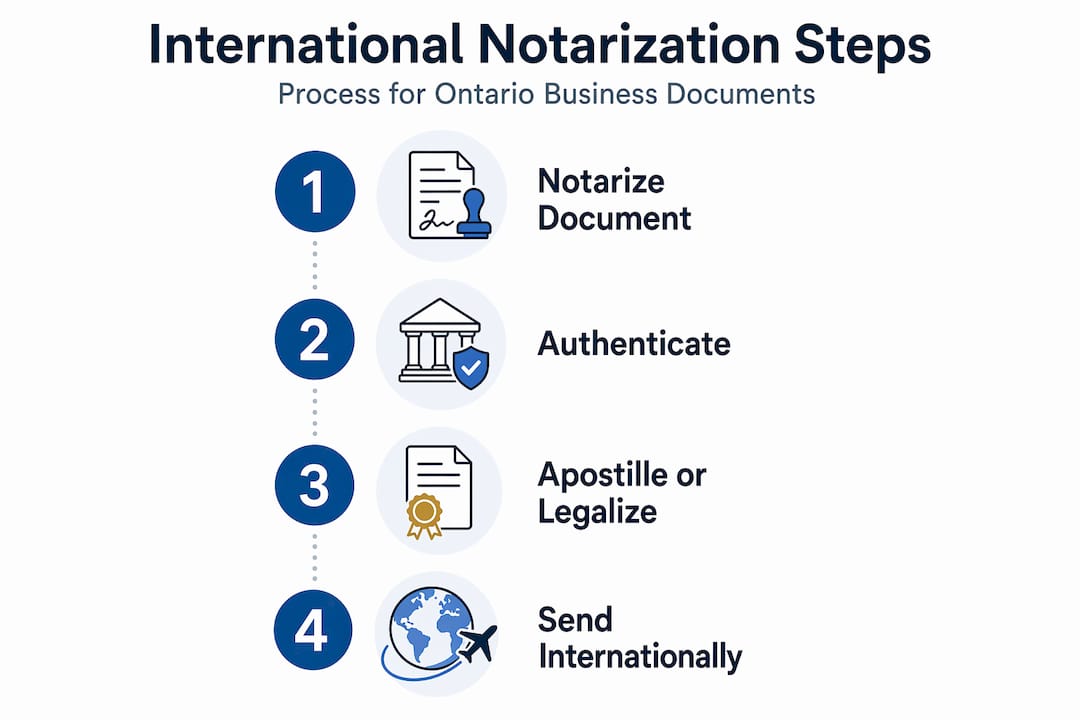
The apostille process applies to countries that are party to the Hague Apostille Convention. An apostille is a standardized certificate that confirms the notary’s credentials are legitimate, allowing foreign authorities to accept the document without further authentication. Canada became a signatory to the convention, which has significantly simplified cross-border document use for many Ontario businesses.
For countries outside the Hague Convention, consular legalization is required. This involves authentication by the destination country’s consulate or embassy in Canada. Common examples include China and UAE, where legalization requirements are strict and process timelines can stretch to several weeks. Knowing this upfront changes how you plan contract execution timelines.
| Country | Hague member | Process after notarization | Typical timeline |
|---|---|---|---|
| United States | Yes | Apostille | 1 to 5 business days |
| United Kingdom | Yes | Apostille | 3 to 7 business days |
| China | No | Consular legalization | 2 to 6 weeks |
| UAE | No | Consular legalization | 2 to 4 weeks |
| Brazil | Yes | Apostille | 5 to 10 business days |
Pro Tip: Confirm what the receiving authority requires before booking any notarization appointment. A document notarized incorrectly for a specific foreign jurisdiction may need to be re-executed entirely, wasting both time and legal fees. For complex cross-border matters, guidance from a specialist such as those handling cross-border legal matters can prevent costly missteps.
Remote online notarization works well for international transactions where signers are in different countries, but it carries an important caveat. RON is not recognized in every destination jurisdiction. Some foreign authorities specifically require that notarization was performed in person. Verify this before relying on a remote session for a document headed overseas.
My take on notarization strategy for Ontario businesses
I have seen businesses treat notarization as a bureaucratic checkbox, something they do at the last minute because a counterparty asked for it. That approach is what creates problems.
In my experience, the businesses that handle notarization well treat it as a planning decision, not a paperwork task. They identify during contract negotiations which agreements will need notarization, who will sign, and whether cross-border authentication will be required. That early planning is what prevents the scramble at closing when someone realizes the corporate resolution is missing or the apostille process adds three weeks to the timeline.
I also think many Ontario businesses underestimate the value of using notary services for agreements that are not strictly required to be notarized. When a deal is significant, having notarized signatures on record is a form of fraud prevention and dispute protection that costs very little relative to the risk it mitigates. The importance of notarization in business is not just about legal compliance. It is about building a clean paper trail that holds up when things go sideways.
Remote online notarization has been a genuine improvement for businesses with geographically dispersed signers. But I would caution against assuming it works everywhere internationally. The rules are still catching up in many jurisdictions. Use it where it is confirmed to be accepted, and default to in-person when there is any doubt about foreign acceptance.
The single most common mistake I see is businesses not preparing their corporate authorization documents. A CEO who walks into a notary appointment without a board resolution authorizing the specific agreement is going to leave without a completed notarization. That is a half-day of lost time that was entirely preventable.
— Ken
How Theonlinenotary simplifies business agreement notarization
If you are an Ontario business owner working through a contract that requires notarization, the process does not need to be complicated or time-consuming. Theonlinenotary provides trusted online notary services with 24/7 availability, meaning you can schedule a session around your business needs rather than a notary’s office hours.

Whether your agreement involves a single local signer or multiple representatives in different time zones, Theonlinenotary handles corporate signings with the attention to detail that authorization verification demands. Remote sessions are available for Ontario businesses, with expert support for selecting the correct notarial act and reviewing certificate wording before you close out the appointment. For businesses dealing with agreements that will go through the apostille or legalization chain, early coordination with a professional notary service prevents the sequencing errors that cause rejection. Explore notary services for Ontario businesses to find the right option for your specific agreement type and get started today.
FAQ
Does every business contract need to be notarized?
No. Most business agreements are legally binding without notarization. Notarization is required or strongly recommended in specific situations: cross-border transactions, court filings, public sector contracts, and agreements submitted to foreign registries.
What ID does a signer need for business contract notarization?
Signers need valid government-issued photo ID that matches the name on the agreement. For corporate representatives, a board resolution or power of attorney establishing signing authority is also required.
Can business agreements be notarized online in Ontario?
Yes. Ontario permits remote online notarization, and Theonlinenotary offers video-based sessions for this purpose. However, some foreign authorities do not accept remotely notarized documents, so confirming destination requirements before using this option is critical.
What is the difference between an apostille and consular legalization?
An apostille is a simplified authentication used between Hague Convention member countries after notarization. Consular legalization is required for non-member countries like China and UAE, involving additional steps through the destination country’s consulate in Canada.
What happens if the notarial certificate wording is incorrect?
Incorrect certificate wording can cause the receiving authority to reject the document entirely, requiring the signing process to be repeated. Always confirm the required certificate format with your counterparty or the accepting institution before the notarization appointment.
Recommended
- Notarizing Business Documents in Ontario: 2026 Guide – The Online Notary
- Notary process for Ontario small businesses: 2026 guide – The Online Notary
- Online Notarizing for Ontario Business Documents: Cut Time by 40% – The Online Notary
- What needs notarization in Ontario? Essential 2026 guide – The Online Notary