
TL;DR:
- Ontario notary qualifications specify eligibility criteria, application procedures, and authority governed by recent 2026 regulatory reforms. Applicants include lawyers, paralegals, and certain public officials, with non-lawyers needing to meet specific criteria and obtain a notarization license valid for 10 years. The 2026 updates extended appointment terms, replaced certificates with Notices of Approval, and expanded office-based commissioners, streamlining Ontario’s notary appointment process.
Ontario notary qualifications define who can be appointed as a notary public in the province, specifying eligibility requirements, application procedures, and the legal authority to certify documents. The role is governed by provincial regulations under Ontario’s Notaries Act and the Commissioners for Taking Affidavits Act, and the rules changed significantly in 2026. Whether you are a lawyer, paralegal, or a non-legal professional seeking appointment, understanding the current requirements is the fastest way to avoid delays and get your application right the first time.
What are Ontario notary qualifications?
A notary public in Ontario is a provincially appointed official authorized to certify copies of documents, administer oaths, and authenticate signatures for use in legal, government, and business contexts. The term “notary public qualifications Ontario” refers to the full set of eligibility criteria, professional standing requirements, and procedural obligations that an applicant must satisfy before receiving an appointment.
Ontario draws a clear line between two appointment pathways. Lawyers and paralegals licensed by the Law Society of Ontario follow one route, while non-legal applicants follow a separate process with different forms, fees, and term conditions. Both pathways were updated by regulatory amendments that took effect January 1, 2026, making it critical to check current rules before submitting any application.
The notary public role is also distinct from a commissioner for taking affidavits, a point that confuses many applicants. A commissioner can administer oaths and take affidavits, but a notary public holds broader authority, including the power to certify true copies and notarize documents for international use. Understanding this difference between notary and commissioner in Ontario is the first step toward choosing the correct application stream.
Who is eligible to become a notary public in Ontario?
Eligibility for notary appointment in Ontario depends on your professional status and personal background. The requirements split cleanly into two groups.

Lawyers and paralegals licensed by the Law Society of Ontario qualify automatically for appointment as notaries public. They do not need to demonstrate additional credentials beyond their active license and good standing with the Law Society. This pathway is faster and carries a one-time application fee rather than a renewable term structure.
Non-lawyer, non-paralegal applicants must meet a separate set of baseline criteria. According to basic eligibility requirements, every applicant in this category must satisfy all of the following:
- Be a resident of Ontario
- Be at least 18 years old
- Be a Canadian citizen or permanent resident
- Have no serious criminal convictions on record
- Demonstrate a legitimate need for the appointment, typically tied to their employment or community role
Beyond these baseline rules, non-legal applicants must also show that their role requires regular access to notarial functions. A human resources manager who processes immigration documents, for example, would have a stronger application than someone with only occasional need.
Pro Tip: If you are a paralegal or lawyer, confirm your good standing with the Law Society of Ontario before applying. A lapsed license or outstanding compliance issue will block your application immediately.
The 2026 program modernization also expanded the list of individuals who qualify as commissioners by virtue of their office, meaning certain public officials no longer need to apply at all. This change, introduced under O. Reg. 337/25 and O. Reg. 338/25, reduced the administrative burden for specific government roles while keeping the formal application process intact for everyone else.
What are the key steps to apply for notary public appointment in Ontario?
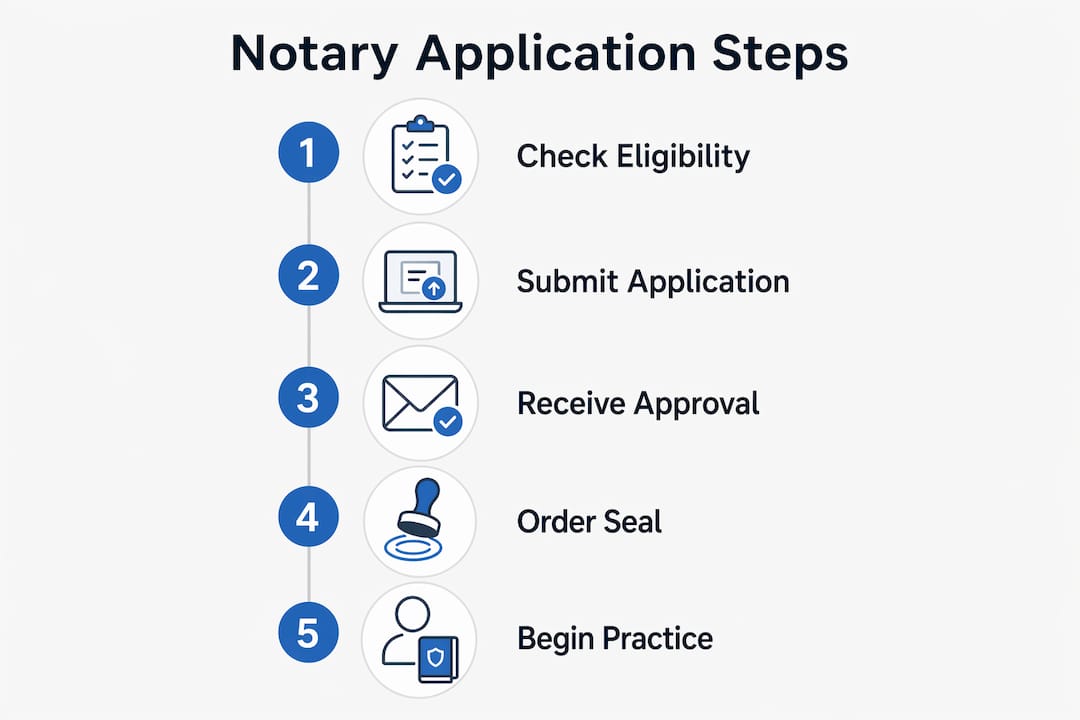
The Ontario notary application steps differ slightly depending on whether you are a legal professional or a non-legal applicant, but the core sequence is consistent.
- Download the correct application form. The Attorney General’s office provides separate forms for lawyers, paralegals, and non-legal applicants. Using the wrong form is one of the most common causes of processing delays.
- Complete the form in full. Include your professional license number if applicable, your employer information, and a clear statement of why you need the appointment. Incomplete forms are returned without processing.
- Pay the application fee. Lawyers and paralegals pay a $145 fee for their notary appointment. Government lawyers are exempt from this fee. Non-legal applicants follow a separate fee schedule tied to their appointment term.
- Submit the application to the Ministry of the Attorney General. Processing times vary, but applicants should expect several weeks for review.
- Receive your Notice of Approval. Since January 1, 2026, the Notice of Approval replaces the certificate of appointment as the official appointing instrument. This document is your proof of authority and must be retained carefully.
- Purchase and register your official embossed seal. Notaries must register their seal with the appointing authority and submit a specimen signature. The seal is required to validate any notarization you perform.
- Begin practicing within your authorized scope. Your authority is limited to the jurisdiction and functions specified in your appointment.
Pro Tip: Order your embossed seal from a reputable supplier as soon as you receive your Notice of Approval. Seal production can take one to two weeks, and you cannot legally notarize documents without it.
For non-legal applicants, the Ontario notary certification process now results in a 10-year appointment term, a significant extension from the previous 3-year term. This change reduces the frequency of renewals and lowers the long-term administrative cost of maintaining your appointment.
How do the 2026 regulatory changes affect notary appointments?
The 2026 reforms represent the most significant update to Ontario’s notary appointment program in decades. Two regulatory amendments, O. Reg. 337/25 and O. Reg. 338/25, came into force on January 1, 2026, and they changed both the duration of appointments and the documentation used to prove authority.
The most immediate change for applicants is the extension of appointment terms from 3 years to 10 years for non-lawyer notaries and commissioners. This means fewer renewals, lower fees over time, and greater stability for individuals whose employment depends on holding an active appointment.
The second major change is the discontinuation of certificates of appointment. The Notice of Approval now serves as the sole appointing instrument. This matters practically because employers and clients who previously verified a notary’s authority by reviewing a physical certificate must now accept the Notice of Approval as equivalent proof.
“Modernizing the appointment program in 2026 reflects Ontario’s efforts to streamline administrative processes and extend appointment stability.” — Women’s Law Association of Ontario
The table below summarizes the key differences between the pre-2026 and post-2026 appointment framework:
| Feature | Before 2026 | After January 1, 2026 |
|---|---|---|
| Appointment term (non-lawyers) | 3 years | 10 years |
| Appointing document | Certificate of appointment | Notice of Approval |
| Commissioners by virtue of office | Limited list | Expanded under O. Reg. 386/12 |
| Fee exemption for government lawyers | Yes | Yes (unchanged) |
The Notice of Approval replacing certificates also requires notaries to keep digital or physical copies readily accessible. Employers and clients may request proof of appointment at any time, and the Notice of Approval is the only document that satisfies this requirement under the updated rules.
What practical advice helps applicants meet Ontario notary qualification criteria?
Getting your application right the first time saves weeks of back-and-forth with the Ministry of the Attorney General. These are the most common points where applicants run into problems.
- Use only current forms. The 2026 regulatory changes updated the application documentation. Forms downloaded before January 2026 may reference certificates of appointment or 3-year terms. Always pull the latest version directly from the Ontario government website.
- Confirm your professional standing before applying. Lawyers and paralegals must be in good standing with the Law Society of Ontario at the time of application. A compliance hold or suspended license disqualifies you regardless of your experience or employment.
- Address your criminal record proactively. Non-legal applicants with any criminal history should review the eligibility criteria carefully. Not all convictions are disqualifying, but serious offenses will result in rejection. If you are uncertain, consult a legal professional before submitting.
- Plan your seal purchase in advance. The embossed seal and specimen signature must be submitted as part of the appointment registration. Sourcing a seal takes time, so begin the process as soon as you receive your Notice of Approval.
- Check whether your role qualifies you automatically. The 2026 reforms expanded the list of positions that qualify as commissioners by virtue of office. If your job title is on that list, you may not need to apply at all.
Pro Tip: Keep a digital copy of your Notice of Approval stored in a secure, accessible location such as a password-protected cloud folder. Employers and clients will ask for it, and losing the original creates a verification problem that takes time to resolve.
For a detailed walkthrough of the updated process, the 2026 appointment checklist from Theonlinenotary covers each step with current documentation requirements.
Key takeaways
Ontario notary qualifications require applicants to meet specific eligibility criteria, follow a defined application process, and comply with 2026 regulatory changes that extended appointment terms to 10 years and replaced certificates with the Notice of Approval.
| Point | Details |
|---|---|
| Two distinct pathways | Lawyers and paralegals follow a separate, faster route than non-legal applicants. |
| Core eligibility for non-lawyers | Applicants must be Ontario residents, at least 18, Canadian citizens or permanent residents, with no serious criminal record. |
| 2026 term extension | Non-lawyer notary and commissioner appointments now run 10 years instead of 3. |
| Notice of Approval | This document replaces the certificate of appointment and must be retained as proof of authority. |
| Seal registration is mandatory | Every notary must purchase an embossed seal and submit a specimen signature before practicing. |
Why the 2026 changes matter more than most applicants realize
I have worked with enough notary applicants to know that most people underestimate how much the 2026 reforms actually changed day-to-day practice. The shift from a 3-year to a 10-year appointment term sounds like a minor administrative tweak. It is not. For non-legal professionals whose employers require them to hold an active appointment, a 10-year term means one application instead of three over a decade. That is real time and real money saved.
The switch from certificates of appointment to the Notice of Approval is the change I see causing the most confusion right now. Employers who have been verifying notary authority for years by looking at a physical certificate are being handed a document they do not recognize. I advise every new appointee to proactively share a copy of their Notice of Approval with their HR department and any regular clients before they are asked for it. Getting ahead of that question builds credibility and avoids awkward verification delays.
The expanded list of commissioners by virtue of office is also underused. Many people in qualifying government roles are still going through the full application process when they do not need to. Before you spend time and money on an application, check the updated list under O. Reg. 386/12. You may already hold the authority you are applying for.
My broader advice is this: the notary profession requirements in Ontario are not complicated, but they are specific. The applicants who run into trouble are almost always the ones working from outdated information. The 2026 compliance guide from Theonlinenotary is the most current resource I point people to when they want a single, reliable reference.
— Ken
Get expert notary services and application support in Ontario
Qualifying as a notary public is only part of the picture. Once appointed, you need a reliable way to handle notarization requests efficiently and in full compliance with Ontario’s 2026 rules.

Theonlinenotary provides trusted online notary services for affidavits, statutory declarations, solemn declarations, invitation letters, and more across Ontario. The platform operates 24/7, so you can get documents notarized without scheduling delays or office visits. Whether you are a newly appointed notary looking to understand your scope of practice or a business that needs documents certified quickly, Theonlinenotary has the expertise and infrastructure to support you. For businesses managing notarized government forms, the platform also provides step-by-step guidance aligned with current provincial requirements.
FAQ
What are the basic eligibility requirements for a notary in Ontario?
Applicants must be Ontario residents, at least 18 years old, Canadian citizens or permanent residents, and have no serious criminal convictions. Lawyers and paralegals licensed by the Law Society of Ontario qualify through a separate, streamlined pathway.
How long does a notary public appointment last in Ontario?
Since January 1, 2026, non-lawyer notaries and commissioners receive 10-year appointments, extended from the previous 3-year term under amendments to O. Reg. 337/25 and O. Reg. 338/25.
What replaced the certificate of appointment in Ontario?
The Notice of Approval now serves as the official appointing instrument for notaries public in Ontario. New appointees receive this document instead of a certificate and must retain it as proof of their authority.
What is the difference between a notary and a commissioner in Ontario?
A commissioner for taking affidavits can administer oaths and take affidavits. A notary public holds broader authority, including the power to certify true copies of documents and notarize materials for international use.
Do lawyers need to renew their notary appointment in Ontario?
Lawyers and paralegals licensed by the Law Society of Ontario pay a one-time application fee and are not subject to the same renewal cycle as non-legal notaries. Their appointment is tied to their active professional license rather than a fixed term.