
TL;DR:
- Getting a government form notarized in Ontario involves ensuring the correct notarization type, jurisdiction, and certificate wording to avoid rejection. Proper preparation includes unsigned documents, valid ID, and confirming specific agency requirements, with online notarization offering a convenient option. Common errors like pre-signing or incomplete certificates often lead to rejection; clear communication with the receiving agency ensures smooth approval.
Getting a government form notarized sounds straightforward until it gets rejected. Notarizing government forms in Ontario requires more than finding a notary and showing up with your paperwork. The type of notarization, the notary’s jurisdiction, whether your document is signed or unsigned, and the specific certificate wording all affect whether the receiving agency accepts your document. One wrong step and you are starting over. This guide walks you through exactly what to prepare, how the government document notarization process works, and how to avoid the mistakes that cause rejections.
Table of Contents
- Key Takeaways
- What you need before notarizing government forms
- Step-by-step notarization process in Ontario
- Common mistakes when notarizing government forms
- What happens after notarization
- My take on navigating the Ontario notarization process
- How Theonlinenotary simplifies your government forms
- FAQ
Key Takeaways
| Point | Details |
|---|---|
| Bring unsigned documents | Never pre-sign forms requiring a jurat or affidavit; the notary must witness your signature in person. |
| Jurisdiction matters | Your notary must be commissioned in Ontario and act within that jurisdiction for the notarization to be valid. |
| Know your notarial act | Confirm whether you need an acknowledgment, jurat, or certified copy before your appointment. |
| Post-notarization steps | Some government agencies require additional authentication beyond standard notarization for cross-border use. |
| Online notarization is available | Ontario residents can complete government document notarization remotely through licensed online notary services. |
What you need before notarizing government forms
Preparation prevents problems. Before you book a notary appointment, you need to know which documents you are bringing, what identification is acceptable, and what the receiving agency actually requires. Skipping this step is where most people run into trouble.
Common government forms that require notarization
Many forms submitted to government agencies or used in legal proceedings require notarization. The most common examples include affidavits, statutory declarations, powers of attorney, consent letters for minors traveling abroad, solemn declarations, and certified true copies of identity documents. Business owners also frequently need notarized forms for corporate filings, license applications, and regulatory submissions. You can review the full scope of government forms needing notarization to confirm your specific document type before booking.
Accepted identification
Ontario notaries require government-issued photo identification. A valid Canadian passport, provincial driver’s license, or permanent resident card are the most widely accepted. Some notaries accept a combination of two pieces of ID if only one is non-photo. Check with your notary in advance about their specific ID requirements.

Prerequisites checklist
Before your appointment, confirm the following:
- The document is unsigned unless the form specifically allows pre-signing
- You have the original document, not a photocopy
- You know the type of notarial act required (jurat, acknowledgment, or certified copy)
- You have confirmed the destination agency’s specific notarization requirements
- Your notary holds an Ontario commission and is acting within that jurisdiction
| Document type | Common notarial act | Signed before appointment? |
|---|---|---|
| Affidavit | Jurat | No |
| Statutory declaration | Jurat | No |
| Power of attorney | Acknowledgment | Sometimes |
| Certified true copy | Certification | N/A |
| Consent letter | Acknowledgment | No |
Pro Tip: Call or email the agency receiving your form before your notary appointment. Ask specifically what wording they require on the notarial certificate and whether they accept a commissioner for taking affidavits or require a full notary public. This one call saves significant time.
Step-by-step notarization process in Ontario
Once you are prepared, the actual government document notarization process is straightforward. Here is exactly what happens from start to finish.
Book with a licensed Ontario notary. Confirm the notary holds an active Ontario commission. For affidavits and declarations, personal appearance is required to verify identity and witness the signing. Online notarization through video is legally recognized in Ontario and counts as personal appearance under current rules.
Bring your unsigned document and valid ID. Do not sign the form before your appointment if the notarial act is a jurat or affidavit. The notary must witness you signing. Bring the original document, not a copy, and at least one piece of valid government-issued photo ID.
The notary verifies your identity. The notary reviews your identification, confirms you understand the document, and checks that the form is complete. A notary cannot alter document content or advise you on the legal meaning of what you are signing. That crosses into legal advice and requires a lawyer.
You sign in the notary’s presence. For jurats and affidavits, you sign the document while the notary watches. For acknowledgments, you confirm to the notary that you previously signed the document willingly.
The notary completes the notarial certificate. This is the formal section attached to or written on your document. It must include your name, the date, the jurisdiction, and clear wording of the notarial act performed. The notary signs and applies their official seal.
Review before you leave. Confirm the certificate matches what the receiving agency expects. Check the spelling of your name, the date, and the jurisdiction listed. Errors here are a common reason for rejection.
Keep a copy for your records. Scan or photocopy your notarized document before submitting it. Government agencies occasionally lose documents, and having your own copy speeds up any re-submission.
Pro Tip: If the form came directly from a government agency, ask the notary to confirm the certificate wording aligns with that agency’s standards before you leave the appointment. Reprinting a certificate is easy at that point. Reprinting it after submission is rejected is not.
Common mistakes when notarizing government forms
Even people who have been through this process before make errors. These are the mistakes that most frequently cause a notarized form to be rejected.
Pre-signing the document. Bringing a signed affidavit or statutory declaration to a notary appointment is one of the most common errors. Experts advise bringing unsigned copies for any jurat or affidavit to preserve the legal validity of the notarization.
Incomplete notarial certificates. A certificate missing the jurisdiction, signer’s name, or specific act language will be rejected. The notary is responsible for completeness at the time of notarization, but you should verify it before leaving.
Using the wrong notarial capacity. Not every Ontario notarization professional holds the same authority. A commissioner for taking affidavits cannot perform the same acts as a notary public. Some agencies, including authentication programs, require a specific designation. Using the wrong capacity risks full rejection of your document.
Notarizing incomplete or blank sections. A notary should never certify a form with blank fields. If your form has fields you believe should remain empty, confirm this with the receiving agency first, then note it explicitly on the form before notarization.
Ignoring jurisdiction requirements. Notarizing outside jurisdiction or misidentifying the notary’s capacity invalidates the notarization. Your Ontario-commissioned notary must operate within Ontario for the document to carry legal weight.
“Ontario notarization rejections often stem from procedural details like pre-signing documents, incorrect certificates, or jurisdiction misunderstandings. Ensuring unsigned forms, confirming certificate type, and using an Ontario notary public prevents these.” — Texas Secretary of State Notarization Guide
If your notarization is rejected, find out exactly why in writing from the receiving agency. Then contact your notary to correct the specific issue. Many corrections are minor and can be resolved quickly. For a full overview of your notarization options in Ontario, compare approaches before rebooking.
What happens after notarization
Submitting your notarized document is not always the final step. Depending on where the form is going and why, there may be additional requirements.
Confirming acceptance with the receiving agency
After notarizing official documents, contact the receiving agency to confirm their acceptance criteria before submitting. Some agencies have specific formatting requirements, additional certification needs, or processing windows that affect when your document is valid.
When authentication or legalization is required
If your government form is being submitted internationally or to a foreign authority, standard Ontario notarization may not be sufficient. Authentication or legalization adds a layer of official recognition that foreign governments accept. Cross-border notarizations require strict jurisdiction compliance to avoid rejection at the authentication stage. Canada does not use the apostille system, so documents going abroad require authentication through Global Affairs Canada followed by legalization at the relevant embassy or consulate. The full document legalization process is separate from notarization and adds time to your timeline.
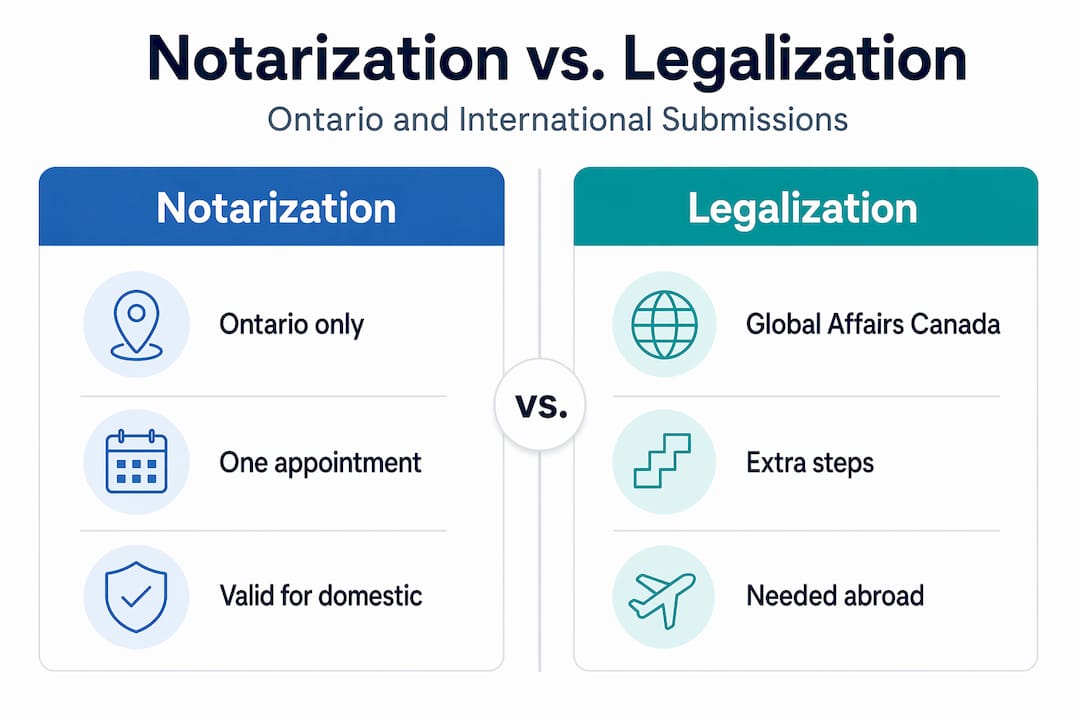
| Process | Who performs it | When needed |
|---|---|---|
| Notarization | Ontario notary public | Domestic government filings, affidavits |
| Authentication | Global Affairs Canada | Documents leaving Canada |
| Legalization | Foreign embassy or consulate | Required by specific countries |
Pro Tip: If your documents are heading overseas, work backward from the foreign agency’s deadline. Authentication and legalization through Global Affairs Canada can take several business days to several weeks depending on the method you choose. Start early.
Additionally, many banks offer free notary services for account holders, which is worth exploring for simple notarizations. For complex government forms, a dedicated notary public with experience in government document requirements is a more reliable choice.
Keep certified copies of everything you submit. Government agencies lose documents. Having your notarized copy means you can produce a replacement quickly without repeating the entire process from scratch.
My take on navigating the Ontario notarization process
I’ve watched otherwise well-prepared people get tripped up on details that seem minor until they cause a full rejection. In my experience working with Ontario government forms, the single most underestimated step is communication with the receiving agency. Most people assume standard notarization is standard everywhere. It is not.
I’ve seen rejections happen because a provincial agency required a notary public but the applicant used a commissioner for taking affidavits. I’ve seen forms rejected because the certificate said “subscribed and sworn” when the agency required “affirmed.” These are not big legal failures. They are clerical mismatches. The fix takes ten minutes if you catch it in advance and ten days if you catch it after submission.
My honest advice: treat your first call to the receiving agency as part of the notarization process itself. Ask what notarial act they require, what certificate wording they expect, and whether they have ever rejected a notarized form and why. That conversation tells you more than any checklist. The full notarization guide for Ontario is a good starting point, but direct communication with the agency you are submitting to is where real confidence comes from.
— Ken
How Theonlinenotary simplifies your government forms
If you need notarizing government forms done correctly without the scheduling headaches, Theonlinenotary offers licensed Ontario notary services available online, seven days a week. Whether you are dealing with affidavits, invitation letters, solemn declarations, or statutory declarations, the platform connects you with qualified notaries who understand Ontario’s specific requirements.

You book an appointment online, connect via secure video, present your ID, and have your notarial certificate completed and delivered digitally. No office visits, no waiting rooms. The service is particularly useful for businesses handling multiple government forms or individuals who need notary services for government forms outside standard business hours. If you are evaluating your options, reviewing the best online notary solutions available in Ontario gives you a clear picture of what to expect from different providers before you book.
FAQ
What government forms typically require notarization in Ontario?
Affidavits, statutory declarations, powers of attorney, consent letters for minors, and solemn declarations are among the most common forms requiring notarization in Ontario. Businesses also frequently notarize corporate resolutions and regulatory filings.
Can I sign a government form before seeing a notary?
Not if the form requires a jurat or affidavit. For those notarial acts, you must sign in the notary’s presence. Pre-signing invalidates the notarization and will likely result in the form being rejected.
What is the difference between a notary public and a commissioner for taking affidavits?
A notary public in Ontario holds broader legal authority, including the ability to certify copies and prepare legal documents, while a commissioner for taking affidavits is limited to witnessing oaths and declarations. Some government agencies require a notary public specifically, so confirm which designation the receiving agency accepts.
Do I need more than notarization if my document is going abroad?
Yes. Documents submitted to foreign governments typically require authentication through Global Affairs Canada and legalization at the relevant embassy after notarization. Standard Ontario notarization alone is not sufficient for international use.
How do I know if my notarization was done correctly?
Review the notarial certificate before leaving your appointment. Confirm it includes your name spelled correctly, the correct date, the notary’s jurisdiction, and the specific language describing the notarial act performed. If the receiving agency later rejects the document, request their rejection reason in writing to identify the exact issue.