
Walking into a notary public office only to discover your identification is not accepted is frustrating and wastes valuable time. Many Ontario residents assume any government ID will suffice, but notaries have specific legal requirements for the documents they can accept. Understanding these identification rules before your appointment saves hassle and ensures your documents get notarized properly the first time. This comprehensive guide explains exactly what identification Ontario notaries public require in 2026, how they verify your identity, and what to do if you lack standard ID documents.
Table of Contents
- Understanding Who Notaries Public Are And Their Role In Ontario
- Official Identification Documents Accepted By Ontario Notaries Public
- How Notaries Verify Your Identity: The Identification Process Explained
- Common Questions And Exceptions About Identification For Notary Services
- Find Ontario Notary Services With Trusted Online Verification
Key takeaways
| Point | Details |
|---|---|
| Required identification | Ontario notaries require current government-issued photo ID such as passports, driver’s licenses, or provincial identity cards |
| Legal authority | Notaries public have broader powers than Commissioners of Oaths and their seal is recognized internationally |
| Verification process | Notaries inspect physical ID documents, check for tampering, and confirm photo match and personal details |
| Unacceptable documents | Health cards, credit cards, and expired IDs typically cannot be used alone for notarization |
| Online options | Secure online notarization allows digital ID upload with the same legal validity as in-person services |
Understanding who notaries public are and their role in Ontario
Before diving into identification requirements, you need to understand what makes notaries public distinct from other legal professionals in Ontario. Notaries are appointed by the Attorney General and hold significant authority to certify documents, verify signatures, and administer oaths that are recognized internationally. This appointment process ensures notaries meet strict professional standards and understand their legal obligations.
The key difference between notaries public and Commissioners of Oaths lies in their scope of authority. While Commissioners can witness signatures and administer oaths within Ontario, notaries public can certify true copies of documents and their notarizations carry weight in foreign jurisdictions. This broader authority makes notaries essential for international business transactions, immigration applications, and legal documents used outside Canada.
Notarization serves multiple critical functions in our legal system. When a notary certifies your document, they create a permanent record that you appeared before them, presented proper identification, and signed willingly without coercion. This process protects against fraud and gives your documents legal credibility. The notary’s seal and signature act as a guarantee to third parties that proper procedures were followed.
Identification verification forms the foundation of this entire process. Without confirming your identity conclusively, a notary cannot legally notarize your documents. The identification requirements exist to prevent imposters from signing documents fraudulently and to ensure the person whose name appears on the document is actually the person signing it. These safeguards protect both you and the parties who will rely on your notarized documents.
Key responsibilities of Ontario notaries public include:
- Certifying true copies of original documents for legal and official purposes
- Administering oaths, affirmations, and affidavits with legal binding force
- Witnessing signatures on important legal documents and contracts
- Verifying identity through rigorous examination of government-issued identification
- Maintaining detailed records of all notarizations performed for accountability
Understanding notary public duties in Ontario helps you appreciate why identification standards must be so stringent and non-negotiable.
Official identification documents accepted by Ontario notaries public
Ontario notaries operate under clear legal guidelines about which identification documents they can accept. The government-issued photo ID requirement ensures consistency across all notarization services and provides a reliable standard for identity verification. Not all official documents qualify, even if they seem legitimate.
Acceptable primary identification includes Canadian passports, which remain the gold standard for notarization purposes. Passports contain security features, recent photographs, and standardized information that notaries can easily verify. Ontario driver’s licenses also qualify as primary identification, provided they include your photograph and have not expired. The provincial photo identification card issued by ServiceOntario serves as another valid option for residents who do not drive.

Federal and provincial government-issued photo cards with embedded security features meet notary standards as well. These documents must display your full legal name exactly as it appears on the document being notarized, include a clear recent photograph, show your signature, and list an expiration date that has not passed. The combination of these elements allows notaries to confirm your identity with confidence.
Several common documents fail to meet notary identification standards despite being official. Ontario health cards cannot be used for identification purposes under provincial privacy legislation, even though they are government-issued. Credit cards, employee ID badges, and student cards lack the security features and legal standing required for notarization. Library cards, gym memberships, and similar documents provide no legal proof of identity.
Expired identification presents a gray area that most notaries resolve by refusing it entirely. Even if your expired passport clearly shows your photograph and details, the expiration indicates the issuing authority no longer vouches for the document’s validity. Some notaries might accept recently expired ID in exceptional circumstances, but this remains entirely at their discretion and creates potential liability issues.
Understanding identification documents for notaries in Ontario helps you prepare properly for your appointment and avoid delays. The notary identification requirements in Ontario for 2025 remain consistent into 2026, providing stability and predictability.
Pro Tip: Always bring at least two forms of government-issued photo identification to your notary appointment as backup. If your primary ID has any issues like damage or an unclear photo, having a second option prevents rescheduling and ensures your documents get notarized without delay.
Acceptable identification documents for Ontario notaries:
- Canadian passport (must be current and not expired)
- Ontario driver’s license with photo (full license or G1/G2 with photo)
- Provincial photo identification card issued by ServiceOntario
- Federal government-issued photo identification cards
- Permanent resident card or citizenship card with photo
How notaries verify your identity: the identification process explained
The identification verification process follows a systematic approach designed to catch fraudulent documents and confirm you are who you claim to be. Notaries verify client identity through physical inspection and careful comparison of document details against your appearance and the information on documents requiring notarization. This multi-step process takes only minutes but provides crucial legal protection.
Step one involves the notary requesting your identification and conducting a visual inspection of the physical document. They examine security features like holograms, watermarks, and embedded chips that indicate authenticity. The notary checks for signs of tampering such as altered photographs, scratched-out information, or mismatched fonts that suggest forgery. Any suspicion at this stage may prompt additional questions or refusal to proceed.
Next, the notary compares the photograph on your identification to your actual appearance. They look for distinguishing features, approximate age match, and overall resemblance. Significant changes in appearance since the photo was taken might require explanation, though reasonable aging and hairstyle changes are expected. The notary also verifies that the name on your ID matches exactly with the name on the document being notarized.
The third step involves confirming specific details like your date of birth, address if listed, and the document’s expiration date. The notary may ask you to verbally confirm your birth date or address to ensure you actually possess the identification legitimately rather than having borrowed or stolen it. They record key information from your ID in their notarial register for future reference and legal compliance.
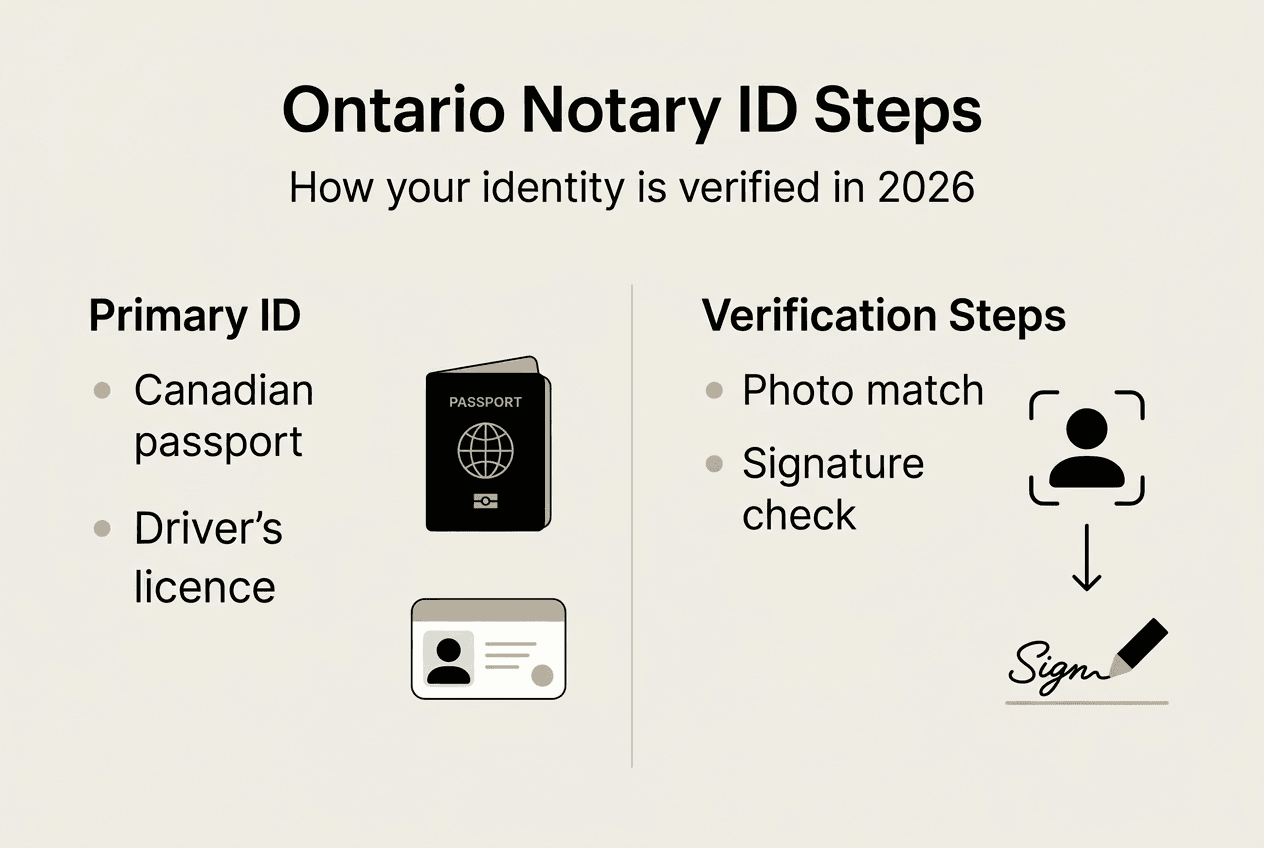
Finally, the notary compares the signature on your identification with the signature you provide on the document being notarized. Significant discrepancies raise red flags about identity or document authenticity. Once satisfied with all verification steps, the notary proceeds with the notarization and applies their official seal.
| Verification Method | In-Person Notarization | Online Notarization |
|---|---|---|
| ID presentation | Physical document handed to notary | Digital upload of ID scan or photo |
| Photo comparison | Face-to-face visual comparison | Video call with live comparison |
| Document inspection | Hands-on examination of security features | Digital analysis of uploaded image quality |
| Signature verification | Compare physical signatures in real-time | Compare digital signatures on screen |
| Record keeping | Manual entry in notarial journal | Automated digital record with timestamps |
Understanding how to verify a notary in Ontario from the client perspective helps you prepare for a smooth experience and know what to expect during your appointment.
Pro Tip: Before your notary appointment, ensure your identification is clean, undamaged, and easy to read. Have your ID ready to present immediately when requested, and be prepared to answer basic identity verification questions clearly and confidently to demonstrate you are the legitimate holder of the identification presented.
Common questions and exceptions about identification for notary services
Real-world situations often present complications that do not fit neatly into standard identification requirements. Understanding how notaries handle exceptions and edge cases helps you navigate unusual circumstances and find solutions when standard ID is unavailable. These scenarios arise more frequently than you might expect.
If you lack standard government-issued photo identification, your options become limited but not impossible. Some notaries may accept a combination of secondary documents along with an affidavit from someone who can vouch for your identity. This guarantor must present their own valid identification and swear to your identity under oath. However, many notaries refuse this approach due to increased liability and fraud risk.
Expired identification creates complications because the issuing authority no longer stands behind the document’s validity. While your appearance and details may not have changed, notaries may refuse notarization without proper ID if they have any concerns about document authenticity or your identity. Renewing your identification before requiring notary services eliminates this problem entirely.
Out-of-province and international identification requires individual notary discretion. A valid British Columbia driver’s license or Alberta photo ID should be acceptable since they meet the same standards as Ontario documents. International passports from recognized countries typically work well. However, identification from countries with known forgery problems or unusual document formats may face additional scrutiny.
Name discrepancies between your identification and the document being notarized cause significant issues. If you recently married and changed your name but have not updated your ID, the notary cannot confirm you are the person named in the document. Bringing your marriage certificate alongside your old ID might help, but some notaries still refuse until you obtain updated identification reflecting your current legal name.
Notaries possess the legal right and professional obligation to refuse notarization if anything seems suspicious or irregular. This includes situations where your identification appears altered, you cannot answer basic identity questions, your appearance does not match your photo, or documents seem fraudulent. While frustrating, these refusals protect everyone from fraud and legal complications.
Alternative approaches when lacking standard identification:
- Obtain a guarantor who holds valid ID to swear an affidavit vouching for your identity
- Apply for a provincial photo identification card from ServiceOntario as a non-driver option
- Use statutory declarations in combination with supporting documentation
- Renew expired identification documents before requiring notarization services
- Consult with the specific notary in advance about acceptable alternatives
Understanding public notary requirements in Ontario helps you anticipate potential obstacles and prepare appropriate documentation before your appointment.
Find Ontario notary services with trusted online verification
Navigating identification requirements and scheduling in-person appointments creates unnecessary friction when you need documents notarized quickly. The Online Notary eliminates these hassles by providing expert online notarization services specifically designed for Ontario residents and businesses. Our platform combines convenience with rigorous identity verification that meets all legal standards.

Our secure online system allows you to upload your government-issued photo identification from anywhere at any time. Licensed Ontario notaries public review your ID through the same thorough verification process used in traditional offices, but without requiring you to travel or take time off work. Video conferencing technology enables face-to-face interaction and real-time signature witnessing that satisfies all legal requirements.
We offer comprehensive notarization services including affidavits, statutory declarations, solemn declarations, invitation letters, and certified true copies of documents. Whether you need a single document notarized or regular ongoing notary services for your business, our 24/7 availability ensures you get expert assistance exactly when you need it. Visit our notary services page to explore the full range of documents we can notarize online.
Ontario businesses benefit particularly from our streamlined approach to notarization. Review our comprehensive list of notary services for Ontario businesses to discover how online notarization can improve your operational efficiency while maintaining complete legal compliance and security.
FAQ
What forms of identification are required by Ontario notaries?
Ontario notaries require current government-issued photo identification such as a Canadian passport, Ontario driver’s license, or provincial photo identity card. The identification must include your photograph, signature, full legal name, and a valid expiration date that has not passed. Multiple forms of identification may be requested if the notary has any concerns about authenticity or if your appearance has changed significantly since your photo was taken.
Can I use expired or out-of-province ID for notarization in Ontario?
Expired identification is typically not accepted for notarization because the expiration indicates the issuing authority no longer vouches for its validity. Out-of-province photo identification from other Canadian provinces may be accepted if it is current, government-issued, and includes a photo and signature, though individual notaries maintain discretion. International passports from recognized countries generally work well, but you should confirm acceptance with your specific notary beforehand.
What if I don’t have proper ID to present to a notary?
Notaries are legally obligated to refuse notarization without proper identification due to fraud prevention requirements and professional liability concerns. Alternative routes might include having a guarantor with valid ID swear an affidavit vouching for your identity, though many notaries decline this approach. Your best solution involves obtaining proper government-issued photo identification from ServiceOntario before requiring notary services, as this eliminates complications and ensures smooth processing.
Is online notarization accepted in Ontario and how is ID verified?
Online notarization is fully recognized in Ontario with the same legal validity as traditional in-person services when proper procedures are followed. Clients securely upload government-issued photo ID which licensed notaries review for authenticity and accuracy during video conference sessions. This method combines convenience with rigorous identity verification, allowing you to complete notarization from home or office without compromising legal standards or security.