
Notarizing loan documents in Ontario seems straightforward, just another box to check when finalizing a financial agreement. But did you know that errors like incomplete ID verification or a missing seal can instantly void the whole loan document, risking serious legal trouble? Most people focus on getting a signature, yet the real protection for both lenders and borrowers comes from following a strict notarization process that keeps your agreement legally bulletproof.
Table of Contents
- Understanding Notarizing Loan Documents In Ontario
- Steps For Notarizing Loan Documents
- Legal Requirements And Common Mistakes
- Choosing The Right Notary For Your Needs
Quick Summary
| Takeaway | Explanation |
|---|---|
| Notarization adds legal credibility | Notarized documents enjoy higher acceptance and validity, protecting lenders and borrowers alike in financial agreements. |
| Meeting notarization requirements is essential | Individuals must provide original documents, valid ID, and physically sign in front of a notary public to ensure validity. |
| Avoid common notarization mistakes | Errors such as incomplete ID verification or incorrect seals can invalidate documents, risking legal complications. |
| Choose a qualified notary public | Selecting a notary with specific expertise in loan documents is crucial for compliance and effective processing of your agreements. |
| Be prepared for verification process | Notaries will verify identities and understanding of documents, making preparation key to a smooth notarization experience. |
Understanding Notarizing Loan Documents in Ontario
Notarizing loan documents in Ontario involves a specific legal process that ensures the authenticity and validity of financial agreements. The process goes beyond simply signing papers, requiring careful verification and professional oversight. Learn more about the notarization process to understand its critical role in legal and financial transactions.
The Legal Significance of Notarized Loan Documents
In Ontario, notarized loan documents carry substantial legal weight. When a notary public witnesses and validates a document, they provide an official stamp of credibility that can protect both lenders and borrowers. According to the Ministry of the Attorney General, a notary public confirms the identity of the signatories and ensures they are signing the document willingly and with full understanding.
This verification process serves multiple crucial purposes. First, it helps prevent fraud by requiring signatories to present valid government issued identification. Second, it creates a legal record that can be used as evidence in potential disputes. Third, many financial institutions and legal entities in Ontario require notarization as a standard practice for loan agreements, making it an essential step in formal financial transactions.
Key Requirements for Notarizing Loan Documents
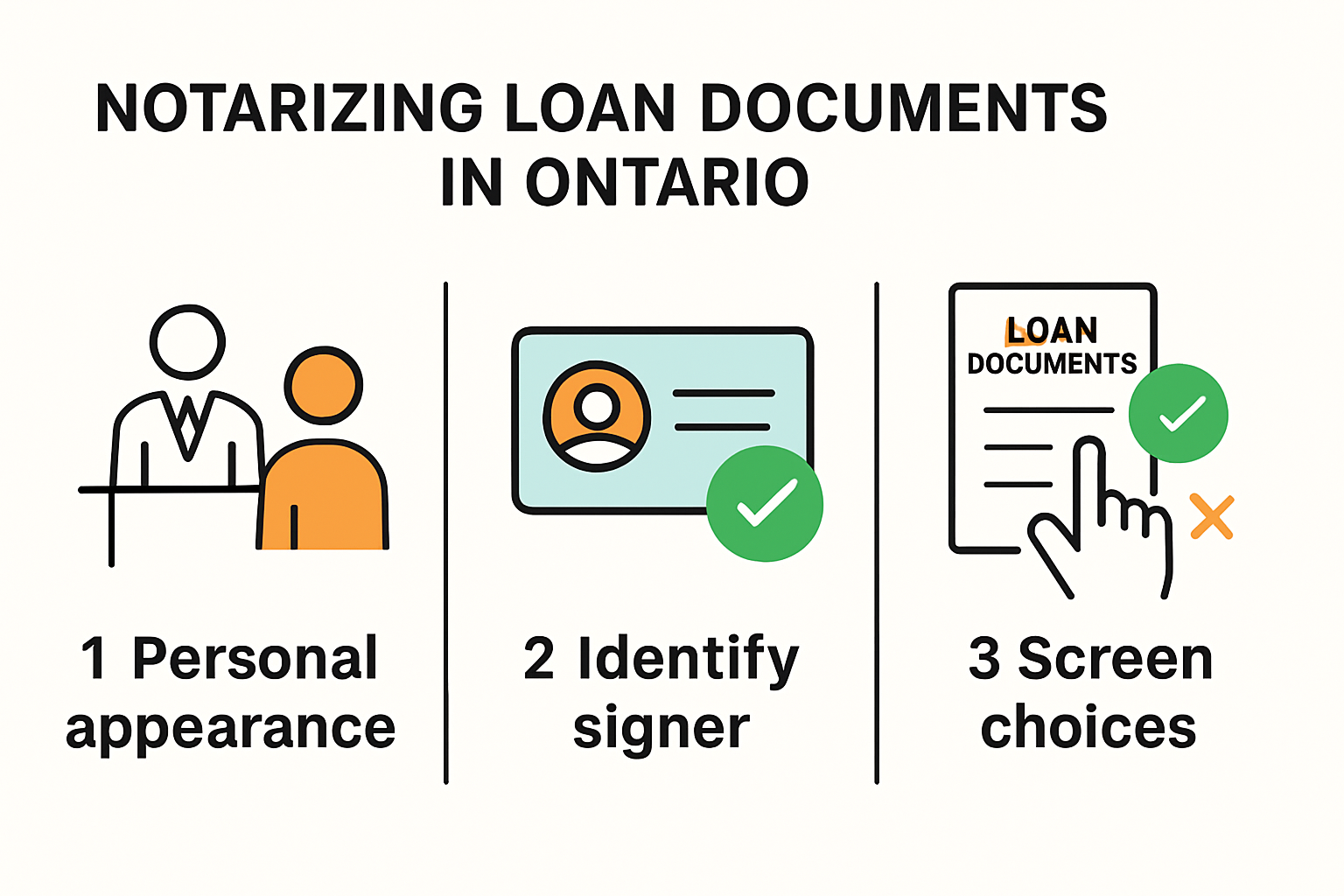
Notarizing loan documents in Ontario requires careful attention to specific details. Individuals must bring original documents, valid government issued photo identification, and be prepared to sign in the presence of a certified notary public. The process typically involves several critical steps:
- Personal Appearance: All parties must physically appear before the notary
- Identification Verification: Government issued photo ID is mandatory
- Document Comprehension: Signatories must demonstrate understanding of the document
- Voluntary Signing: Participants must sign without coercion
Financial institutions and legal professionals rely on these stringent requirements to maintain the integrity of loan documentation. Notarization acts as a crucial safeguard, protecting the interests of all parties involved in the transaction and providing a reliable method of document authentication.
By understanding the notarization process, individuals can navigate loan agreements with greater confidence and legal protection. The careful verification and official witnessing of documents ensure that financial agreements are executed professionally and transparently.
Steps for Notarizing Loan Documents
Notarizing loan documents requires a systematic approach to ensure legal validity and authenticity. The process involves multiple precise steps that protect all parties involved in the transaction. Learn about the complete notarization process to navigate this critical legal requirement effectively.
Preparing Necessary Documentation
Before attending a notarization session, borrowers must gather specific documents and information. According to the Ontario Notaries Act, proper preparation is crucial for a successful notarization. The required documentation typically includes:
- Original Loan Agreement: Unaltered, complete original document
- Government Issued Photo ID: Valid driver’s license, passport, or provincial identification
- Proof of Address: Recent utility bill or official correspondence
- Additional Identification: Secondary forms of identification if required
Each document must be authentic, current, and reflect the exact details of the signatories. Incomplete or inconsistent documentation can delay or invalidate the notarization process.
Verification and Authentication Process
During the notarization, a certified notary public conducts a rigorous verification process. As specified by Official Documents Services, this involves comparing signatures, confirming identities, and ensuring voluntary participation. The authentication process includes:
- Confirming the identity of all signatories through government issued photo identification
- Verifying that all parties understand the document’s contents
- Witnessing the signing of the loan documents
- Applying an official seal or stamp to validate the document
Remote commissioning may require additional steps, such as completing a modified jurat indicating the oath was administered in accordance with specific regulations. The notary ensures that each step adheres to legal standards, protecting the integrity of the loan document.
Successful notarization transforms a standard loan document into a legally recognized instrument. By following these meticulous steps, borrowers and lenders can create a secure, verifiable record of their financial agreement, minimizing potential future disputes and providing clear legal protection for all parties involved.
Legal Requirements and Common Mistakes
Notarizing loan documents in Ontario involves navigating complex legal requirements and avoiding potential pitfalls that could compromise the document’s validity. Understanding these nuances is crucial for ensuring a smooth and legally compliant notarization process. Explore the detailed guidelines for document notarization to protect your financial interests.
Critical Legal Requirements for Loan Document Notarization
Legal requirements for notarizing loan documents in Ontario are stringent and multifaceted. According to the National Notary Association, several key legal standards must be meticulously followed:
- Personal Appearance: All signatories must physically appear before the notary
- Voluntary Consent: Participants must sign without coercion or undue pressure
- Mental Competence: Signers must demonstrate full understanding of the document
- Accurate Identification: Government issued photo ID is mandatory
The legal framework surrounding loan document notarization is designed to prevent fraud and protect all parties involved. Each requirement serves a specific purpose in maintaining the document’s integrity and legal standing.
To help you understand the essentials, this table summarizes the key legal requirements for notarizing loan documents in Ontario and explains why each is important.
| Legal Requirement | Description | Purpose |
|---|---|---|
| Personal Appearance | All signatories must appear before the notary | Prevents fraud and ensures document authenticity |
| Voluntary Consent | Signers must act without coercion | Ensures agreements are made willingly |
| Mental Competence | Signers must understand the document | Guarantees validity and protects all parties |
| Accurate Identification | Valid government-issued photo ID required | Confirms signers’ identities and prevents forgery |
Common Mistakes in Loan Document Notarization
Professional notaries and signers must be acutely aware of potential errors that can invalidate loan documents. According to the Notary Signing Agent Certification Study Guide, the most frequent mistakes include:
- Incomplete or illegible identification verification
- Incorrect completion of notarial certificates
- Failing to confirm the signer’s understanding of the document
- Improper application of the notary seal or stamp
- Missing critical documents or signatures
These mistakes can result in significant legal complications, potentially rendering the entire loan document invalid.
Here’s a table outlining common mistakes made during loan document notarization in Ontario and the potential consequences of each. This can help you avoid costly errors and ensure your documents remain legally valid.
| Common Mistake | Possible Consequence |
|---|---|
| Incomplete/illegible ID verification | Document may be invalidated |
| Incorrect notarial certificate completion | Legal complications, document rejected |
| Failure to confirm signer’s understanding | Questioned validity, potential disputes |
| Improper application of notary seal | Document unenforceable |
| Missing documents or signatures | Notarization failure, process delays |
Financial institutions and legal professionals rely on precise notarization to ensure the enforceability of loan agreements.
Navigating the legal landscape of loan document notarization requires exceptional attention to detail and a comprehensive understanding of provincial regulations. By recognizing potential pitfalls and adhering to strict legal requirements, individuals can ensure their loan documents are properly authenticated and legally binding. Professional guidance and thorough preparation remain the most effective strategies for avoiding costly errors in the notarization process.
Choosing the Right Notary for Your Needs
Selecting the appropriate notary for loan document authentication is a critical decision that can significantly impact the legal validity of your financial agreements. The right notary ensures smooth, professional document processing and provides crucial legal protection. Learn about verifying notary credentials to make an informed choice.
Qualifications and Professional Standards
Choosing a qualified notary requires careful consideration of several key factors. According to the National Notary Association, professional notaries must meet rigorous standards. Essential qualifications include:
- Active Notary Commission: Current and valid provincial authorization
- Professional Certification: Specialized training in document authentication
- Experience with Loan Documents: Specific expertise in financial document notarization
- Professional Liability Insurance: Protection against potential errors
Beyond basic qualifications, the ideal notary demonstrates comprehensive understanding of legal requirements and meticulous attention to detail. Comparing notary professionals can help you understand the nuanced differences in professional capabilities.
Evaluating Notary Specialization and Reliability
Notary signing agents play a unique role in loan document processing. As explored in the Signing Agent overview, these professionals require specialized training beyond standard notary credentials. When selecting a notary for loan documents, consider these critical evaluation criteria:
- Specific experience with loan and financial document notarization
- Understanding of provincial legal requirements
- Technology and remote notarization capabilities
- Professional reputation and client testimonials
- Availability and scheduling flexibility
The complexity of loan documents demands a notary with precise technical knowledge and professional integrity. A specialized notary signing agent understands the intricate requirements of financial document authentication, ensuring your loan documents are processed accurately and legally.
Ultimately, choosing the right notary is an investment in your financial and legal security. By carefully assessing professional credentials, specialization, and reputation, you can select a notary who will provide expert guidance through the loan document notarization process. Thorough research and a systematic approach to selection will help you find a notary who meets your specific needs and provides the highest standard of professional service.

Frequently Asked Questions
What is the process for notarizing loan documents in Ontario?
Notarizing loan documents in Ontario involves gathering necessary documentation, appearing before a certified notary public for identity verification, and signing the documents in their presence. The notary will then apply an official seal or stamp to authenticate the documents.
What documents do I need to bring for loan document notarization?
You need to bring the original loan agreement, a valid government-issued photo ID, proof of address, and any additional identification if required. Ensuring that all documentation is complete and authentic is essential for the notarization process.
Why is notarization important for loan documents?
Notarization adds legal credibility to loan documents, protects against fraud, verifies the identities of signers, and ensures that all parties understand and willingly agree to the terms of the document. Many financial institutions require notarized documents for the loan process to be valid.
What are common mistakes to avoid during the notarization of loan documents?
Common mistakes include incomplete or illegible ID verification, improper application of a notary seal, and failing to confirm a signer’s understanding of the document. Avoiding these errors is crucial to ensure the legal validity of loan documents.
Take the Stress Out of Notarizing Your Loan Documents in Ontario
Worried that a small error could invalidate your loan agreement? The article explains how missing a seal or incomplete ID verification can make your loan documents useless and leave you exposed to legal issues. You want security and certainty when handling financial agreements. Our online notary service is built for Ontario residents just like you who need accuracy and validation at every step. With experts who know the strict requirements for notarizing loan documents, we can help you avoid costly mistakes and delays. For more on how the notarization process works, visit our detailed guide.

Why risk your financial security? Act now and get your loan documents notarized correctly with The Online Notary. All you need is a computer or smartphone to get started. Secure your financial future today by booking your session with a certified notary who understands the exact needs you read about here.
Recommended
- How to Notarize Documents in Ontario: Easy 2025 Guide – The Online Notary CA
- Can Anyone Notarize a Document in Ontario? 2025 Guide – The Online Notary CA
- How to Get Documents Notarized Online in Ontario 2025 – The Online Notary CA
- When Is a Notary Required in Ontario? Essential 2025 Guide – The Online Notary CA