
TL;DR:
- Digital notaries in Ontario are fully legal and offer the same validity as in-person notarizations.
- The process involves real-time video, ID verification, electronic signatures, and secure record retention.
- It provides faster, more convenient, and cost-effective notarizations suitable for various legal documents.
Many people in Ontario assume that online notarization is either legally questionable or simply not secure enough for important legal documents. That assumption is outdated. Remote commissioning of legal documents is fully permitted in Ontario under provincial regulation, giving digital notary services the same legal standing as traditional in-person processes. Whether you need an affidavit notarized at midnight or a statutory declaration signed while traveling abroad, digital notary is a real and compliant option. This guide breaks down exactly how it works, why it’s trustworthy, and when it makes the most sense for your situation.
Table of Contents
- What is digital notary and how does it work in Ontario?
- Key benefits of using a digital notary for Ontario legal documents
- Legal requirements and compliance for online notarization in Ontario
- When to choose a digital notary: Top use cases in Ontario
- The reality of digital notary: What the hype misses
- Get started with Ontario’s trusted digital notary services
- Frequently asked questions
Key Takeaways
| Point | Details |
|---|---|
| Fully legal in Ontario | Digital notary services are legally recognized and regulated across Ontario for most document types. |
| Stronger fraud prevention | Real-time video sessions and ID checks provide robust protection against fraud. |
| Convenience and speed | Digital notarization saves travel time, enables remote access, and lets you notarize anytime. |
| Strict compliance required | Missing a required step can result in legal issues or document rejection. |
What is digital notary and how does it work in Ontario?
A digital notary, sometimes called a remote or online notary, is a licensed commissioner of oaths or notary public who witnesses and certifies your legal documents through a secure, real-time video session rather than a face-to-face meeting. The result carries the same legal weight as a traditional notarization. Understanding what is digital notary helps you move past the uncertainty and see it for what it actually is: a regulated, documented process with specific legal safeguards built in.
Ontario’s framework under O. Reg. 431/20 sets clear rules. Remote notarization requires real-time video communication, government-issued ID verification, and the retention of electronic records. These are not optional steps. They are the legal backbone of every valid digital notarization.
Here is how the process works from start to finish:
- Schedule your session: Book an appointment online with a licensed Ontario notary who offers remote services.
- Prepare your documents: Upload the document requiring notarization before your session begins.
- Join the video call: Connect via a secure platform where the notary can see you and your ID clearly in real time.
- Verify your identity: Present a valid government-issued photo ID, such as a passport or driver’s license, directly to the camera.
- Take the oath or affirmation: The notary administers the oath verbally during the video session, just as they would in person.
- Sign and certify: Both you and the notary apply electronic signatures, and the session record is stored securely.
The entire process typically takes 15 to 30 minutes, depending on document complexity. Robust digital notary security protocols, including encrypted video and electronic audit trails, make this process at least as secure as visiting a notary in person, and arguably more traceable.
Pro Tip: Prepare your government-issued ID and ensure your device has a working webcam and stable internet connection before your session. A blurry camera or expired ID can delay or cancel the process entirely.
Key benefits of using a digital notary for Ontario legal documents
With the basics of how digital notary works covered, let’s look at the clear advantages it offers over traditional in-person notarization. The digital notarization benefits go well beyond simple convenience.
Here are the top advantages at a glance:
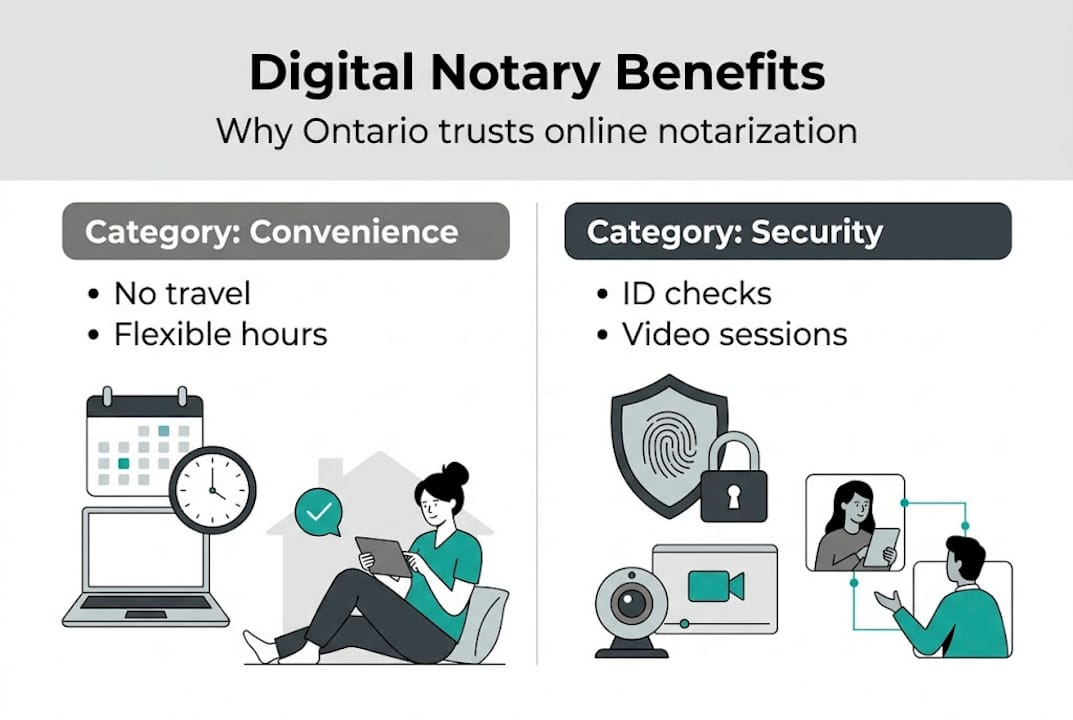
- Speed: Most sessions are completed in under 30 minutes, with no commuting time.
- Anytime access: Many digital notary providers offer evening and weekend availability.
- Cost savings: You eliminate travel costs and often pay lower service fees than in-person offices charge.
- Multi-location flexibility: Both the client and notary can be anywhere in Ontario, or even different locations, during the session.
- Reduced paperwork: Documents are signed and stored electronically, cutting down on printing and physical filing.
| Feature | Traditional notary | Digital notary |
|---|---|---|
| Travel required | Yes | No |
| Office hours | Business hours only | Often 24/7 |
| Identity verification | In-person ID check | Video and government ID |
| Document storage | Physical records | Encrypted electronic records |
| Fraud protection | Manual checks | Regulated video and ID verification |
| Turnaround time | Same day if available | Same day, often faster |
Fraud prevention is a major differentiator. Regulation prioritizes fraud prevention through mandatory video sessions and government ID checks, creating a documented audit trail that physical notarizations often lack. Every session is recorded and stored, meaning there is a verifiable record if any dispute arises later.

For businesses handling contracts with remote employees or international partners, online notarization legality is particularly valuable. You no longer need everyone in the same room, or even the same city, to complete binding legal documents.
Pro Tip: Use digital notary for urgent documents, such as last-minute affidavits or statutory declarations, when you simply cannot wait for a next-day in-person appointment.
Legal requirements and compliance for online notarization in Ontario
Understanding the benefits is great, but it’s essential to use digital notary correctly. Here are the compliance details you must not overlook. Skipping even one required step can result in your document being rejected outright.
Ontario’s regulation specifies a clear sequence of steps for valid remote notarization:
- Identity verification: The notary must confirm your identity by viewing a government-issued photo ID over live video. A driver’s license or passport is standard.
- Real-time video session: The entire notarization must occur in one continuous, real-time video call. Pre-recorded video is not acceptable.
- Administration of oath or affirmation: The notary verbally administers the oath during the session, adapting the traditional process for the remote format.
- Modified jurat: ID is verified via government ID over video, and the jurat (the written statement confirming the oath) is adapted to reflect the remote process.
- Electronic record retention: The notary must retain a secure electronic record of the session and the signed document.
- Electronic signatures applied: Both parties sign electronically, completing the legal instrument.
Important: Non-compliance risks regulatory action and outright document rejection. If any required step is skipped or improperly documented, courts and government agencies may refuse to accept the notarized document.
Common mistakes include using outdated document forms, poor video quality that prevents clear ID verification, and failing to retain the session recording. Following the electronic notarization legal guide helps you avoid these pitfalls before they cost you time and money. Reviewing digital notary best practices is also a smart move before your first remote session.
Pro Tip: After your session, ask your notary to confirm the electronic record has been saved and that you have received a copy of your certified document in the correct format.
When to choose a digital notary: Top use cases in Ontario
Once you know how to meet compliance, you can confidently select the right notary solution for your documents. Here’s when digital is your best bet.
Ontario’s regulation confirms that remote commissioning is permitted for affidavits, statutory declarations, and a range of other common legal documents. The most popular document types handled through digital notary services include:
- Affidavits for court filings and legal proceedings
- Statutory declarations for insurance claims, name changes, and more
- Travel consent letters for minors traveling without both parents
- Solemn declarations for government applications
- Invitation letters for visa and immigration purposes
- Power of attorney documents where permitted under remote rules
| Scenario | Best choice | Reason |
|---|---|---|
| Urgent same-day filing | Digital notary | Faster scheduling, no travel |
| Remote signer in another city | Digital notary | Location-independent process |
| International document use | Digital notary | Electronic records are easy to transmit |
| Court-mandated original signature | In-person notary | Some courts require physical documents |
| Land transfer or title documents | In-person notary | Often require original wet signature |
Following online notarization instructions tailored to your specific document type ensures you use the right approach from the start. There are scenarios where an in-person notary is still required, particularly for land registry documents and certain court filings that mandate original wet ink signatures.
If you are unsure about the digital notary meaning as it applies to your specific document, a quick consultation with your notary provider before booking saves time and prevents costly errors.
The reality of digital notary: What the hype misses
Digital notary is a genuine improvement for most Ontarians, but it is not a click-and-forget solution. That is the part the promotional materials rarely mention.
In practice, users sometimes underestimate the technical requirements. A poor internet connection, a device without a functioning webcam, or an expired piece of ID can derail a session entirely. The notary cannot proceed without full compliance, and rightfully so. The regulation exists for a reason. Beyond the technical side, record keeping matters more than most people realize. Electronic records must be retained properly, and clients should keep their own copies of all certified documents. Mistakes in this area have real consequences.
Ontario’s approach to virtual notary safety is genuinely progressive. The province recognized the need for accessible legal services before most other Canadian jurisdictions. But progressive law does not guarantee smooth execution if users arrive unprepared. Education and preparation still matter as much as the technology itself. The best outcome comes when both the client and the notary treat every step of the process with the same seriousness they would bring to an in-person appointment.
Get started with Ontario’s trusted digital notary services
With the facts and perspective in mind, here’s how to take your next step with Ontario’s most reliable digital notary solutions.
The Online Notary makes it straightforward to access fully compliant digital notary services for the legal documents you actually need. Affidavits, statutory declarations, solemn declarations, invitation letters, and more are all supported through a secure, regulation-compliant process.

Our platform is available around the clock, so you are never stuck waiting for business hours to handle time-sensitive documents. Explore the full range of notary services in Ontario or read up on the types of notarization available to find the right fit for your situation. Booking takes minutes, and your documents are handled by licensed professionals who know Ontario’s remote notarization rules inside and out.
Frequently asked questions
Is digital notary legal for all documents in Ontario?
Digital notary is legal for most documents, including affidavits and statutory declarations, but some exceptions exist such as land transfer documents that may still require an in-person process.
What ID do I need for a digital notary session in Ontario?
You need a valid government-issued photo ID such as a driver’s license or passport. Identity verification via government ID is required under Ontario regulation and must be presented clearly over live video.
How does a digital notary prevent fraud?
Digital notary sessions use real-time video and government ID checks combined with encrypted electronic records to create a traceable audit trail that prevents identity fraud and meets provincial compliance standards.
What happens if digital notary steps are missed?
Non-compliance risks regulatory penalties and document rejection, so every legally required step including ID verification, live video, and electronic record retention must be completed in full.