
Many people assume electronic notarization in Ontario means clicking a button online and receiving instant, automated approval. That assumption is wrong. Ontario’s legal framework for electronic notarization is nuanced, requiring specific compliance steps, identity verification protocols, and often physical presence. This guide cuts through the confusion by explaining how Ontario Regulation 431/20 actually governs electronic notarization, what businesses and individuals must do to ensure legal validity, and how to avoid costly mistakes when notarizing affidavits, statutory declarations, and other critical documents in 2026.
Table of Contents
- Understanding Electronic Notarization In Ontario: Legal Framework And Definitions
- Common Misconceptions And Practical Realities Of Electronic Notarization In Ontario
- Legal Risks And Compliance Essentials When Using Electronic Notarization
- Practical Steps To Effectively Use Electronic Notarization For Business And Personal Documents
- Explore Trusted Online Notary Services In Ontario
- Frequently Asked Questions
Key takeaways
| Point | Details |
|---|---|
| Legal framework | Ontario Regulation 431/20 governs electronic notarization, ensuring legal validity. |
| Not fully online | Electronic notarization is not a fully automated or always remote process. |
| Physical presence | Physical presence is often still required in Ontario for notarizations. |
| Identity verification | Proper identity verification and security are critical to avoid legal risks. |
| Professional consultation | Consulting a licensed Ontario notary is essential for compliance. |
Understanding electronic notarization in Ontario: legal framework and definitions
Electronic notarization in Ontario refers to the use of digital signatures and electronic records in the commissioning of documents, governed primarily by Ontario Regulation 431/20. This regulation provides comprehensive guidelines for electronic commissioning of documents, explicitly outlining the conditions under which remote notarization is permitted. The law gives electronic signatures and records the same legal weight as traditional paper documents when proper protocols are followed.
However, the term electronic does not mean fully automated or always remote. Ontario’s digital notary legal framework maintains strict requirements for identity verification, security protocols, and often physical presence. The regulation ensures that electronic notarization serves as a legally equivalent alternative to traditional methods while preserving the integrity and authenticity of notarized documents.
Key terms under Ontario law include:
- Electronic signature: A digital mark or authentication method that identifies the signatory and indicates their intent to sign
- Electronic record: Information stored in digital format that can be retrieved and reviewed
- Commissioning: The act of a notary public or commissioner certifying a document’s authenticity
- Remote commissioning: Electronic notarization conducted when the signatory and notary are not physically in the same location, subject to strict conditions
- Identity verification: The process of confirming a person’s identity through approved methods before notarization
Understanding these definitions is crucial because Ontario law treats electronic and paper documents identically only when proper procedures are followed. The regulation specifies exactly how notaries must verify identity, maintain records, and ensure security when using electronic methods. This framework protects both the notary and the document holder from legal challenges while enabling legitimate digital workflows.
Common misconceptions and practical realities of electronic notarization in Ontario
The biggest misconception is that electronic notarization equals fully online, automated processing. In reality, Ontario’s system is hybrid, combining digital tools with traditional safeguards. Most electronic notarizations still require some form of physical presence or rigorous identity verification that goes far beyond simply uploading a photo ID.
Typical workflows in Ontario often involve:
- Initial consultation with a notary via phone or video to discuss document requirements
- Physical meeting for identity verification and document signing, even when final records are stored electronically
- Hybrid processes where documents are prepared digitally but signed in person
- Secure video conferencing with multi-factor authentication for limited remote scenarios
- Follow-up electronic delivery of certified copies after in-person verification
For example, small business owners in Brampton cannot simply email a document to a notary and receive a certified copy; in-person appointments are usually required. This practical reality surprises many who expect convenience similar to e-signatures on consumer contracts.
Common false assumptions include believing that any digital signature constitutes legal notarization, thinking all documents can be notarized remotely, and assuming electronic notarization is always faster or cheaper than traditional methods. The truth is that Ontario’s regulations prioritize security and legal validity over convenience, meaning the online notarization process involves multiple verification steps that can take as long as traditional methods.
Pro Tip: Before scheduling any notarization, confirm with your notary whether your specific document type qualifies for remote electronic processing or requires physical presence. This simple question saves time and prevents rejected documents.
What is legally valid? Documents notarized following Regulation 431/20 protocols, with proper identity verification, secure electronic signatures, and compliant record keeping. What is not valid? Documents with simple e-signatures lacking notary verification, remotely notarized documents without proper identity protocols, or electronic records that do not meet security standards.
Legal risks and compliance essentials when using electronic notarization
Failure to meet Ontario’s notarization requirements can render documents invalid and expose businesses to legal liabilities. Invalid notarizations can result in rejected court filings, unenforceable contracts, immigration application denials, and potential fraud charges if misrepresentation is involved.
Compliance essentials for businesses and individuals:
- Verify the notary’s credentials and ensure they are licensed in Ontario and authorized for electronic commissioning.
- Confirm your document type is eligible for electronic notarization under current regulations.
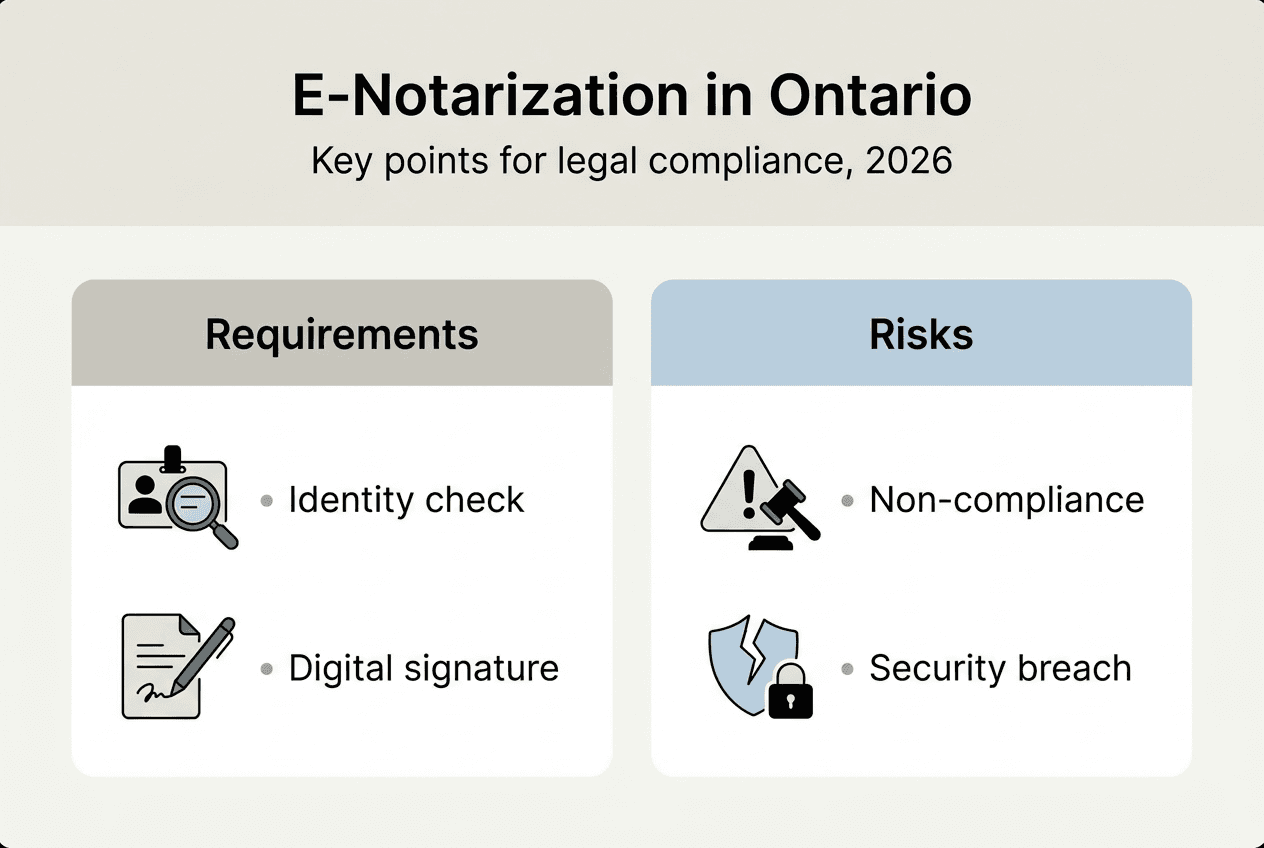
- Prepare valid government-issued photo identification for verification, understanding that copies or scans may not suffice.
- Follow the notary’s specific identity verification protocol, which may include video calls, biometric checks, or in-person meetings.
- Ensure all electronic signatures use approved technology that creates tamper-evident records.
- Maintain secure copies of all notarized documents with proper encryption and access controls.
- Document the entire notarization process, including dates, methods used, and verification steps completed.
- Understand Ontario’s physical presence requirements and confirm whether your situation qualifies for any remote exceptions.
Businesses must implement strong identity verification and security protocols to avoid legal challenges associated with remote processes. This means investing in secure document management systems, training staff on compliance requirements, and establishing clear policies for when electronic notarization is appropriate versus when traditional methods are necessary.

Pro Tip: Create a compliance checklist specific to your business’s most common document types and review it with your notary quarterly to stay current with any regulatory changes.
Ontario generally requires physical presence for most notarizations, with limited exceptions for specific circumstances outlined in Regulation 431/20. These exceptions involve heightened security measures and are not universally applicable. The regulation prioritizes preventing fraud and ensuring document integrity, which means digital notary security protocols are non-negotiable.
“The legal validity of your notarized document depends entirely on following prescribed protocols. Shortcuts or assumptions about what counts as proper electronic notarization can invalidate critical legal documents and create significant business risks.”
Non-compliance consequences extend beyond document rejection. Businesses may face regulatory penalties, loss of legal standing in disputes, damaged professional reputation, and increased scrutiny from authorities. For individuals, invalid notarizations can derail immigration applications, property transactions, or legal proceedings at critical moments.
Practical steps to effectively use electronic notarization for business and personal documents
Preparing documents for electronic notarization requires careful attention to detail and understanding of Ontario’s specific requirements:
- Identify your document type and verify it qualifies for electronic notarization by consulting Regulation 431/20 or asking a licensed notary directly.
- Gather all required supporting materials, including identification documents, supporting evidence, and any forms specified by the receiving institution.
- Review the document for completeness and accuracy before contacting a notary, as corrections after notarization can be complicated.
- Contact a licensed Ontario notary who offers electronic commissioning services and confirm their availability and fees.
- Schedule your appointment and clarify whether it will be in-person, hybrid, or remote based on your document’s requirements.
- Prepare your identification and be ready to verify your identity through the notary’s prescribed method, which may include video verification or biometric scans.
- Follow the notary’s instructions precisely during the signing and commissioning process, ensuring all electronic signatures are properly captured.
- Receive and securely store your notarized electronic document, maintaining backup copies in encrypted storage.
- Verify the notarized document meets the requirements of its intended recipient before submission.
Choosing the appropriate notarization approach depends on your document type and circumstances:
| Approach | Best for | Requirements | Typical timeline |
|---|---|---|---|
| In-person traditional | Affidavits, court documents, complex declarations | Physical presence, paper documents, wet signatures | Same day to 2 days |
| Hybrid electronic | Business contracts, standard declarations | Initial in-person meeting, electronic final delivery | 1 to 3 days |
| Fully digital | Limited document types meeting strict criteria | Multi-factor identity verification, approved platforms | 2 to 5 days |
Always confirm the specific authentication requirements for your document type directly with a licensed Ontario notary to ensure full legal compliance. Different institutions and jurisdictions may have varying acceptance criteria for electronically notarized documents, so verification upfront prevents rejection later.
When scheduling, verify notary credentials by checking their license status with the Ontario government and confirming their experience with your specific document type. Ask about their security protocols for electronic documents, including encryption methods, storage practices, and how they handle identity verification.
Security best practices for electronic documents include using encrypted email or secure file transfer services, enabling two-factor authentication on all accounts storing notarized documents, regularly backing up files to secure cloud storage with strong passwords, and limiting access to notarized documents on a need-to-know basis. Never store notarized documents in unsecured shared drives or send them via unencrypted channels.
For those getting documents notarized online in Ontario, understanding the technology requirements is essential. You may need a reliable internet connection, a device with a camera for video verification, approved electronic signature software, and secure document storage solutions. Confirm these technical requirements with your notary before your appointment to avoid delays.
Explore trusted online notary services in Ontario
Navigating Ontario’s electronic notarization requirements can feel overwhelming, especially when legal validity and compliance are at stake. The Online Notary provides expert electronic notarization services available 24/7, helping businesses and individuals across Ontario ensure their affidavits, statutory declarations, and other critical documents meet all regulatory requirements. Our licensed professionals understand the nuances of Regulation 431/20 and guide you through every step, from identity verification to secure document delivery.

Whether you need assistance with trusted online notary services or want to learn more through our comprehensive online notarization guide, we make compliance simple and accessible. Our team stays current with Ontario’s evolving digital notary guidelines, ensuring your documents are processed correctly the first time. Save time, reduce legal risks, and gain peace of mind by working with professionals who prioritize your document’s legal validity.
Frequently asked questions
What is electronic notarization, and how is it different from traditional notarization?
Electronic notarization uses digital signatures and electronic records but often involves physical presence or rigorous identity verification, unlike traditional notarization which is always conducted in person with paper documents. Ontario regulations ensure electronic notarizations carry similar legal weight when proper protocols under Regulation 431/20 are followed. The key difference is the format of the final document and signature method, not necessarily the level of personal interaction or verification required.
Can I complete the entire notarization process online without visiting a notary in Ontario?
Fully online notarization without any physical presence is generally not permitted in Ontario for most document types. The law mandates strong identity verification protocols to maintain document validity, which typically requires at least initial in-person contact or highly secure video verification that goes beyond simple video calls. Physical presence or hybrid verification remains the standard practice in 2026.
What documents can be notarized electronically in Ontario?
Documents like affidavits and statutory declarations can often be electronically notarized following Regulation 431/20 guidelines. However, types of affidavits vary in their electronic eligibility, and some institutions may require traditional paper notarization regardless of legal permissions. Always verify with a licensed notary about specific document requirements to ensure compliance with both Ontario law and the receiving institution’s policies.
How do I ensure my electronically notarized document is legally valid in Ontario?
Follow Ontario Regulation 431/20 guidelines precisely and ensure identity verification and security protocols are met during the notarization process. Consult licensed Ontario notaries who understand current digital notary legal compliance requirements for electronic notarization. Maintain secure records of the notarization process, including verification methods used and timestamps, to provide evidence of proper procedure if ever questioned. Verify that your notary uses approved electronic signature technology and follows prescribed record-keeping practices.