
TL;DR:
- Ontario’s strict notarization rules require all signers to appear together and sign in the notary’s presence for multi-party documents. Missing or improperly executing signatures can invalidate legal documents, especially for powers of attorney and real estate agreements, emphasizing the importance of thorough preparation and compliance. Remote notarization is generally not permitted under Ontario law for these documents, underscoring the necessity of in-person attendance to ensure legal validity.
You’re finalizing a multi-party property agreement, every signer is ready, and then you discover that the notarization requirements are nothing like what you assumed. One signer couldn’t make it to the appointment. A second signer already signed the document at home. Now the whole deal is in jeopardy. This situation happens more often than most people realize. The Notaries Act in Ontario sets out strict rules for witnessing and certifying document execution, and missing even one requirement can render your document legally void.
Table of Contents
- When do you need notarization of multiple signatures?
- What you need before notarizing multiple signatures
- Step-by-step process for notarizing documents with multiple signatures
- Common mistakes and how to avoid them
- Why Ontario’s multiple signer notarization rules are stricter than you think
- Need help notarizing your Ontario documents?
- Frequently asked questions
Key Takeaways
| Point | Details |
|---|---|
| All signers must be present | Every individual whose signature is being notarized must appear in person before the notary in Ontario. |
| Remote notarization is not allowed | Ontario law does not allow remote or online notarization of multiple signatures unless explicitly regulated. |
| Witnesses and notaries differ | Notarization and witnessing are distinct legal requirements and may be required together on certain documents. |
| Preparation avoids rejection | Gathering all signers, IDs, and correct documents in advance prevents costly delays and invalidation. |
| Follow step-by-step process | Adhering to Ontario’s notarization steps ensures your multi-signer documents are valid and recognized. |
When do you need notarization of multiple signatures?
Not every document with multiple signatures requires notarization, and that distinction matters enormously. A standard business contract between two parties may need both signatures witnessed, but not necessarily notarized. Knowing the difference upfront protects you from either over-preparing or, more dangerously, under-preparing.
Documents that commonly require multiple notarized signatures in Ontario include:
- Multi-party real estate agreements and conveyances
- Continuing powers of attorney for property or personal care
- Corporate resolutions or shareholder agreements
- Statutory declarations involving multiple deponents
- Affidavits with co-signers or multiple deponents
- International commercial contracts requiring legalization
It is also important to understand that notarization and witness signatures are not the same thing. A witness simply observes you signing and confirms your identity. A notary public does something far more formal: they verify identity, confirm that you are signing freely, and apply their official seal and certificate to the document. These are legally distinct acts.
Important: For certain Ontario documents, including continuing powers of attorney for property and personal care forms, Ontario law requires two witnesses to sign and for both witnesses to be present together at the time of signing. This is separate from, and in addition to, any notarization requirements.
One of the most common points of confusion involves powers of attorney. Many people assume that because a notary is present, the witness requirements are automatically satisfied. They are not. Ontario has independent statutory witness rules that must be met regardless of whether a notary is also present. You can learn more about who can witness signatures in Ontario to avoid mixing up these roles, and review the specific power of attorney witness requirements before your appointment.
Pro Tip: Map out every signer, every witness, and every role before you book your notary appointment. Create a simple list with each person’s name, their role (signer or witness), and the ID they will bring. This one step eliminates most last-minute surprises.
What you need before notarizing multiple signatures
Once you know which documents and scenarios require notarization of multiple signatures, you’ll need to gather all necessary requirements before your notary appointment. Walking in underprepared wastes everyone’s time and, in some cases, triggers additional fees for rescheduling.
Here is what every party must bring:
| Item | Requirement | Notes |
|---|---|---|
| Government-issued photo ID | Required for each signer | Passport, driver’s license, or provincial ID |
| The original document | Complete but unsigned | All fields filled in except signature lines |
| Any required witnesses | Must be present in person | Check specific document requirements |
| Supporting documents | As required by document type | Corporate resolutions, letters of authority |
| Completed forms | Ready before appointment | No blanks in substantive sections |
Common requirements to confirm before your appointment:
- Valid, unexpired photo ID for every person signing
- All signers physically present at the same time before the notary
- Documents must be fully completed in all sections except the signature lines
- Witnesses must meet eligibility requirements (no family members for some documents)
- Correct version or edition of the form, particularly for government-issued documents
The Notaries Act underscores that the notary’s role is to witness and certify the actual execution of a document. That means everyone must be present and ready to sign in real time, in front of the notary. There are no shortcuts here. For a complete breakdown of acceptable identification, review the notary identification requirements specific to Ontario in 2026.
Pro Tip: If one signer has an unusual form of ID, such as a foreign passport or a recently renewed license, contact the notary office in advance. Some documents and transactions require specific ID formats, and confirming this ahead of time prevents appointment cancellations.
One detail that trips people up repeatedly: the document must be unsigned when you arrive. This is not a formality. If a signer has already signed at home, the notary cannot certify that execution because they did not witness it. The signature is then legally unverifiable, and the notarization cannot proceed for that signer without starting fresh with a new document.

Step-by-step process for notarizing documents with multiple signatures
With all your required items and people ready, you’re set to walk through the notarization process for documents with more than one signature. Follow these steps carefully to avoid the most common points of failure.
1. Confirm all signers and witnesses are available for the same appointment.
Everyone who must sign or witness must attend simultaneously. Schedule with enough lead time to coordinate schedules, especially if signers are traveling or have work constraints.
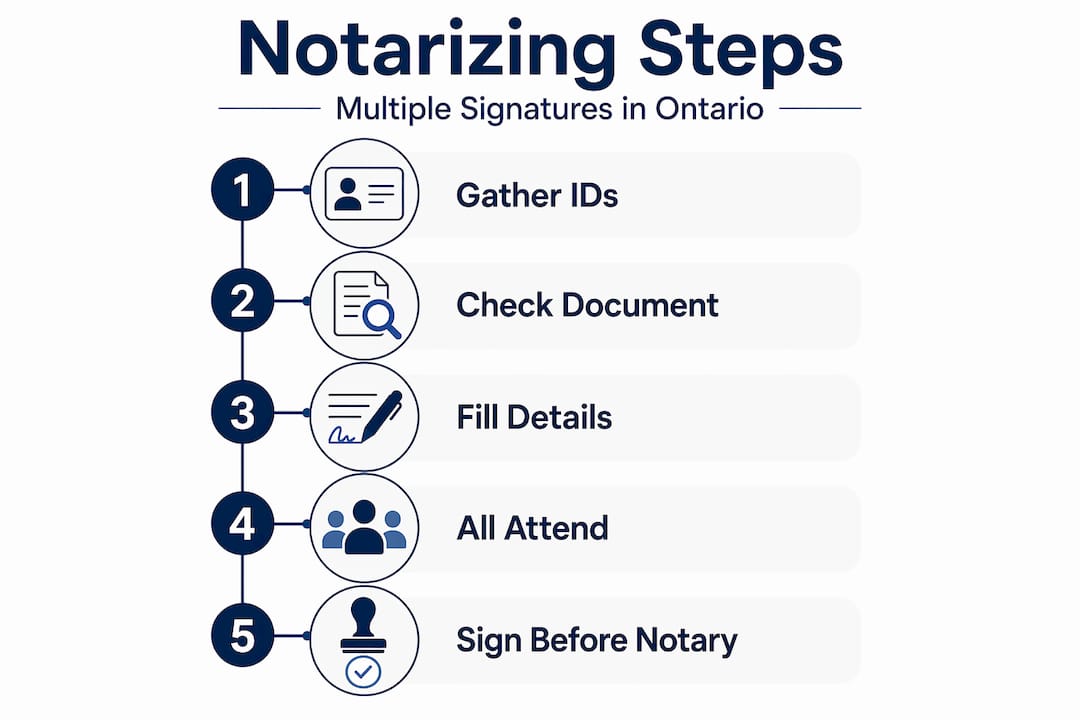
2. Verify that you have the correct, current version of your document.
Outdated forms, particularly for government-related documents, are a leading cause of rejected notarizations. Download forms directly from official Ontario government sources on the day of or shortly before your appointment.
3. Complete all sections of the document except the signature lines.
Fill in every field, including dates, addresses, and identifying information. Leave the signature and witness lines blank. Do not date the signature section in advance.
4. Arrange valid photo ID for every person attending.
Each signer must present their own valid identification. The notary will inspect and confirm each person’s identity individually.
5. Attend the appointment together, bringing all materials.
Arrive with all signers, all witnesses (where required), all ID, and the unsigned documents. The notary will review the document and confirm everyone’s understanding of its contents.
6. Sign in the notary’s presence, in the required order.
The notary will direct each signer to sign in their presence. Do not skip ahead or sign out of order. For documents requiring witnesses, witnesses also sign at this stage.
7. Allow the notary to apply their seal and notarial certificate.
The notary will attach their official seal and complete the notarial certificate, which affirms that the execution took place before them. This step makes the document legally valid.
Critical warning: Ontario does not permit remote or online notarization of documents under the Notaries Act unless specific regulations authorize it. As the Law Society of Ontario warns, documents notarized remotely may be invalid without those regulations in place. This applies to multi-signature documents as much as to any other.
| Feature | In-person notarization | Remote notarization |
|---|---|---|
| Legal validity in Ontario | Confirmed | Uncertain or not permitted |
| Identity verification | Direct and reliable | Technology-dependent, less certain |
| Simultaneous signing | Easily managed | Difficult to coordinate and verify |
| Notarial seal | Applied directly | Regulatory concerns apply |
| Recommended for | All Ontario documents | Not generally recommended in Ontario |
For situations involving multiple documents, you can also review guidance on efficient online notarization and how to legalize a document in Ontario to understand the full post-signing process when international use is involved.
Common mistakes and how to avoid them
Even careful preparation can’t prevent all errors. Here are the most common mistakes and what you can do to avoid them.
The most frequent reasons multiple signature notarizations are rejected or invalidated:
- One or more signers arrived having already signed the document at home
- Signers attended separate appointments rather than appearing together
- Outdated or incorrect version of the form was used
- A required witness was ineligible (spouse, family member, or a party to the document)
- ID was expired or did not match the name on the document
- The document had blank fields when it was presented for notarization
- Remote notarization was attempted for a document type that requires in-person execution
A particularly dangerous assumption is that remote commissioning and remote notarization are the same thing. They are not. While Ontario has, under specific and regulated circumstances, allowed remote commissioning of oaths and affidavits, this does not extend broadly to notarization under the Notaries Act. The Law Society of Ontario has been explicit: remote notary services are not permitted under the Notaries Act absent specific enabling regulations. Businesses and individuals who rely on remote notarization for contracts, powers of attorney, or other key documents risk having those documents declared invalid when it matters most.
Statistic callout: Legal professionals across Ontario have reported a noticeable increase in document rejection rates tied directly to improperly executed remote notarizations, particularly as more service providers market online signing tools without clarifying their limitations under provincial law.
Before using any online or remote service for notarization needs, read a thorough guide on online notary risks so you fully understand what is and is not permitted. You should also know who can notarize in Ontario, since not every commissioner of oaths has the authority to perform full notarial acts for every document type.
Pro Tip: Always check the specific regulatory requirements for your exact document type before booking any notary service. A power of attorney, a statutory declaration, and a commercial contract each carry different rules. Do not assume that what worked for one document applies to another.
Why Ontario’s multiple signer notarization rules are stricter than you think
With the main process and pitfalls covered, let’s take a step back and look at why Ontario’s approach is intentionally rigorous.
Ontario’s legal framework for notarization was not designed with convenience in mind. It was designed with integrity in mind. When you require multiple parties to appear physically before a notary, sign in the notary’s presence, and have their identities independently verified, you create a chain of accountability that is extremely difficult to dispute or forge. That is the entire point.
Many businesses treat notarization as a box-checking exercise, something to get done quickly so the deal can move forward. This mindset is where legal leverage is lost. A document with a procedural defect, even a minor one, can be challenged in court. Opposing counsel will look for exactly these gaps. A missing witness, a signer who did not appear in person, an outdated form: any of these can be enough to call a document’s validity into question at the worst possible moment.
The gap between legal technology and legal regulation is real and it matters. Remote signing tools, digital witnesses, and electronic notarizations are genuinely useful in the right context. But Ontario’s Notaries Act has not kept pace with these technologies at the same speed they have entered the market. That lag means the legal risk of using these tools for notarization purposes remains significant. Assuming that modern technology has resolved a legal requirement is a dangerous shortcut. Laws evolve on their own timeline.
There is also a fundamental protective logic to these rules. When both parties in a legal agreement have their signatures independently notarized in person, neither party can later claim they did not fully understand what they were signing or that their signature was obtained under duress. The notary’s presence is a safeguard for everyone involved, not just the receiving party. Understanding the types of notarization in Ontario helps you appreciate why different documents carry different requirements, and why cutting corners on one type of document is not the same risk as cutting corners on another.
The rules feel strict because the consequences of getting them wrong are severe. Once you accept that, the process becomes much easier to follow and much easier to respect.
Need help notarizing your Ontario documents?
If managing these legal requirements feels daunting, the right Ontario notary service can make the process simple and compliant.
Working with an experienced notary who understands Ontario’s specific requirements for multiple signers removes the guesswork entirely. You get clear guidance on which documents need what type of notarization, what ID to bring, how to organize your witnesses, and how to structure your appointment so every signature is legally sound from the start.

Our trusted notary services cover affidavits, statutory declarations, solemn declarations, invitation letters, and more for individuals and businesses across Ontario. Whether you are coordinating two signers or a full group, we walk you through each step so nothing gets missed. Review the Ontario notary requirements to understand exactly what applies to your situation, and then book with confidence knowing you have expert support behind you.
Frequently asked questions
Do all signers have to be present at the same time for notarization in Ontario?
Yes, each signer must be physically present before the notary when signing. The Notaries Act requires that the notary witness and certify the actual execution of the document.
Can documents with multiple signatures be notarized remotely in Ontario?
No, Ontario does not permit remote or online notarization under the Notaries Act unless specific regulations authorize it. The Law Society of Ontario has warned that documents notarized remotely without that authorization may be invalid.
Are the requirements different for witnesses versus notaries?
Yes, witnesses and notaries serve distinct legal functions. For documents like continuing powers of attorney, Ontario law requires two eligible witnesses present at signing, which is separate from the notary’s certification role.
What happens if one signer cannot attend the notary appointment?
The notarization cannot proceed for that signer. All required signers must appear together before the notary, as the Notaries Act requires witnessing the actual execution in real time. Reschedule the appointment once all parties are available.