
TL;DR:
- Over 80% of Ontario birth affidavit rejections are due to errors like missing ID verification or signing mistakes.
- Choosing between a commissioner and a notary depends on whether the document is for local use or international purposes.
- Proper preparation, using official templates, and expert verification can significantly reduce rejection risks.
Over 80% of birth affidavit rejections in Ontario stem from errors like missing ID verification or not signing in person. Many parents assume the process is straightforward, only to face delays when their documents come back rejected. The confusion often starts with not knowing whether you need a notary or a commissioner, and what each one actually does. This guide walks you through every step, from understanding when you need a birth affidavit to avoiding the most common pitfalls, so your submission goes through the first time.
Table of Contents
- When do parents need a birth affidavit?
- Who can commission and notarize birth affidavits?
- Step-by-step: Preparing and signing a birth affidavit
- Common mistakes and rejection risks (and how to avoid them)
- Why professional verification matters: Insights from notary and government experts
- Get expert help for your birth affidavit needs
- Frequently asked questions
Key Takeaways
| Point | Details |
|---|---|
| Delayed registration triggers affidavit | Birth affidavits are essential if registration happens after 12 months or for document amendments. |
| Commissioner vs. notary clarified | Commissioners handle Ontario use at ServiceOntario and Clerk offices, notaries are for international purposes. |
| Sign in person to avoid rejection | Affidavits must be signed in-person with valid ID to reduce rejection risk from authorities. |
| Pay attention to required content | Affidavit must include parents’ details, child’s birth info, and explain missing birth certificate. |
| Professional verification prevents repeat mistakes | Notary and expert guidance help avoid errors that lead to 80%+ rejection rates. |
When do parents need a birth affidavit?
Most parents first encounter a birth affidavit when something goes wrong with the standard registration process. Maybe the birth wasn’t registered on time, or a hospital record went missing. Whatever the reason, knowing the exact circumstances that trigger the need for an affidavit saves you time and stress.
In Ontario, birth registration normally happens within 30 days of the birth. If that window passes and the birth still isn’t registered after 12 months, you’re in delayed registration territory. At that point, a birth affidavit becomes a required part of the process. This isn’t a rare situation. Families who move between provinces, parents dealing with complicated hospital stays, or those who simply didn’t know the deadline can all find themselves here.
Beyond delayed registration, parents also need affidavits when they want to amend an existing birth record. Corrections to a child’s name, spelling errors, or changes to listed parent information all require a sworn statement explaining the change and why it’s necessary.
A third common scenario is using an affidavit in place of a birth certificate entirely. This happens when official documents are lost, destroyed, or never issued. Parents complete birth affidavits in these cases to provide identity verification for school enrollment, passport applications, or government benefit claims.
Here’s a quick summary of the most common situations:
- Delayed birth registration (more than 12 months after birth)
- Amendments to an existing birth record (name corrections, parent info updates)
- Lost or unavailable birth certificates (used as identity proof)
- Foreign language names or marks (may require additional witness affidavits)
- Lost hospital records (especially relevant for home births or older births)
Important: An affidavit in lieu of a birth certificate is not the same as a birth certificate. Some institutions will accept it; others require the official document. Always confirm with the receiving institution before submitting.
Edge cases add another layer of complexity. If a child’s name includes characters from a non-Latin script, or if a parent signed the original document with a mark rather than a signature, extra witness affidavits may be required. These situations are more common than most people realize, and being unprepared for them can add weeks to your timeline.
Who can commission and notarize birth affidavits?
Understanding when an affidavit is needed, the next step is knowing who can legally commission or notarize your document. These two roles are often confused, but the distinction matters depending on how and where the document will be used.
A commissioner of oaths is authorized to witness and certify sworn statements for use within Ontario. A notary public has broader authority and is required when your document will be used internationally or needs to be apostilled (authenticated for foreign use).
Commissioners are available at ServiceOntario locations, City Clerk offices, banks, lawyers, paralegals, and notaries. ServiceOntario often provides commissioning for free when the document is for a government purpose. Toronto’s City Clerk office charges around $28.85 including tax as of April 2026.
| Service provider | Cost (approx.) | Best for |
|---|---|---|
| ServiceOntario | Free | Ontario government documents |
| City Clerk (Toronto) | ~$29 incl. HST | Ontario civic documents |
| Bank | Free to low fee | Ontario-use affidavits |
| Lawyer or paralegal | $25 to $75+ | Complex or legal matters |
| Notary public | $50 to $150+ | International or apostilled docs |
| Online notary | Varies | Remote-eligible Ontario docs |
For most parents handling a delayed birth registration or amendment within Ontario, a commissioner of oaths is all you need. If you’re submitting the affidavit to a foreign embassy, immigration authority, or international school, you’ll need a notary. You can learn more about online notary Ontario options if in-person visits are difficult.
Here’s what to look for when choosing a service:
- Confirm the provider is authorized in Ontario
- Ask whether they have experience with birth affidavits specifically
- Check if the receiving institution has preferences for who commissions the document
- Verify fees upfront, including any additional charges for notarizing birth certificates
Pro Tip: Call the institution receiving your affidavit before booking a commissioner. Some government offices only accept affidavits commissioned at specific locations, and finding out after the fact means starting over.
Step-by-step: Preparing and signing a birth affidavit
Once you know who can commission your document, getting the details right will ensure it’s accepted without hassle. The preparation stage is where most errors occur, and most of them are entirely preventable.
Here’s the process broken down:
- Download the correct template. Use the official ServiceOntario forms for delayed registration or amendments. Using an unofficial or outdated template is a common rejection trigger.
- Fill in all required fields. This includes both parents’ full legal names, the child’s full name, date of birth, place of birth, and the hospital name.
- Write a clear explanation. If the affidavit is in lieu of a birth certificate, explain specifically why the certificate is unavailable. Vague explanations like “certificate is lost” are often flagged.
- Leave the signature blank. You must sign in front of a commissioner or notary. Signing beforehand invalidates the document.
- Bring valid government-issued ID. The commissioner must verify your identity. A driver’s license or passport works. Expired ID does not.
- Sign in person. The commissioner watches you sign, then applies their seal and signature.
For delayed birth registration, ServiceOntario requires a full package including affidavits confirming the unregistered birth, so confirm all required documents before your appointment.
| Document element | Required? | Notes |
|---|---|---|
| Both parents’ legal names | Yes | Must match government ID |
| Child’s full name | Yes | Include middle names |
| Date and place of birth | Yes | Hospital name if applicable |
| Explanation for missing cert | Yes (if applicable) | Be specific, not vague |
| Government-issued ID | Yes | Must be current and valid |
| Witness or co-affiant | Sometimes | Required for edge cases |
Pro Tip: Make two copies of your completed, unsigned affidavit before your appointment. If the commissioner spots an error, you’ll have a clean backup ready to correct on the spot rather than reprinting everything.
For more guidance on structuring your document, see our resources on creating an affidavit Ontario and writing affidavit Ontario.
Common mistakes and rejection risks (and how to avoid them)
Even the most prepared parents sometimes make small mistakes. Let’s cover how to avoid the costly pitfalls that send documents back for revision.
The number one cause of rejection is missing ID verification. 82% of affidavit rejections in 2024 were caused by errors like missing verification. That’s not a small margin. It means the vast majority of rejected documents had a fixable problem that a simple checklist would have caught.
Here are the most common mistakes parents make:
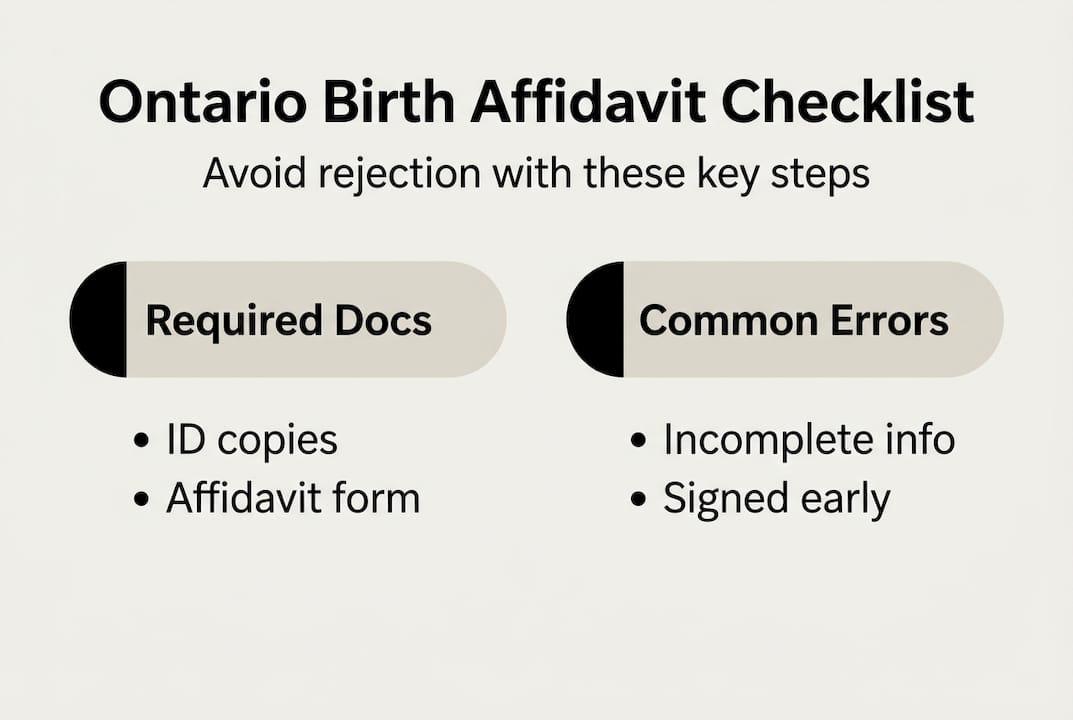
- Signing the affidavit before the appointment. The commissioner must witness your signature. Pre-signed documents are invalid.
- Bringing expired or unofficial ID. Health cards are not always accepted. Stick to a passport or driver’s license.
- Leaving fields incomplete. Every blank field is a reason to reject. If something doesn’t apply, write “N/A” rather than leaving it empty.
- Using the wrong form. Ontario has specific forms for delayed registration, amendments, and identity verification. Using the wrong one wastes everyone’s time.
- Vague explanations. “The certificate is unavailable” isn’t enough. Explain when it went missing, what steps you took to find it, and why it cannot be obtained.
For cases involving foreign script names or signatures made by mark, additional witness affidavits are often required. Check the Ottawa notarization info sheet for regional specifics if you’re outside Toronto.
Virtual signing is another gray area. Most birth affidavits for government registration in Ontario require in-person signing. Online options may be accepted for some Ontario-use documents, but confirm this with the receiving office before booking a remote appointment.
Pro Tip: Use the Ontario affidavit guide 2026 as a final checklist before submitting. Running through it takes five minutes and can save you weeks of back-and-forth.
Why professional verification matters: Insights from notary and government experts
Government websites tell you what to do. They rarely tell you what happens when things go wrong, or why so many parents end up in that situation in the first place.
Here’s the reality: government sites focus on process, while notary professionals focus on avoiding rejection through expert verification. That difference matters more than most parents realize until they’ve already had a document returned.
The high rejection rate isn’t just a statistic. It represents real families waiting weeks longer for a child’s identity documents, missing school enrollment deadlines, or delaying passport applications. A professional who specializes in birth affidavits knows the edge cases, the regional preferences, and the institutional quirks that a general government page can’t cover.
We’ve seen parents come to us after two or three failed submissions, each one rejected for a different small error. The time cost alone is significant. A notary or experienced commissioner who works with these documents regularly can spot problems before they reach the submission stage. That’s not just convenience. It’s a meaningful reduction in stress and delay for your family.
Knowing who can sign affidavit Ontario documents correctly is the foundation of getting this right the first time.
Get expert help for your birth affidavit needs
Navigating birth affidavit requirements on your own is doable, but it’s easy to miss a detail that sends your document back. That’s where we come in.

At The Online Notary, we provide trusted Ontario notary services for parents handling birth affidavits, delayed registrations, amendments, and identity verification documents. Our process is straightforward: book online, get clear pricing upfront, and work with a professional who knows exactly what Ontario institutions require. We also help you understand notary public identification Ontario requirements so you arrive prepared. Whether you’re dealing with a first-time registration or a complex amendment, we’re here to make sure your affidavit is accepted the first time.
Frequently asked questions
Can I use an online notary for birth affidavits in Ontario?
Remote online commissioning is possible for most Ontario-use documents if audio/video is permitted, but many birth affidavits for government registration still require in-person signing. Always confirm with the receiving institution first.
What information must be included in a birth affidavit?
A birth affidavit must include both parents’ names, the child’s date of birth, place of birth, hospital name, and a specific explanation for the missing certificate. Vague or incomplete entries are a leading cause of rejection.
How much does commissioning an affidavit cost in Ontario?
ServiceOntario typically commissions affidavits for free, while City Clerk offices charge around $28.85 including tax in Toronto as of April 2026. Lawyers and notaries charge more, depending on document complexity.
Why are birth affidavits rejected in Ontario?
The most common causes are missing ID verification, incomplete data, and signing before the appointment. 82% of rejections in 2024 came down to these preventable errors.
Do I need a notary or commissioner for birth affidavits?
A commissioner of oaths is sufficient for Ontario-based documents. If the affidavit is for international use or apostille, you’ll need a notary public with the appropriate authority.