
TL;DR:
- Notaries public handle documents requiring international certification or true copies, while commissioners of oaths are limited to domestic sworn statements.
- Common business forms needing notarization include powers of attorney, certified corporate copies, affidavits, and legal declarations for international use.
- Building relationship with a notary and using online services streamline notarization, reducing delays and costs for Ontario small businesses.
Many Ontario small business owners assume every business form needs to go through a notary public. That assumption leads to wasted time, unnecessary costs, and sometimes missed deadlines when the wrong professional is chosen for the job. The reality is more nuanced. Some documents genuinely require a notary public, especially for international use or certified true copies, while others only need a commissioner of oaths. Knowing the difference protects your business from compliance gaps and keeps operations moving. This guide walks you through which forms need notarization, who should handle them, and how to get it done efficiently.
Table of Contents
- Understanding notary public vs commissioner in Ontario
- Which business forms typically require notarization
- The notarization process for Ontario businesses explained
- Compliance and practical tips for smooth notarization
- What most Ontario business owners miss about notarization
- Next steps: Streamlined notarization for Ontario businesses
- Frequently asked questions
Key Takeaways
| Point | Details |
|---|---|
| Notaries vs commissioners | Only notaries can certify documents for international use or true copies—commissioners are limited to Ontario-related affidavits and oaths. |
| Common forms needing notarization | Statutory declarations, business contracts, and powers of attorney may require notarization when legal certification or international recognition is needed. |
| Workflow saves time | Understanding the process, fees, and online options helps Ontario business owners streamline compliance and prevent costly mistakes. |
| Proactive compliance | Preparing documents and ID in advance and choosing the right notary are key to efficient, stress-free notarization. |
Understanding notary public vs commissioner in Ontario
The single most common source of confusion for Ontario business owners is treating notaries public and commissioners of oaths as interchangeable. They are not. Each professional has a distinct legal role, and using the wrong one can invalidate your documents entirely.
In Ontario, notaries are appointed under the Notaries Act, RSO 1990, giving them authority to certify documents for international use, authenticate signatures, and produce certified true copies. A commissioner of oaths, by contrast, is authorized only to administer oaths and take sworn statements within Ontario. Commissioners cannot certify true copies or prepare documents for use outside Canada.
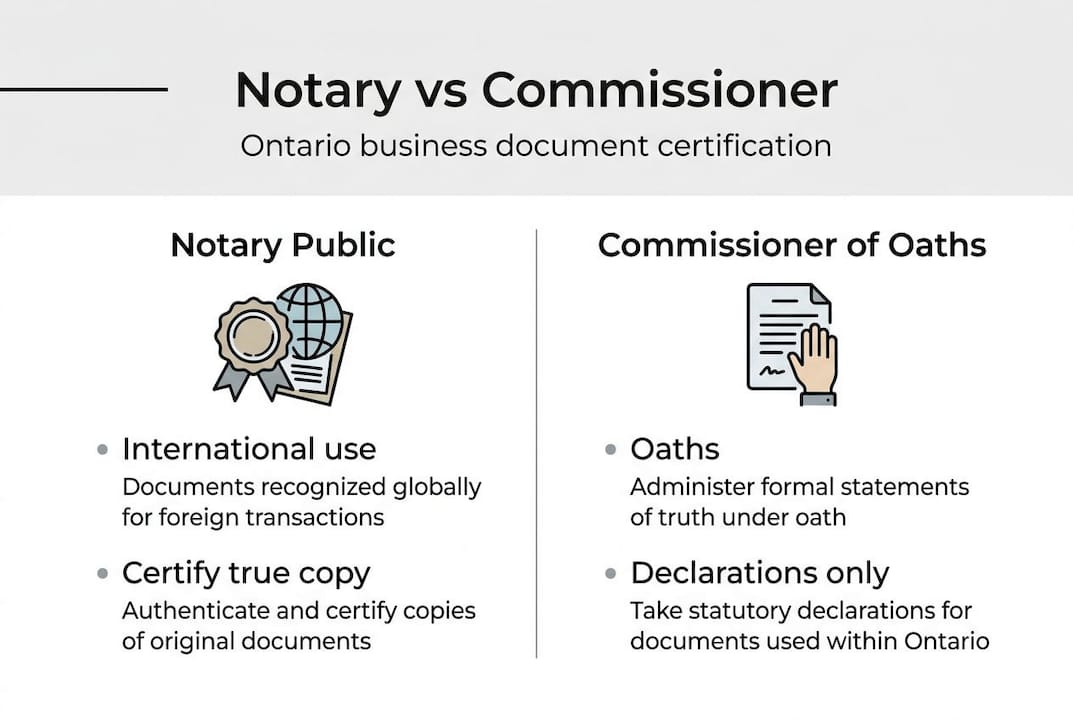
Here is a quick comparison to keep things clear:
| Function | Notary public | Commissioner of oaths |
|---|---|---|
| Administer oaths in Ontario | Yes | Yes |
| Certify true copies | Yes | No |
| Authenticate for international use | Yes | No |
| Witness business contracts | Yes | Limited |
| Statutory declarations | Yes | Yes |
For most day-to-day Ontario filings, a commissioner of oaths is sufficient. But the moment a document crosses a border or needs to be recognized by a foreign government or institution, you need a notary public. This distinction matters enormously for businesses that work with international suppliers, investors, or clients.
Scenarios where Ontario businesses specifically need a notary public include:
- Exporting certified copies of corporate documents abroad
- Notarizing powers of attorney for use in another country
- Authenticating business contracts for foreign partners
- Preparing affidavits intended for international legal proceedings
Scenarios where a commissioner is enough:
- Statutory declarations for domestic use
- Sworn statements for local regulatory bodies
- Internal compliance documents that stay within Ontario
Understanding the notary process for businesses early prevents the frustrating situation of submitting a document only to have it rejected because it was certified by the wrong professional.
Pro Tip: Before booking any appointment, confirm with the receiving institution whether they require a notary public or will accept a commissioner of oaths. This one question saves you time and money.
Which business forms typically require notarization
Not every piece of paper your business generates needs a notary’s seal. In fact, Ontario Business Registry filings do not explicitly require notarization for standard submissions. However, several common business forms do require it under specific circumstances.
Here is a breakdown of common business forms and their notarization requirements:
| Document type | Notarization required? | Who handles it |
|---|---|---|
| Power of attorney (international) | Yes | Notary public |
| Certified true copy of incorporation | Yes | Notary public |
| Statutory declaration (domestic) | Sometimes | Commissioner or notary |
| Affidavit for court use | Yes | Notary public |
| Business contracts (domestic) | Rarely | Commissioner if needed |
| Solemn declaration | Sometimes | Notary public |
The forms that most frequently require a notary public include:
- Powers of attorney intended for use outside Canada
- Certified true copies of corporate registration documents, shareholder agreements, or financial statements
- Affidavits required by foreign courts or government agencies
- Solemn declarations for regulatory submissions
- Invitation letters for business visitors applying for Canadian visas
For notary services covering business documents, the key trigger is almost always international use or a specific legal requirement from a receiving institution. If a foreign bank, embassy, or government body is asking for the document, assume a notary public is required.
Pro Tip: When a client or partner sends you a document request, ask for the exact wording of their requirement. “Notarized” and “certified” mean different things in different jurisdictions. Getting that detail upfront prevents you from preparing the wrong version.
For certification of business documents, the process involves the notary comparing the original to the copy, signing, and affixing their seal. It is straightforward once you know what is needed.
The notarization process for Ontario businesses explained
Once you know which forms require notarization, the actual process is more manageable than most business owners expect. Here is a step-by-step workflow that keeps things efficient.
- Identify the requirement. Confirm whether the receiving party needs a notary public or a commissioner of oaths. Get this in writing if possible.
- Prepare your documents. Gather the original documents and any copies that need certification. Make sure forms are complete before your appointment.
- Gather valid identification. Bring government-issued photo ID. Most notaries require at least one piece of primary ID.
- Choose your notary. Decide between in-person and online notary options based on your timeline and document type.
- Attend the notarization session. The notary will verify your identity, review the documents, witness signatures if needed, and apply their seal.
- Receive your certified documents. For online notarizations, digital copies are typically available immediately, with physical copies mailed if required.
Fees for notarization start at $25 per document but vary depending on the complexity of the document and the provider. Online notary services often offer competitive pricing with faster turnaround than traditional in-person offices.
Timeline is another factor. In-person notarization often requires booking days or weeks in advance. Online notarization through a service like The Online Notary can frequently be completed within 24 to 48 hours, which matters when a deal or deadline is on the line.

Pro Tip: If your business regularly needs notarized documents, build a relationship with a notary who understands your industry. Familiarity speeds up the process considerably.
For a detailed walkthrough of Ontario notarization steps, knowing what to bring and what to expect removes the guesswork entirely.
Compliance and practical tips for smooth notarization
Efficient notarization is about more than just following steps. Small errors derail the entire process and create costly delays. Here is how to stay ahead of common pitfalls.
Common mistakes to avoid:
- Showing up without valid government-issued photo ID
- Submitting incomplete or unsigned forms before the notarization session
- Using a commissioner when a notary public is required for international documents
- Failing to confirm whether the receiving country requires an apostille (a secondary authentication) after notarization
- Waiting until the last minute, which limits your options for finding an available notary
Documentation checklist for business owners:
- Original document plus copies if certification is needed
- Government-issued photo ID (passport preferred for international documents)
- Any supporting documents referenced in the form
- Contact information for the receiving institution in case the notary has questions
For documents destined for international use, the notary’s broader authority enables valid international transactions that a commissioner simply cannot support. Some countries also require an apostille from Global Affairs Canada after notarization. Confirm this requirement before you start.
Choosing between in-person and online notarization depends on your situation. Online works well for standard business documents, certified true copies, affidavits, and statutory declarations. In-person may still be preferred for highly complex transactions or when wet signatures are explicitly required.
Pro Tip: Keep a digital folder of your most frequently notarized business documents. Having clean, ready-to-go originals on hand cuts preparation time significantly when urgent needs arise.
Understanding when a notary is needed versus when a simpler option works is the foundation of a compliant, efficient document management system for your business.
What most Ontario business owners miss about notarization
Here is something worth saying plainly: most business owners only think about notarization when something has already gone wrong. A deal stalls because a document is not certified. A visa application gets rejected because the invitation letter was not properly notarized. A foreign partner refuses to proceed without authenticated corporate documents.
The pattern is consistent. Notarization gets treated as an afterthought rather than a standard part of business operations. That reactive approach costs real money and creates real stress.
The smarter move is to build notarization awareness into your workflow before you need it. Know which documents your business regularly produces that might require notarization. Identify a reliable notary in advance. Explore small business notary insight to understand what a streamlined process actually looks like.
Online notary services have genuinely changed the equation here. What once required scheduling days in advance and traveling to an office can now be handled from your desk in under an hour. For busy business owners, that shift is significant. Treat notarization as a business function, not an emergency.
Next steps: Streamlined notarization for Ontario businesses
If you have been piecing together notarization requirements on a case-by-case basis, there is a better way to handle it.

The Online Notary provides fast, reliable trusted Ontario notary services for affidavits, statutory declarations, solemn declarations, invitation letters, certified true copies, and more. Everything is handled online, which means no office visits, no long wait times, and no disruption to your business day. Whether you are preparing documents for international partners or managing routine compliance needs, the process is designed to be simple and efficient. Explore the full Ontario document types guide to find exactly what your business needs and get started today.
Frequently asked questions
Do all Ontario business forms need to be notarized?
No. Most standard filings through the Ontario Business Registry do not require notarization. Notarization is typically only needed for specific legal, regulatory, or international purposes.
Can a commissioner handle business documents for international use?
No. Commissioners cannot certify documents for international use. Only a notary public has the legal authority to authenticate documents recognized outside Canada.
How much does notarization cost for a business document in Ontario?
Fees start at $25 per document but vary depending on the type of document and the notary service you choose. Online notaries often offer competitive rates with faster turnaround.
What is needed to notarize a business form online?
You need a valid government-issued photo ID, the completed form ready for review, and access to an online notary platform. The session is typically conducted via video call and takes under an hour.