
TL;DR:
- Notarization in Ontario is quicker, more accessible, and often online, saving time and effort.
- Essential for legal validity and credibility of business documents like contracts and affidavits.
- Proper preparation and understanding of requirements prevent costly rejection delays.
Most small business owners in Ontario assume that getting documents notarized means booking time off, driving across town, and waiting in a stuffy office. That assumption is outdated. The notary process in Ontario has evolved significantly, and today’s options are faster, more accessible, and far less intimidating than most people expect. Whether you need an affidavit, a statutory declaration, or a signed business contract authenticated, this guide walks you through every stage of the process. You’ll learn what documents require notarization, how to prepare, and how to avoid the mistakes that cause costly delays.
Table of Contents
- Why small businesses need notarization in Ontario
- Key steps of the notary process for small business documents
- Comparing traditional and online notarization for Ontario businesses
- Common mistakes and how to avoid them
- Our perspective: Efficiency vs. accuracy in the notary process
- Streamline your notary needs with trusted Ontario experts
- Frequently asked questions
Key Takeaways
| Point | Details |
|---|---|
| Notarization ensures compliance | Many Ontario business documents must be notarized to be legally valid and enforceable. |
| Preparation avoids delays | Having the right documents and valid ID ready will help you avoid rejection or setbacks. |
| Online options save time | Remote notarization can help Ontario businesses complete paperwork up to 40 percent faster. |
| Accuracy outweighs speed | Rushing through the process can result in costly mistakes, so careful review is crucial. |
| Expert help available | Specialized notary services can simplify the process and provide peace of mind for small businesses. |
Why small businesses need notarization in Ontario
Notarization is not just a formality. It’s a legal safeguard that protects your business, your contracts, and your relationships with partners, clients, and government agencies. When a notary public witnesses and certifies a document, they confirm that the signatures are genuine, the signatories are who they claim to be, and the content is accurate at the time of signing. That certification carries real legal weight.
For small businesses in Ontario, certain business documents require notarization for legal validity. This applies to a wider range of situations than many owners realize. Here are the most common documents that small businesses encounter:
- Affidavits: Written statements sworn under oath, often used in legal proceedings or regulatory filings
- Statutory declarations: Formal declarations required by government agencies, banks, or licensing bodies
- Business resolutions: Corporate decisions that may need notarization for third-party acceptance
- Contracts and agreements: Partnership agreements, vendor contracts, and lease agreements that require authenticated signatures
- Invitation letters: Required when sponsoring foreign nationals for business visits to Canada
Understanding who needs a notary in Ontario helps you plan ahead rather than scramble at the last minute. The benefits go beyond just compliance. Notarized documents are harder to dispute, carry more credibility with banks and government bodies, and protect you if a contract is ever challenged in court.
Did you know? Many small business owners only discover they need notarization after a document has already been rejected, costing them days or even weeks of rework.
The practical impact is significant. A rejected document can delay a business license renewal, hold up a real estate transaction, or stall a partnership agreement. Notarization removes that risk by adding a verified, tamper-evident layer of legitimacy to your paperwork.
Pro Tip: Build a simple checklist of the documents your business regularly produces and flag which ones require notarization. Reviewing this list quarterly prevents last-minute scrambles when deadlines arrive.
Key steps of the notary process for small business documents
Now that you know why notarization matters, let’s break down the practical steps involved. The process is more straightforward than most people expect, especially when you go in prepared.
Identify the document and its requirements. Not every document needs the same type of notarization. Some require witnessing, others require certification of a copy, and some require a sworn oath. Know what you need before you book.
Prepare your documents. Review every page carefully. Check for blank fields, unsigned lines, or missing dates. Incomplete documents are one of the top reasons notarizations fail on the first attempt.
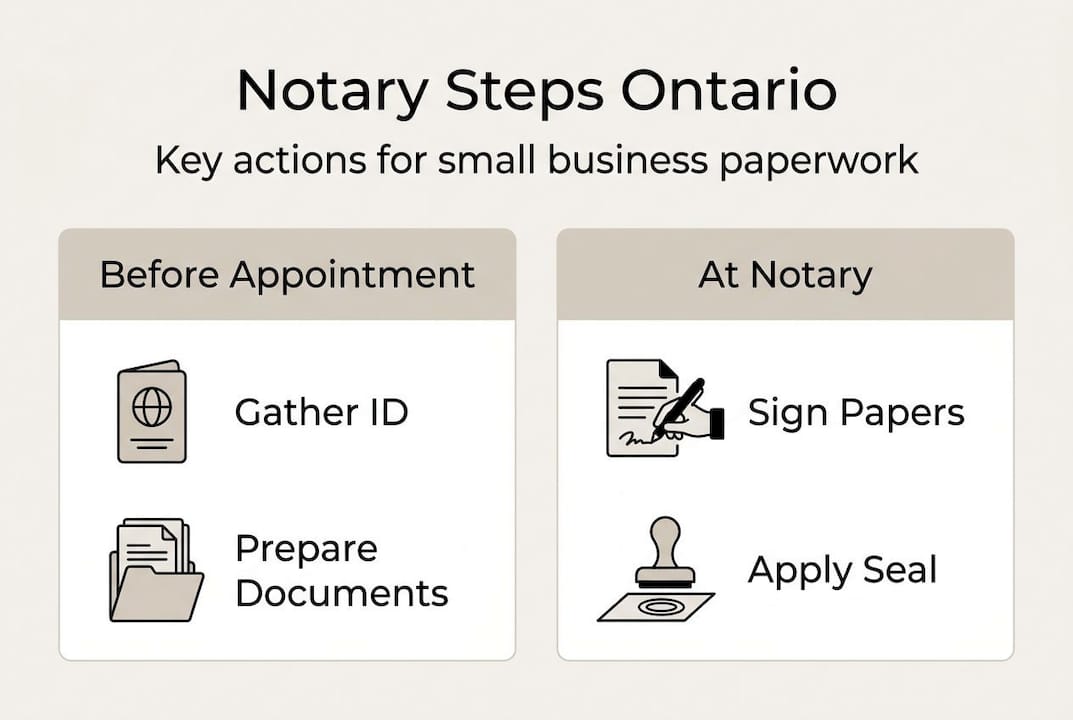
Gather valid identification. Preparing required identification is essential for a smooth notarization process. You’ll need at least one piece of valid, government-issued photo ID. A driver’s license or passport works in most cases.
Schedule your appointment. You can choose between an in-person notary visit or an online session. Online appointments are increasingly popular for their speed and convenience, especially for business owners with tight schedules.
Attend the notarization session. During the session, the notary public will verify your identity, review the document, witness your signature, and apply their official seal or stamp. For online sessions, this happens via a secure video call.
Finalize and store your documents. After notarization, keep both digital and physical copies in a secure location. Share copies with relevant parties and confirm that the receiving organization accepts the format, whether digital or paper.
Understanding the notary requirements in Ontario for your specific document type ensures you don’t waste time preparing the wrong materials.
Pro Tip: Always confirm with the receiving organization whether they accept digitally notarized documents before you book. Some government agencies and financial institutions still require paper originals, while others now accept electronic versions.
Comparing traditional and online notarization for Ontario businesses
With the process mapped out, it’s vital to know which notarization method best suits your business needs. Both traditional and online options have their place, but the differences in time, cost, and convenience are significant.
Traditional notarization means scheduling an in-person appointment, traveling to the notary’s office, and physically presenting your documents and ID. For some business owners, this works fine. For others, it means taking hours away from running their business.

Online notarization uses secure video conferencing, electronic signatures, and digital seals to complete the same process remotely. Switching to online notarizing can cut time for Ontario business documents by up to 40%. That’s not a trivial saving when you’re managing a business with limited administrative support.
| Feature | Traditional notarization | Online notarization |
|---|---|---|
| Location | In-person office visit | Anywhere with internet |
| Scheduling | Business hours only | Flexible, often same-day |
| Time required | 1 to 3 hours including travel | Under 30 minutes |
| Document handling | Physical originals | Digital files |
| Cost | Varies, often higher | Generally lower |
| Acceptance | Universally accepted | Accepted for most purposes |
Here are the scenarios where online notarization gives small businesses a clear edge:
- Time-sensitive documents where same-day turnaround is needed
- Multi-party agreements where signatories are in different locations
- Routine filings like statutory declarations that don’t require physical originals
- Business owners outside major urban centers who face longer travel times
For a deeper look at how this works in practice, the business contract notarization guide covers specific scenarios where online notarization is the smarter choice. Traditional notarization still has its place for documents that explicitly require a physical seal or original signature, but for most routine business needs, online is faster and just as legally sound.
Common mistakes and how to avoid them
Even with a streamlined process, mistakes can derail your legal documents. Here’s what to watch out for.
The most frequent problems small business owners encounter are not complicated. They’re simple oversights that are entirely preventable with a bit of preparation. Missing signatures or outdated identification can result in rejected documents, forcing you to restart the process from scratch.
Here are the most common mistakes and how to prevent each one:
- Incomplete documents: Leaving fields blank or forgetting to date a section. Always do a full review before your appointment.
- Expired or incorrect ID: Using an expired driver’s license or a piece of ID that doesn’t match the name on the document. Check your ID expiry date before booking.
- Wrong document type: Submitting a statutory declaration when an affidavit is required, or vice versa. Confirm with the receiving party what they specifically need.
- Assuming all documents need notarization: Not every signed document requires a notary. Notarizing unnecessary documents wastes time and money.
- Poor file management: Failing to save a digital copy or distribute the notarized version to all relevant parties. Set up a simple folder system for notarized documents.
“Compliance failures in business document submissions are often traced back to avoidable errors made before the notary appointment, not during it.”
One often overlooked mistake is failing to confirm the format requirements of the receiving organization. A notarized document that arrives in the wrong format, whether digital when paper is required or vice versa, is treated as non-compliant regardless of how perfectly the notarization itself was done. Always ask upfront.
Our perspective: Efficiency vs. accuracy in the notary process
Here’s something most notarization guides won’t tell you: speed is not the goal. Accuracy is. Speed is just a welcome byproduct of being well-prepared.
We’ve seen small business owners rush through the notarization process because they’re under deadline pressure, only to have documents rejected for a missing signature or an ID discrepancy. The time lost fixing those errors far exceeds the time they would have spent preparing properly in the first place.
Online notarization, when used correctly, genuinely delivers on its promise of cutting time by up to 40%. But that efficiency only materializes when the groundwork is solid. A rushed online session with incomplete documents is no better than a rushed in-person visit.
Our honest recommendation: treat every notarization as a two-stage task. Stage one is preparation, and it deserves most of your attention. Stage two is the appointment itself, which should feel almost automatic if stage one was done right. Efficiency and accuracy are not opposites. Done correctly, they reinforce each other.
Streamline your notary needs with trusted Ontario experts
Ready to simplify your notary process? Ontario experts can help you avoid headaches and keep your business running smoothly.

Working with a professional notary service means you’re not guessing about requirements or risking costly rejections. Our online notary services in Ontario cover affidavits, statutory declarations, invitation letters, solemn declarations, and more. Whether you’re handling a one-time filing or managing ongoing documentation needs, you get fast, secure, and legally sound notarization without leaving your office. We also make it easy to understand the public notary requirements that apply to your specific documents, so there are no surprises. Book a session today and experience how straightforward the notary process can actually be.
Frequently asked questions
What documents typically require notarization for small businesses in Ontario?
Many business documents in Ontario require notarization, including contracts, affidavits, statutory declarations, partnership agreements, and business resolutions. The specific requirement depends on the receiving organization or legal context.
Can I notarize business documents online in Ontario?
Yes, Ontario allows remote online notarization for business documents using secure platforms and video meetings. Most routine business documents qualify for online notarization.
What identification do I need for notarizing documents in Ontario?
You must bring valid ID such as a government-issued driver’s license or passport. The name on your ID must match the name on the document being notarized.
How long does the notary process take for small business documents?
Online notarization reduces time by up to 40% compared to traditional methods, with most sessions completed in under 30 minutes. In-person appointments typically take longer due to travel and scheduling constraints.