
TL;DR:
- Most Ontario citizenship applicants do not need notarization for general documents but must notarize affidavits and certified true copies as per IRCC guidelines. Notarization of translations and copies requires specific formal affidavits and approval from authorized Ontario professionals like notaries or commissioners of oaths. Proper understanding of document authentication, especially for international use, ensures smooth processing and prevents delays or rejections.
Applying for Canadian citizenship is a significant milestone, and most Ontario applicants are well prepared with their residency records and language test results. Where things quietly go wrong, though, is the notarization step. Many people assume every document needs a notary’s stamp, while others assume notarization is never required at all. Both assumptions lead to rejected submissions, frustrating delays, and unnecessary cost. This guide cuts through those misconceptions, showing you exactly which documents require notarization, who can witness them in Ontario, and what IRCC’s rules actually say so your application moves forward without a hitch.
Table of Contents
- When does notarization matter for Canadian citizenship?
- Affidavits and translation requirements for IRCC
- Certified true copies: What’s required for Ontario applicants?
- When is notarization not enough? Documents used outside Canada
- A practical view: Why “one-size-fits-all” notarization advice fails Ontario applicants
- How The Online Notary simplifies Canadian citizenship notarization in Ontario
- Frequently asked questions
Key Takeaways
| Point | Details |
|---|---|
| Notarization is specific | Only certain documents like affidavits or IRCC-requested certified copies need notarization for citizenship. |
| Affidavit requirement for translations | Uncertified translations must be accompanied by an affidavit sworn before an authorized person. |
| Certified true copies demand details | Certified true copies must include specific language and ID details from the certifier. |
| Check Ontario’s authorized persons | Not all commissioners or notaries are interchangeable—verify IRCC’s current standards for document acceptability. |
| International use requires authentication | For documents used outside Canada, Global Affairs authentication is often necessary beyond notarization. |
When does notarization matter for Canadian citizenship?
Let’s pin down exactly when notarization is, and isn’t, needed for citizenship applications. Most applicants think of notarization as a blanket requirement, as if every page of every submission needs an official stamp. The reality is far more targeted.
According to IRCC’s guidance on forms and documents, the citizenship process usually doesn’t require “general notarization.” Notarization comes up specifically when an affidavit is required or when you need to submit certified true copies of original documents. If IRCC’s instructions don’t mention either of those, you likely don’t need a notary for that particular form.
Understanding documents requiring notarization in Ontario is the first step to building a clean application package.
Documents that typically involve notarization for IRCC:
- Translation affidavits (for documents originally in a language other than English or French)
- Statutory declarations of identity or name change
- Certified true copies of passports, birth certificates, or marriage certificates
- Solemn declarations of physical presence or residency
- Affidavits supporting a minor’s application
Documents that generally do not require notarization:
- Completed IRCC application forms
- Photographs
- Test results submitted directly by testing organizations
- Tax records already issued by a government body
It also helps to understand the difference between two kinds of authorized witnesses in Ontario.
| Scenario | Notary public | Commissioner of oaths |
|---|---|---|
| Swearing an affidavit for IRCC | Yes | Yes (for in-province use) |
| Certifying a true copy | Yes | Often yes, check IRCC instructions |
| Documents for use outside Canada | Yes (first step) | Usually not sufficient |
| Statutory declarations | Yes | Yes |
| Translation affidavits | Yes | Sometimes, confirm with IRCC |
Pro Tip: Always read the specific IRCC instruction guide for your application type before booking a notary. The guide will tell you exactly which documents need to be notarized and what language must appear on each one.
Affidavits and translation requirements for IRCC
Once you know when notarization applies, it’s vital to understand how it works for translations and affidavits, because this is the area that trips up the largest number of applicants.
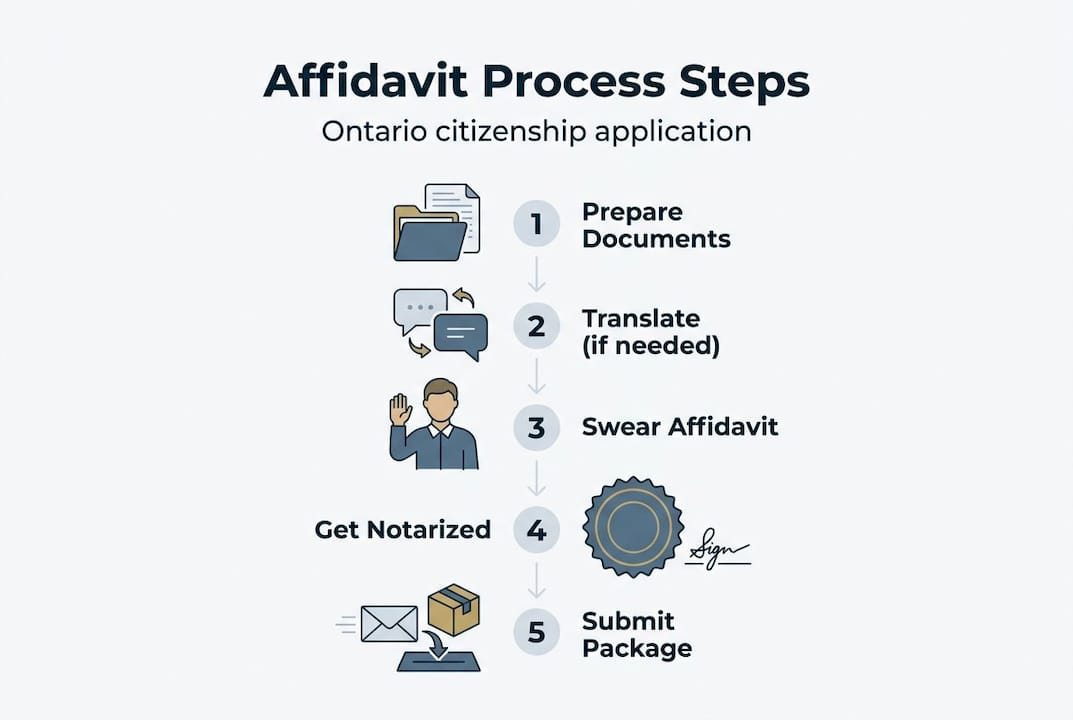
IRCC requires all documents that are not in English or French to be translated. The translator’s credentials matter here. If the translator is certified by a recognized body, such as the Association of Translators and Interpreters of Ontario, the translation itself may carry enough authority. But if you work with an uncertified translator, whether that’s a professional freelancer or a bilingual community member, IRCC requires something more formal: a translation affidavit.
A translation affidavit is a sworn statement in which the translator confirms their qualifications and attests that the translation is accurate. According to IRCC’s requirements, the translator must swear an oath for the translation affidavit in the presence of an authorized person, and in Canada that authorized person can include a notary public. A simple signed cover letter from the translator, no matter how detailed, does not meet this requirement.
As IRCC’s guide for citizenship minors makes clear: if you use an uncertified translator, you need an affidavit signed before a notary or other authorized person, not just a simple signed letter.
“Documents that are not in English or French must be accompanied by a translation. The translation must be accompanied by an affidavit from the person who did the translation.” — IRCC
How to prepare a translation affidavit for IRCC:
- Obtain the completed translation from your translator.
- Confirm that your translator is prepared to swear an oath about the accuracy of their work.
- Book an appointment with a notary public or commissioner of oaths in Ontario who is authorized to administer oaths.
- The translator appears before the authorized person (this can now often be done online in Ontario).
- The translator swears the affidavit stating their language credentials and the accuracy of the translation.
- The notary or commissioner signs and seals the affidavit.
- Attach the sworn affidavit to the translation before submitting to IRCC.
You can learn more about how certified translation affidavits work in practice when preparing your package.
Pro Tip: Don’t skip the affidavit step because the translator “sounds official.” IRCC reviewers look for the sworn statement, and a rejection at this stage can push your file back by weeks or even months.
Certified true copies: What’s required for Ontario applicants?
Translations aside, certified true copies are another key area where applicants face avoidable setbacks. Let’s clarify exactly what IRCC expects here.
A certified true copy is a photocopy of an original document accompanied by a statement that confirms the copy is a faithful reproduction of the original. You cannot simply photocopy your passport and submit it. Someone with the appropriate authority must review the original, compare it to the copy, and then certify the copy with specific language.
IRCC’s guide is precise: certified true copy requirements include specific language, the date, the official’s name, and signature. It also notes that province and territory authority may affect who is eligible to certify.
| Required field | Example |
|---|---|
| Certification phrase | “I certify that this is a true copy of the original document” |
| Date of certification | The exact date the certifier reviewed the original |
| Name of certifier | Full legal name of the authorized person |
| Title or position | Notary Public, Commissioner of Oaths, etc. |
| Signature | Original handwritten or legally recognized signature |
| Description of document | “Passport issued by Canada, pages 1 through 4” |
Understanding who can certify copies in Ontario is equally important because not everyone with an official title qualifies under IRCC’s specific rules.
Common mistakes Ontario applicants make with certified true copies:
- Using a photocopy made at a store with no certification at all
- Having a friend or relative who is a lawyer certify without checking IRCC’s approved list
- Omitting the date from the certification stamp
- Not naming the document being certified (for example, writing “document” instead of “Canadian passport”)
- Using a commissioner of oaths for a document that IRCC specifies must be notarized by a notary public
- Certifying a blurry or incomplete photocopy that doesn’t capture every page of the original
Each of these errors forces IRCC to return your application, request corrections, and restart processing timelines. Taking an extra ten minutes to confirm your certified copy meets every field in the table above saves weeks of waiting.
When is notarization not enough? Documents used outside Canada
Finally, if any of your supporting documents are destined for use outside Canada, the process changes significantly and notarization is only the beginning.
This situation comes up more often than people expect. For example, if you were born in another country and need a birth record from that country’s embassy, or if you’re submitting a Canadian document to a foreign government as part of a dual residency process, simple notarization won’t be accepted internationally.
Global Affairs Canada requires authentication as a separate process if you use Canadian documents abroad. Notarization is often just the first of several steps. The full authentication process adds layers that many applicants don’t discover until they’ve already submitted an incomplete package.
Here is what the broader process looks like:
- Step 1: Have your document notarized by an Ontario notary public.
- Step 2: Submit the notarized document to Global Affairs Canada for federal authentication.
- Step 3: Depending on the destination country, you may also need legalization through that country’s embassy or consulate in Canada, or an apostille if the country is a member of the Hague Apostille Convention.
As Global Affairs Canada confirms, if your documents go outside Canada, their authentication steps, and sometimes apostille requirements, must also be followed.
Understanding the difference between legalization vs notarization helps you map out the complete chain of steps before you start, rather than discovering midway that you’ve missed a stage.
Pro Tip: Start the authentication process at least six to eight weeks before your deadline if any document must be sent internationally. Global Affairs Canada processing times can vary significantly depending on the volume of requests they are handling.
A practical view: Why “one-size-fits-all” notarization advice fails Ontario applicants
Here is something we see repeatedly from applicants who walk into consultations frustrated: they followed advice from a forum, a Facebook group, or even a well-meaning friend who had been through the citizenship process in a different province. That advice was not wrong in a general sense. It was simply not Ontario-specific, and the gap between “generally right” and “specifically correct” is where applications get rejected.
IRCC’s authority varies by province or territory, which means Ontario applicants must confirm the right authorized person for their document type. What a commissioner of oaths can certify in one province may require a notary public in Ontario, or the wording on the certification may need to differ. These are small details that carry big consequences.
The most common errors we see are not careless mistakes. They are the result of people applying advice that was correct for someone else’s situation. Someone in British Columbia may have used a different type of certifier. Someone in Quebec may have had a different language requirement. Ontario has its own rules, its own licensed notary public profession separate from commissioners of oaths, and IRCC instructions specifically reference provincial authority.
Looking at the full range of Ontario notarization types helps you understand that each document type may need a different approach, and that a single appointment may not cover everything in your application package.
The other overlooked pitfall is the authentication step for documents that will eventually be sent internationally, even if the citizenship application itself is domestic. Applicants often prepare everything correctly for IRCC, then discover later that a document they included also needs to go to a foreign embassy and has not been authenticated. By that point, the original document has already been submitted. Starting with a clear picture of the entire document lifecycle, not just the IRCC submission, saves enormous rework down the line.
How The Online Notary simplifies Canadian citizenship notarization in Ontario
For those ready to make their next step hassle-free, here’s how expert help can save time and worry.
Preparing notarized documents for a citizenship application doesn’t have to mean taking time off work, driving across the city, or waiting weeks for an in-person appointment.

The Online Notary offers streamlined, online appointments for Ontario applicants who need affidavits, certified true copies, translation affidavits, statutory declarations, and solemn declarations specifically for IRCC submissions. Our team knows IRCC’s current language requirements and can help ensure every field on your certified copy, every line of your affidavit, and every element of your translation package meets the standard that reviewers expect. You can explore our full Ontario notary services and review notary requirements in Ontario before booking, or go straight to booking translation affidavit help if that’s your immediate need. Fast, professional, and designed specifically for Ontario applicants.
Frequently asked questions
Do I always need a notary for Canadian citizenship documents in Ontario?
No. Notarization is only required for affidavits or certified true copies as per IRCC guidance, not for general forms or standard supporting records.
What happens if my translations are not certified?
You must provide an affidavit for uncertified translations, sworn before a notary or authorized person, because a signed letter from the translator does not satisfy IRCC’s requirements.
Can any notary or commissioner in Ontario certify my documents for IRCC?
You should verify IRCC’s specific requirements because certification authority varies by province, and not every authorized person in Ontario qualifies for every document type IRCC requests.
Is notarization enough for documents used outside Canada?
No. Global Affairs Canada authentication is also required for documents used internationally, and some destination countries additionally require an apostille or embassy legalization.
What should be written on a certified true copy?
IRCC specifies that the certifier must include required certification language, the exact date, the document’s name, their official position, and their original signature on every certified copy.