
Preparing an affidavit in Ontario doesn’t have to be complicated. Many residents and businesses face rejections due to simple errors in drafting, notarization, or submission. This guide walks you through every step to create legally valid affidavits that meet Ontario’s requirements, saving you time and avoiding costly mistakes.
Table of Contents
- Understanding Affidavits In Ontario
- Prerequisites: What You Need Before Starting Your Affidavit
- Step-By-Step Affidavit Preparation And Notarization Process In Ontario
- Common Mistakes And How To Avoid Them
- Expected Outcomes, Costs, And Timelines For Ontario Affidavits
- Why Choose The Online Notary For Your Ontario Affidavit Needs?
Key takeaways
| Point | Details |
|---|---|
| Legal requirements | Affidavits must be sworn before authorized commissioners or notaries to be valid in Ontario. |
| Essential documents | Valid government ID and organized supporting documents are required before starting. |
| Preparation process | Follow clear steps for drafting, notarizing, and submitting affidavits correctly. |
| Common mistakes | Unclear statements and missing notarization cause over 40% of rejections. |
| Costs and timelines | Processing takes 3 to 5 business days with varying fees depending on method chosen. |
Understanding affidavits in Ontario
An affidavit is a written sworn statement used as evidence in legal or administrative proceedings. When you sign an affidavit, you’re declaring under oath that the facts you’ve stated are true to the best of your knowledge. This makes affidavits powerful legal tools in Ontario courts, government agencies, and business transactions.
Affidavits serve several critical purposes in Ontario’s legal system. They provide sworn proof of facts without requiring in-person testimony in every case. Courts and agencies rely on affidavits to establish evidence, verify identity, confirm relationships, and support applications ranging from name changes to immigration sponsorships.
Ontario recognizes several types of sworn documents, each serving specific legal purposes:
- Affidavits: General sworn statements for court proceedings and legal matters
- Statutory declarations: Sworn statements for administrative purposes outside of court
- Solemn declarations: Non-religious alternatives to oaths with the same legal weight
The legal authority of affidavits stems from their witnessing requirement. In Ontario, affidavits must be sworn or affirmed before an authorized commissioner of oaths or notary public to be legally valid. Without proper witnessing, your document carries no legal weight and will be rejected by courts or agencies.
Understanding types of affidavits helps you choose the right document for your situation. Each type follows similar preparation steps but may have specific formatting or content requirements depending on its intended use.
Prerequisites: what you need before starting your affidavit
Before you draft your affidavit, gather everything you’ll need to complete the process smoothly. Missing documents or improper identification causes delays and rejections that could have been easily avoided with proper preparation.
Here’s what you must have ready:
- Valid government-issued photo ID: Ontario driver’s license, passport, or other accepted identification showing your current legal name and photograph
- Clear content draft: A written outline of the facts you need to swear to, including dates, names, and specific details
- Supporting documents: All papers, contracts, receipts, or records referenced in your affidavit statement
- Exhibit organization: Properly labeled and attached supporting materials that prove your sworn facts
- Access to authorized officials: Contact information for commissioners of oaths, notaries public, or online notarization services
Your identification must match the name you’ll use on the affidavit exactly. Any discrepancy between your ID and the affidavit signature can invalidate the document. If you’ve recently changed your name, bring documentation proving the name change along with updated ID.

Organizing your supporting documents before drafting saves time and ensures accuracy. Review each document you plan to reference and make copies if needed. Label exhibits clearly with letters or numbers that correspond to references in your affidavit text.
How to write affidavit Ontario provides detailed guidance on structuring your content properly. Taking time to prepare thoroughly makes the actual drafting and notarization process much faster and smoother.
Step-by-step affidavit preparation and notarization process in Ontario
Follow these steps to create a legally valid affidavit that meets Ontario’s requirements:
Draft your affidavit with precision: Write clear, factual statements in the first person using simple language. Include your full legal name, address, and occupation at the beginning. Number each paragraph and state only facts you have personal knowledge of, avoiding opinions or hearsay.
Organize supporting documents: Attach all referenced materials as labeled exhibits. Each exhibit should be mentioned in your affidavit text with its corresponding label. Create a cover page listing all exhibits if you have multiple documents.
Find an authorized official: Locate a commissioner of oaths, notary public, or lawyer authorized to witness affidavits in Ontario. You can visit law offices, government service centers, or use online notarization platforms that serve Ontario residents.
Verify your identity: Present your valid government-issued photo ID to the authorized official. They will confirm your identity matches the name on the affidavit before proceeding with the oath or affirmation.
Sign in their presence: Do not sign your affidavit beforehand. You must sign it while the authorized official watches. They will administer an oath or affirmation, and you’ll declare that the contents are true.
Obtain official certification: The authorized official will sign, date, and apply their official stamp or seal to your affidavit. This certification proves the affidavit was properly sworn before an authorized commissioner.
Submit to the appropriate authority: Deliver your notarized affidavit to the court, government agency, or organization requiring it within any applicable deadlines.
Online notarization has become a game changer for Ontario residents and businesses. Digital platforms allow you to complete the entire process from home using video conferencing technology. Studies show online notarization reduces processing time by up to 40% compared to traditional in-person methods.
| Factor | In-Person Notarization | Online Notarization |
|---|---|---|
| Average cost | $40 to $100 | $25 to $75 |
| Time required | 1 to 3 days | Same day to 24 hours |
| Convenience | Travel required | Complete from anywhere |
| Availability | Business hours only | Often 24/7 access |
| Legal validity | Fully recognized | Fully recognized since 2022 |
Pro Tip: Schedule your notarization appointment before drafting your final version. Ask the notary or commissioner about any specific formatting requirements they prefer. Some officials have particular preferences for margin sizes, exhibit labeling, or jurat wording that can save you from making corrections later.
How to create an affidavit in Ontario offers templates and examples to guide your drafting. Online notary Ontario services provide expert support throughout the process, ensuring your affidavit meets all legal requirements.
Common mistakes and how to avoid them
Even small errors can render your affidavit invalid or cause delays in legal proceedings. Understanding these common pitfalls helps you avoid them entirely.
Unclear or ambiguous statements top the list of affidavit problems. When your language is vague or open to interpretation, courts and agencies cannot rely on your sworn facts. Common mistakes in affidavit completion include unclear statements, missing notarization, incorrect signer identity, and failure to attach required documents. Be specific about dates, amounts, names, and locations. Replace phrases like “around that time” with exact dates when possible.
Incomplete notarization invalidates affidavits immediately. Your document must include:
- Your signature made in the presence of the authorized official
- The official’s signature and printed name
- The official’s stamp or seal showing their authorization
- The date and location where the oath or affirmation occurred
- Proper jurat wording confirming the oath was administered
Identity verification failures occur when signers present expired ID, documents with name mismatches, or insufficient identification. Always bring current, valid government-issued photo ID that exactly matches the name you’re using on the affidavit. If your ID shows a different name due to marriage or legal name change, bring supporting documentation.
Missing supporting documents undermine your affidavit’s credibility and completeness. Every document, contract, receipt, or record you mention in your sworn statement must be attached as a properly labeled exhibit. Courts and agencies will reject affidavits that reference evidence but fail to include it.
Pro Tip: Create a final review checklist before submission. Verify that every fact is clearly stated, all exhibits are attached and labeled, notarization is complete with visible stamp or seal, and your signature appears only where required. Consider having a legal professional review high-stakes affidavits before filing. How to write affidavit Ontario includes downloadable checklists to ensure you catch errors before they cause problems.
Expected outcomes, costs, and timelines for Ontario affidavits
Knowing what to expect helps you plan effectively and avoid last-minute stress when preparing affidavits.
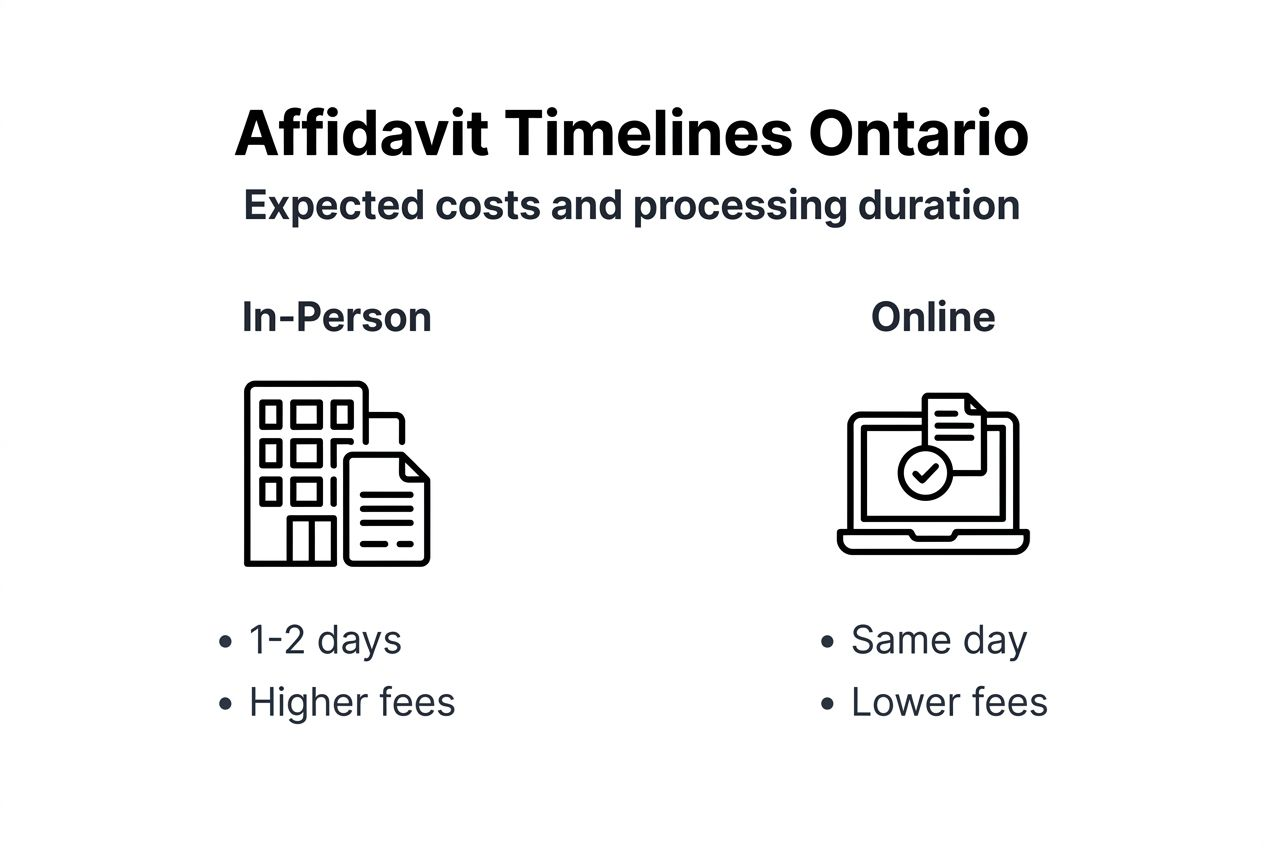
Processing times vary based on your chosen notarization method and the official’s availability. In-person notarization typically takes 1 to 3 business days from initial contact to completed document, depending on appointment availability. Online notarization often provides same-day or next-day service, with some platforms offering appointments within hours.
| Service Type | Typical Cost | Processing Time | Appointment Availability |
|---|---|---|---|
| Law office notary | $50 to $100 | 2 to 3 days | Business hours |
| Government service center | $40 to $60 | 1 to 3 days | Limited hours |
| Online notary platform | $25 to $75 | Same day to 24 hours | 24/7 in many cases |
| Mobile notary service | $75 to $150 | 1 to 2 days | Flexible scheduling |
Successful affidavit completion shows these indicators:
- Clear, factual statements with no ambiguous language or unsupported claims
- Properly attached and labeled exhibits matching all references in the text
- Complete notarization with visible official stamp or seal and signatures
- Acceptance by the receiving court or agency without requests for corrections
- No follow-up questions about missing information or unclear facts
Budget considerations extend beyond notarization fees. Factor in costs for photocopying exhibits, courier or filing fees if required, and potential legal review for complex matters. Most straightforward affidavits cost between $50 and $100 total when using standard notarization services.
Timeline planning should account for potential delays. Start your affidavit process at least one week before any deadline to allow time for drafting, review, notarization scheduling, and submission. Rush situations may require premium fees for expedited service.
How to notarize documents Ontario explains the full range of notarization options and associated costs, helping you choose the most efficient method for your situation and timeline.
Why choose The Online Notary for your Ontario affidavit needs?
Completing affidavits doesn’t have to mean taking time off work or traveling to appointments. The Online Notary provides expert online notarization services available 24/7, designed specifically for Ontario residents and businesses who need fast, legally compliant affidavit services.

Our platform eliminates common affidavit errors through guided preparation and expert review. You’ll save hours compared to traditional methods while ensuring your documents meet all Ontario legal requirements. Access professional notary online services from your home or office, with same-day completion available for urgent matters.
Whether you need a standard affidavit, statutory declaration, or solemn declaration, our experienced notaries guide you through every step. Explore our comprehensive online notary guide to see how digital notarization works, or get affidavit online Ontario services that combine convenience with legal validity.
FAQ
What is an affidavit used for in Ontario?
Affidavits are sworn written statements used to prove facts in court proceedings, government applications, and official administrative matters. They provide legally binding evidence without requiring live testimony in every case. Common uses include supporting legal motions, verifying identity, confirming relationships, and establishing facts in business transactions.
Can affidavits be notarized online in Ontario?
Yes, online notarization became legally valid in Ontario in 2022 and carries the same legal weight as in-person notarization. Digital platforms use secure video conferencing and identity verification to complete the oath administration and witnessing process remotely. This method offers faster service, greater convenience, and often lower costs than traditional appointments. Learn more through our online notary guide.
What identification is required to complete an affidavit in Ontario?
Valid government-issued photo identification is required, such as an Ontario driver’s license, Canadian passport, or other accepted ID showing your current legal name and photograph. Your ID must be current and not expired. The name on your identification must exactly match the name you use when signing the affidavit to ensure legal validity.
How long does it take to get an affidavit notarized in Ontario?
Processing generally takes 3 to 5 business days depending on the notarization method and official availability. In-person appointments may require 2 to 3 days for scheduling and completion. Online notarization platforms often provide same-day or next-day service, with some offering appointments within hours for urgent matters.