
Navigating the notary signing process can feel overwhelming when you need to authenticate legal documents in Ontario. Whether you’re an individual preparing an affidavit or a business finalizing contracts, understanding the exact steps and requirements ensures your documents hold legal weight. This comprehensive guide walks you through everything you need to know in 2026, from gathering the right identification to verifying your completed notarization, so you can approach the process with confidence and avoid costly mistakes.
Table of Contents
- What You Need: Prerequisites For The Notary Signing Process In Ontario
- Step-By-Step Guide To The Notary Signing Process In Ontario
- Common Mistakes And How To Avoid Them During Notarization
- What To Expect After The Notary Signing: Verification And Validity
- Explore Expert Notary Services Online In Ontario
- Frequently Asked Questions
Key takeaways
| Point | Details |
|---|---|
| Proper preparation is essential | Gathering valid ID and complete documents before your appointment prevents delays and rejections |
| Step-by-step process ensures compliance | Following the structured notary signing procedure guarantees your documents meet Ontario’s legal standards |
| Common mistakes can invalidate notarizations | Unsigned pages, expired ID, or incomplete forms are frequent errors that compromise document validity |
| Digital options are legally recognized | Electronic notarization in Ontario offers convenience while maintaining legal compliance in 2026 |
| Post-signing verification matters | Confirming proper stamps and signatures ensures your notarized documents will be accepted when needed |
What you need: prerequisites for the notary signing process in Ontario
Before you schedule your notary appointment, gathering the right materials and understanding requirements saves time and frustration. Proper identification and valid documents are mandatory to complete notarization in Ontario, so knowing exactly what to bring is your first step toward success.
The most commonly notarized documents in Ontario include affidavits, statutory declarations, powers of attorney, real estate agreements, and business contracts. Each document type serves a specific legal purpose, but all require the same foundational notarization process. Understanding which category your document falls into helps you communicate clearly with your notary and ensures you’ve prepared everything correctly.
Valid government-issued photo identification is non-negotiable for notarization. Ontario notaries accept driver’s licenses, Canadian passports, provincial photo ID cards, and permanent resident cards. Your ID must be current, not expired, and presented as an original document rather than a photocopy. Some notaries may accept additional forms like citizenship cards, but confirming accepted ID types when you book your appointment eliminates surprises.
Your documents should be complete but unsigned when you arrive for notarization. This means all text fields are filled in, all parties are identified, and the document is ready for final signatures in the notary’s presence. Signing beforehand invalidates the notarization because the notary must witness the actual signing to verify your identity and willingness. Leave signature lines blank and bring any supporting documents referenced in your main paperwork.
Different notaries may specialize in certain document types or have specific requirements for complex legal papers. Calling ahead to verify that your notary handles your particular document type prevents wasted appointments. For example, some notaries focus primarily on real estate transactions, while others handle a broader range of personal and business documents. Preparing for online notary appointments requires additional technical considerations like camera access and stable internet.
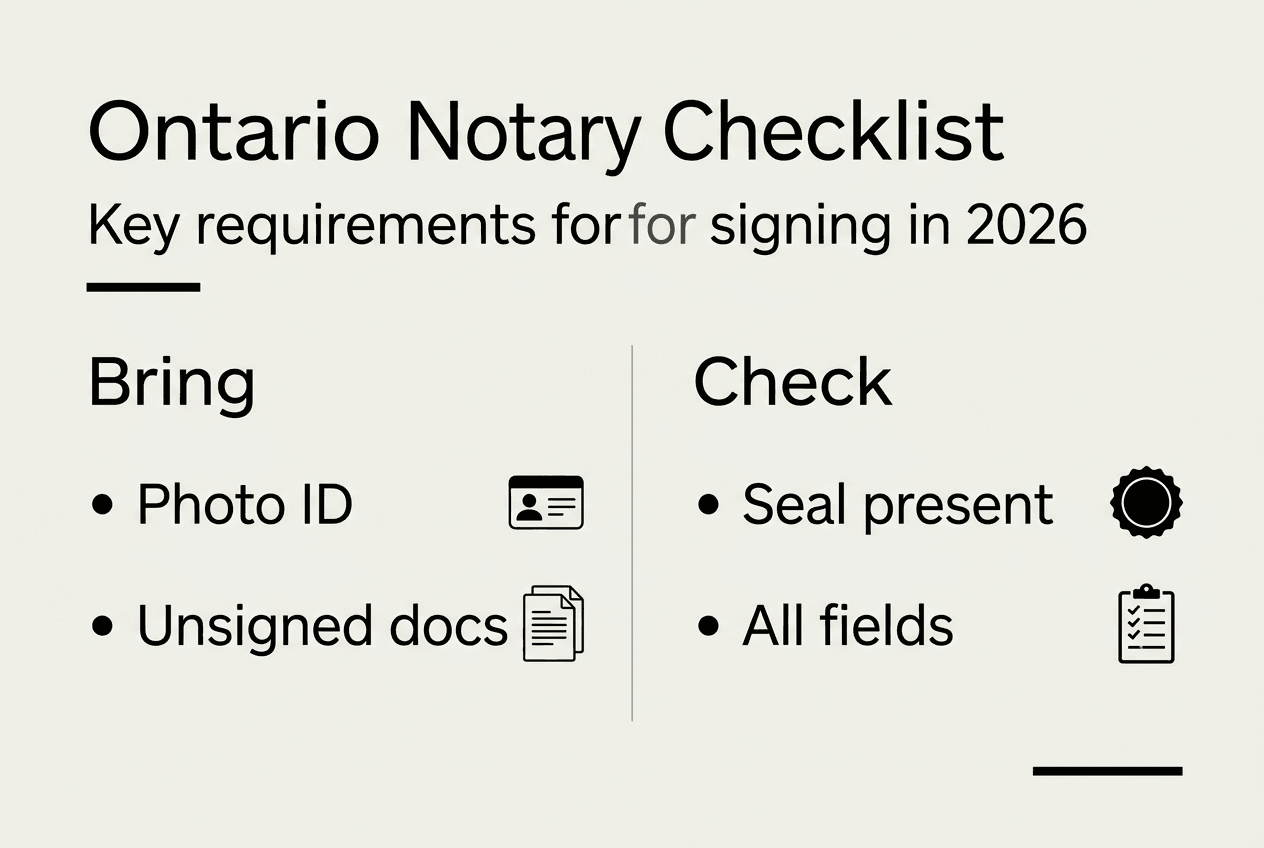
| Essential Item | Why You Need It | Notes |
|---|---|---|
| Government-issued photo ID | Verifies your identity | Must be current and original |
| Complete unsigned documents | Ready for witnessed signing | All fields filled except signatures |
| Supporting documentation | Provides context or proof | Depends on document type |
| Payment method | Covers notary fees | Cash, card, or e-transfer |
| Contact information | For notary follow-up | Email and phone number |
Pro Tip: Make photocopies of your ID and documents before your appointment. While notaries need to see originals, having copies helps you organize your materials and provides a backup record of what you submitted for notarization.
Step-by-step guide to the notary signing process in Ontario
Once you’ve gathered your materials, understanding the actual notarization procedure helps you know what to expect and participate confidently. The process follows a structured sequence designed to protect all parties and ensure legal validity.
Schedule your appointment with a licensed notary public or commissioner of oaths in Ontario. You can find notaries through law offices, dedicated notary services, or online platforms that offer remote notarization. Booking ahead ensures availability and gives you time to confirm requirements.
Arrive on time with all required documents and identification. Whether meeting in person or connecting online, punctuality shows respect for the notary’s schedule and allows sufficient time for thorough review without rushing.
Present your government-issued photo ID to the notary for verification. The notary will examine your ID carefully, comparing the photo and information to your physical appearance. This identity verification is the foundation of the entire notarization process.
Show your unsigned documents to the notary for review. The notary will read through your documents to understand their purpose and ensure they’re complete and ready for notarization. This is your opportunity to ask questions about any unclear sections.
The notary confirms you understand the document contents and are signing willingly without coercion. This verbal confirmation protects you from unwittingly signing something you don’t comprehend or agree to.
Sign the documents in the notary’s presence while they watch. This witnessed signature is what gives notarization its legal power, as the notary can later testify that you personally signed the document.
The notary applies their official seal or stamp and signature to your documents. This mark certifies that proper notarization procedures were followed and that the notary verified your identity.
Receive your notarized documents and any copies you requested. The notary may keep a record in their journal, but you’ll take the original notarized documents for your use.
Ontario’s 2026 legal framework recognizes both in-person and digital notarization with specific procedural rules. Electronic notarization follows the same fundamental steps but uses video conferencing technology for identity verification and digital signatures with encrypted seals. The notary still verifies your ID by having you hold it up to the camera, watches you sign electronically, and applies a digital notarial certificate.
Remote notarization became increasingly accepted during the pandemic and continues to offer convenience for busy professionals and those in remote areas. The legal validity matches traditional in-person notarization when performed by authorized notaries using approved platforms. Some institutions may still prefer physical notarizations for certain high-stakes documents, so confirming acceptance with the receiving party before choosing electronic options saves potential complications.
Proper notarization procedure is not optional or flexible. Skipping steps or failing to follow established protocols can render your documents legally invalid, potentially causing serious consequences when you try to use them for their intended purpose.
Understanding how to notarize documents in Ontario empowers you to participate actively in the process rather than passively following instructions without comprehension.
Common mistakes and how to avoid them during notarization
Even with the best intentions, simple oversights can derail your notarization and force you to start over. Knowing the typical pitfalls helps you sidestep them completely.
Incomplete documents rank among the most frequent notarization problems. Arriving with blank fields, missing pages, or unclear information forces the notary to refuse service until you correct the issues. Double-checking every section before your appointment, including dates, names, addresses, and specific details, ensures your documents are truly ready. If you’re unsure whether a field applies to you, research or consult a lawyer rather than leaving it blank.
Pre-signing documents before meeting the notary invalidates the entire purpose of notarization. The notary must witness your signature to certify your identity and willingness. If you’ve already signed, the notary cannot perform their verification role. Keep all signature lines blank until you’re sitting with the notary, even if it feels awkward to have unsigned documents.
Expired or photocopied identification causes immediate rejection. Notaries cannot accept IDs that have passed their expiration date, even by a single day, because they cannot verify the ID remains valid. Similarly, photocopies or digital images of IDs don’t provide the security features notaries need to confirm authenticity. Always check your ID expiration date well before your appointment and renew if necessary.
Errors like unsigned blank pages or incorrect ID can cause notarizations to be rejected. Unsigned certificate pages, missing initials on multi-page documents, or bringing the wrong type of ID for your specific document all create problems. Some documents require witnesses in addition to notarization, so understanding when notary is required in Ontario versus when other authentication methods suffice prevents unnecessary steps.
- Forgetting to bring multiple forms of ID when your primary ID might be questioned
- Not reading the document thoroughly before signing
- Assuming verbal agreements or side notes will be included in the notarized version
- Failing to ask about the notary’s record-keeping and whether you’ll receive copies
- Neglecting to confirm the notary’s jurisdiction covers your document type
Pro Tip: Call your notary the day before your appointment to confirm the exact documents and ID you’re bringing. This quick conversation catches any misunderstandings early and gives you time to gather missing items rather than discovering problems when you arrive.
Legal experts consistently warn that improper notarization can void contracts, invalidate affidavits, and cause documents to be rejected by courts or government agencies. The consequences of rushing through the process or ignoring requirements far outweigh the minor inconvenience of careful preparation.
What to expect after the notary signing: verification and validity
Your responsibilities don’t end when the notary hands you the completed documents. Verifying the notarization was performed correctly and understanding how to use your documents ensures they serve their intended purpose.
Inspecting the notary’s seal and signature immediately after receiving your documents catches any errors while you’re still present. The seal should be clear and legible, showing the notary’s name, commission number, and jurisdiction. The notary’s signature must be present and match their official records. Any smudges, incomplete stamps, or missing elements should be addressed before you leave, as returning later for corrections creates hassles.
Physical notarizations involve an embossed seal or inked stamp plus a handwritten signature, while electronic notarizations use digital certificates with encrypted signatures. Both methods carry equal legal weight in Ontario for most purposes, but some institutions maintain preferences. Banks processing international documents might require physical notarizations with original seals, while government agencies increasingly accept electronic versions for efficiency.
Notarized documents in Ontario carry legal weight but may require additional verification or filing depending on their type. Real estate documents often need registration with land registry offices. Court affidavits must be filed according to specific procedural rules. Powers of attorney may need to be provided to financial institutions or healthcare providers. Understanding the next steps for your specific document type ensures the notarization achieves its purpose.
Storing notarized documents properly protects your investment in the notarization process. Keep original notarized documents in a secure location like a fireproof safe or safety deposit box. Make several copies for situations where you need to provide documentation but want to preserve the original. Digital scans offer convenient backups and easy sharing, though some recipients require certified copies or originals.
| Aspect | Physical Notarization | Electronic Notarization |
|---|---|---|
| Convenience | Requires in-person meeting | Complete from anywhere with internet |
| Processing time | Immediate upon appointment | Often same-day or next-day |
| Legal acceptance | Universally accepted in Ontario | Accepted for most documents, verify for specific uses |
| Cost | Varies by notary and location | Often competitive or lower |
| Document security | Physical storage required | Encrypted digital storage |
| International use | May need apostille or authentication | Requirements vary by destination country |
Using your notarized documents effectively means understanding their scope and limitations. A notarized affidavit confirms you made statements under oath, but doesn’t guarantee the statements are true or will be believed. A notarized contract proves the signatures are authentic, but doesn’t make unenforceable terms suddenly valid. Notarization adds a layer of verification and solemnity, but doesn’t replace legal advice or due diligence.
- Keep a log of when and where you submitted notarized documents for your records
- Request certified copies from the notary if you anticipate needing multiple originals
- Understand expiration dates or renewal requirements for documents like powers of attorney
- Verify recipient requirements before submitting notarized documents to avoid rejections
Knowing notarized document validity in Ontario helps you plan for long-term document management and ensures you’re prepared when situations require authenticated paperwork.
Explore expert notary services online in Ontario
Now that you understand the complete notary signing process, partnering with experienced professionals makes execution smooth and stress-free. Expert online notary services in Ontario combine convenience with legal compliance, offering 24/7 availability for individuals and businesses who need reliable document authentication.

Professional online notaries handle everything from affidavits and statutory declarations to invitation letters and solemn declarations, guiding you through each step with personalized support. Whether you’re preparing documents for the first time or managing complex business agreements, accessing trusted notary expertise from your home or office saves travel time while ensuring your documents meet 2026 legal standards. Visit the preparation guide for online notary to get started, or explore the comprehensive guide to notarizing documents for detailed insights tailored to Ontario requirements.
Frequently asked questions
What is the notary signing process in Ontario?
The notary signing process involves a licensed notary public verifying your identity through government-issued ID, witnessing you sign legal documents, and applying their official seal to certify the signatures are authentic. This process can be completed in person at a notary’s office or online through approved electronic notarization platforms under current Ontario regulations.
Can notarizations be completed online legally in Ontario in 2026?
Yes, electronic notarization is legally recognized in Ontario for many documents under 2026 legislation. Online notarization uses secure video conferencing to verify identity and witness signatures, then applies digital certificates that carry the same legal weight as traditional notarizations. This provides greater convenience for individuals and businesses while maintaining strict compliance standards.
What documents typically require notarization in Ontario?
Documents like affidavits, statutory declarations, powers of attorney, real estate transactions, and business contracts usually require notarization in Ontario. International documents, consent forms for minors traveling abroad, and certain government applications also commonly need notarial certification. Requirements vary depending on the specific legal and institutional contexts where you’ll use the documents.
What identification is accepted for notarization in Ontario?
Government-issued photo IDs such as driver’s licenses, Canadian passports, provincial photo ID cards, and permanent resident cards are accepted for notarization. Your identification must be current and presented as an original document, not expired or photocopied. Some notaries may accept additional forms of ID, but confirming accepted types when booking your appointment prevents complications.
How long is a notarized document valid in Ontario?
A notarized document remains valid indefinitely unless the law or contract specifies otherwise. The notarization itself, which certifies the signature was witnessed and verified, doesn’t expire. However, certain documents like powers of attorney may have specific validity periods determined by their terms or applicable legislation, and some institutions may require recent notarizations for their purposes.