
If you’ve searched for “Canada consulate notarization” hoping to get your documents ready for international use, you’re not alone in feeling confused. Many Ontario residents assume a Canadian consulate or embassy handles their notarization needs, but that’s rarely how it works. Consulates abroad serve Canadians living overseas, not residents back home. If you’re in Ontario and need documents notarized for a visa application, foreign property deal, or immigration process, the right path runs through local notaries and government authentication, not a consulate office.
Table of Contents
- What is consulate notarization and who actually needs it?
- Ontario notarization basics: Online, traditional, and legal requirements
- Authentication vs. notarization: Why Ontario residents rarely need consulate help
- Practical steps: Getting your Ontario document ready for global use
- Our take: Cutting through the confusion for Ontario residents
- Ontario notary solutions: Next steps for secure, global-ready documentation
- Frequently asked questions
Key Takeaways
| Point | Details |
|---|---|
| Local notarization is key | Ontario residents rarely need consulate notarization; local notaries are sufficient for most international documents. |
| Authentication follows notarization | You must authenticate notarized documents for international use after local notarization. |
| Online notarization is valid | Ontario allows secure online notarization that meets international standards. |
| Consulate services are rare | Consulate notarization is only needed in specific cases, usually for Canadians living abroad. |
What is consulate notarization and who actually needs it?
Notarization is the process of certifying that a signature is genuine, a document is authentic, or that a person has sworn an oath before a qualified official. It creates a legally recognized record that foreign governments, courts, and institutions can trust. When people say “consulate notarization,” they usually mean getting a document certified through a Canadian embassy or consulate, but that’s a very specific service with a narrow audience.
Canadian consulates offer limited notarial services that are mainly designed for Canadians who are already living or traveling abroad and need help with documents required in that foreign country. Think of a Canadian working in Germany who needs to sign a power of attorney for a property sale back home. That person might visit the Canadian embassy in Berlin for notarial assistance. That’s the scenario consulates are built for.
Ontario residents who are physically in Canada almost never need to go through a consulate for notarization. Here’s a quick breakdown of who actually uses consulate notarial services:
- Canadians living as permanent residents in a foreign country
- Canadians temporarily abroad who need to execute Canadian legal documents
- Canadians who need certified copies of passports or identity documents while overseas
- Individuals in rare cross-border situations involving two governments simultaneously
For everyone else in Ontario, the process is much more straightforward. You work with a local notary public or commissioner of oaths, and then follow up with government authentication if the document is headed to another country.
“Most Ontario residents searching for consulate notarization actually need a local notary and a government authentication step. Understanding this distinction saves time, money, and frustration.”
If you’re still unsure what a notary actually does in the digital age, learning the online notary meaning can help clarify the role and scope of services available to you right now in Ontario.
Ontario notarization basics: Online, traditional, and legal requirements
Ontario residents have two main options when it comes to getting documents notarized: visiting a notary in person or using a regulated online notary service. Both are legally valid. Both can meet international standards. The difference is mostly in convenience and speed.
Ontario residents can access notary services locally and online to meet legal standards for international documents. For a notarization to be valid, several core requirements must be met:
- The notary must be a licensed professional in Ontario
- The person signing must be positively identified, usually through government-issued photo ID
- The notary must witness the signature or verify the document in real time
- The notary seal and signature must appear on the completed document
- The notary must confirm the signer understands what they’re signing
Online notarization in Ontario uses secure video conferencing technology. You connect with a notary over a live video call, present your ID on camera, and sign documents electronically. The notary applies a digital seal that carries the same legal weight as a physical one. This process is regulated and recognized for most international purposes.
The types of documents most commonly notarized for international use in Ontario include:
- Affidavits for immigration, legal proceedings, or foreign property matters
- Statutory declarations confirming facts for government agencies abroad
- Invitation letters for visa applications to countries like the United States, Schengen zone nations, and others
- Powers of attorney for managing assets or legal matters in another country
- Business documents such as corporate resolutions or shareholder agreements
Pro Tip: Before booking a notary appointment, confirm with the receiving institution abroad exactly what format they require. Some countries want a wet ink signature with a physical seal. Others accept electronic notarization. Knowing this in advance prevents you from having to redo the process.
The online notary benefits for Ontario residents are significant, especially for people with tight schedules or those in smaller communities without easy access to a notary office. Once notarized, many documents will also need to go through a document authentication guide process before they’re accepted internationally. Understanding that two-step flow is critical. You can also review the full process of notarizing online in Ontario to see exactly how it works from start to finish.
Authentication vs. notarization: Why Ontario residents rarely need consulate help
Here’s where most people get tripped up. Notarization and authentication are two separate steps, and confusing them leads to wasted time and rejected documents.
Notarization is done by a local notary public. It certifies that a signature is genuine or that a copy of a document is accurate. It’s a private professional service.

Authentication is a government process. It verifies that the notary who signed your document is legitimate and properly licensed. Foreign governments require this step before they’ll accept a Canadian document. Authentication is a government process, not a notary function, and it’s not typically managed by consulates inside Canada.
The standard order of operations for Ontario residents looks like this:
- Get the document notarized by a licensed Ontario notary public
- Obtain provincial authentication from the Ontario government if required
- Apply for federal authentication through Global Affairs Canada if the destination country requires it
- Submit to the foreign consulate or embassy only if that specific country requires a final consulate stamp (called legalization)
Note that step four only applies in certain situations. Many countries that have signed the Hague Apostille Convention skip the consulate step entirely and use a simplified apostille certificate instead.
Here’s a comparison to make the difference clear:
| Feature | Notarization | Authentication |
|---|---|---|
| Who does it | Licensed notary public | Government authority |
| What it confirms | Signature or document is genuine | Notary’s credentials are valid |
| Where it happens | Notary office or online | Ontario government or Global Affairs Canada |
| When it’s needed | Always first | After notarization, for international use |
| Consulate involved? | No | Rarely, only for legalization |
For most Ontario residents, Ontario document authentication through provincial or federal channels is the final step. A consulate only enters the picture if the destination country requires legalization, which is a separate process from authentication. Working with reliable online notary services ensures your notarization is done correctly the first time, which makes the authentication step go smoothly.
Practical steps: Getting your Ontario document ready for global use
Now that the concepts are clear, here’s a practical roadmap. The exact steps depend on the destination country, but this framework applies to most international document situations.
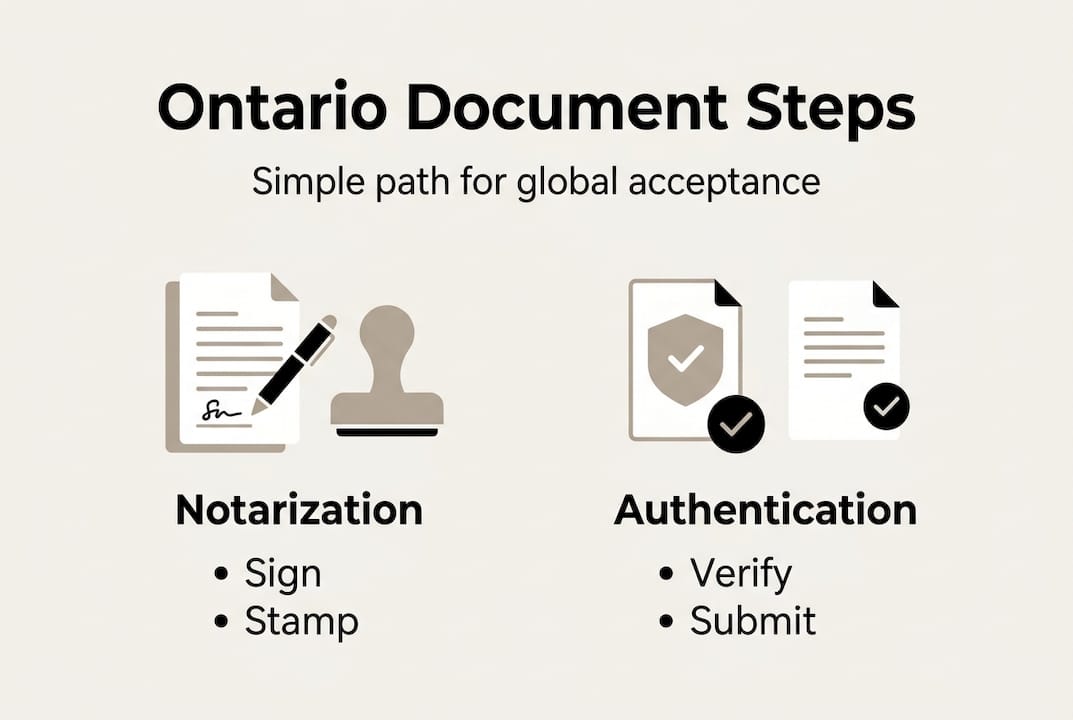
Ontario residents should notarize documents locally, then follow up with authentication for international acceptance. Here’s a data table showing common document types and what each step typically involves:
| Document type | Notarization needed | Authentication needed | Consulate step |
|---|---|---|---|
| Affidavit for visa | Yes | Often | Rarely |
| Invitation letter | Yes | Sometimes | Rarely |
| Power of attorney | Yes | Usually | Sometimes |
| Business resolution | Yes | Usually | Sometimes |
| Statutory declaration | Yes | Often | Rarely |
The most common mistakes Ontario residents make in this process:
- Skipping notarization and going straight to authentication. Authentication offices will reject a document that hasn’t been notarized first.
- Using an unqualified commissioner of oaths when the receiving country specifically requires a notary public. These are different roles.
- Relying on outdated information from forums or old government pages. Requirements change, and what worked two years ago may not work today.
- Forgetting to check apostille requirements. If the destination country is part of the Hague Convention, an apostille replaces the traditional authentication chain entirely.
Pro Tip: Always contact the foreign institution or consulate in the destination country directly before starting your document process. Ask them for their exact requirements in writing. This single step prevents the most common and costly errors.
Once you’ve confirmed the requirements, notarizing online is often the fastest first step. After notarization, you can move to document authentication Ontario through the appropriate government channel. Most people complete the full process in under two weeks when they follow the right order from the start.
Our take: Cutting through the confusion for Ontario residents
We’ve worked with hundreds of Ontario residents who came to us frustrated after spending weeks chasing the wrong process. The phrase “consulate notarization” is everywhere online, and it sends people in the wrong direction almost every time.
Here’s the uncomfortable truth: most of the confusion exists because consulate websites are written for a global audience, not specifically for Ontario residents. When a Canadian embassy in Vienna posts about notarial services, it’s speaking to Canadians living in Austria, not someone in Toronto trying to get a visa letter notarized.
What actually works in real Ontario cases is simple. Notarize locally, authenticate through the right government channel, and only involve a foreign consulate if that specific country’s rules require it. That’s it. The process is not complicated once you stop following advice meant for a completely different audience.
The costliest errors we see come from people who skip steps or reverse the order. Reviewing comparing notary services before you start can help you pick the right professional for your specific document type and destination country, which makes everything downstream faster and cleaner.
Ontario notary solutions: Next steps for secure, global-ready documentation
If your documents need to hold up internationally, starting with a trusted, regulated notary in Ontario is the foundation of the whole process.

At The Online Notary, we provide fast, legally valid notarization for affidavits, invitation letters, statutory declarations, solemn declarations, and more, all from the comfort of your home. Our trusted Ontario notary services are designed specifically for Ontario residents navigating international document requirements. Before your appointment, review the Ontario notary requirements so you arrive prepared, and check the updated notary ID for 2026 to make sure your identification meets current standards. We make the first step easy so the rest of the process goes smoothly.
Frequently asked questions
Do Ontario residents need consulate notarization for international documents?
Almost never. Consulate notarization is mainly for Canadians living abroad. Ontario residents should notarize locally and use government authentication for global acceptance.
What is the difference between notarization and authentication?
Notarization certifies that a signature or document is genuine, while authentication confirms the notary’s credentials are valid for foreign use. Authentication is a government process, not a notary function.
Can documents be notarized online in Ontario for international use?
Yes. Online notarization in Ontario is legally recognized and meets the standards required for most international documentation purposes.
How do I authenticate a notarized document for use abroad?
Start with Ontario notarization, then apply for authentication through the Ontario government or Global Affairs Canada depending on the destination country’s requirements.