
TL;DR:
- Notarization in Ontario requires a licensed notary public to verify identity, witness signing, and apply a seal.
- Only authorized lawyers and paralegals appointed as notaries can perform valid notarizations.
- Remote online commissioning is permitted for certain documents if all legal requirements are strictly followed.
Many Ontarians assume that signing a document in front of any professional makes it legally notarized. That assumption can lead to serious problems, including rejected applications, delayed court filings, and invalid affidavits. Notarization in Ontario follows strict rules set out under provincial law, and the process involves much more than a signature and a stamp. Whether you need an affidavit, a statutory declaration, or another legal document authenticated, understanding exactly what makes notarization valid will save you time, money, and frustration.
Table of Contents
- What does notarization mean in Ontario?
- Key steps for notarizing a document
- Who can notarize a document in Ontario?
- Remote and online notarization in Ontario: What’s allowed?
- Why understanding notarization details protects you and your business
- Get your documents notarized efficiently online
- Frequently asked questions
Key Takeaways
| Point | Details |
|---|---|
| Strict legal steps | A document is notarized only when all Ontario legal requirements are strictly followed. |
| Notary and commissioner roles | Not all officials can notarize—a licensed notary public is required for true notarization. |
| Remote commissioning limits | Only specific documents can be commissioned online under regulated procedures. |
| Identity verification | Proper government-issued photo ID must be verified for any notarization in Ontario. |
What does notarization mean in Ontario?
Notarization is one of those terms people use loosely, but it has a precise legal meaning in Ontario. It is not simply having someone watch you sign a piece of paper. It is a formal legal act performed by an authorized professional who follows a defined process under provincial law.
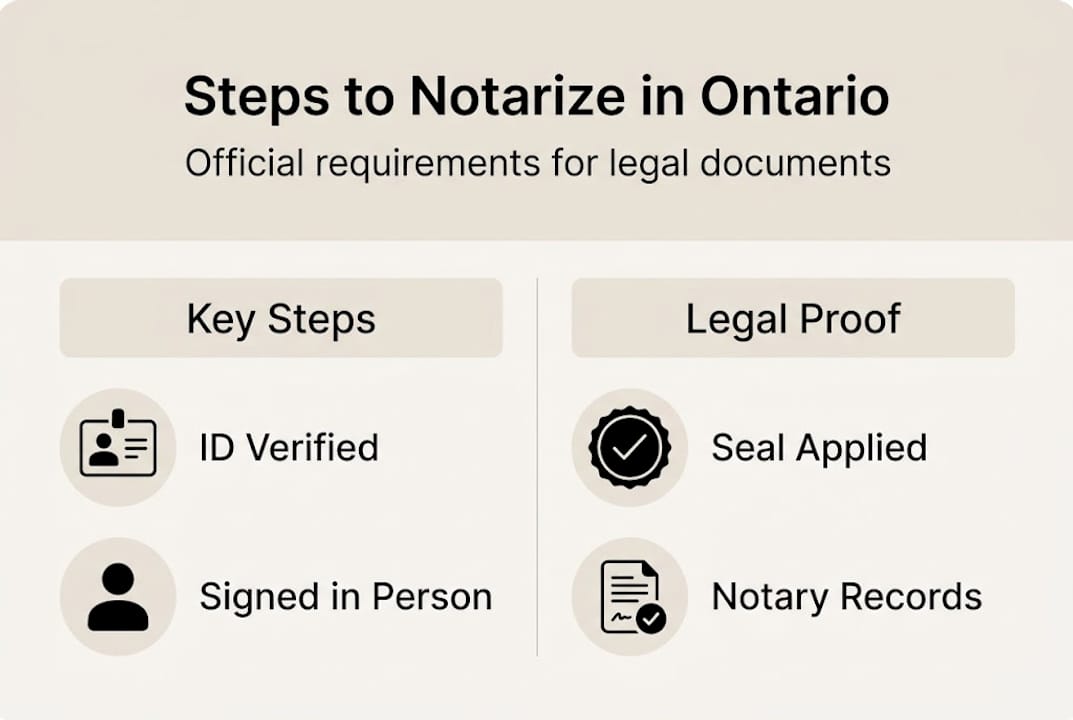
Under the Notaries Act RSO 1990 c N.6, a document is notarized when a licensed notary public verifies the signer’s identity, witnesses the voluntary signing, confirms the signer’s understanding of the document, and applies their official seal. Each of those four steps matters. Skip one, and the notarization is invalid.
A common myth is that any professional, such as a doctor, accountant, or bank manager, can notarize a document. They cannot. Only individuals with specific legal authority, as explained in the section on notary roles in Ontario, are permitted to perform true notarization.
Another widespread misconception is that a commissioner for oaths and a notary public are the same thing. They are not. A commissioner can administer oaths and witness certain declarations, but their authority is narrower than a notary’s.
“A document is notarized in Ontario when a licensed notary public verifies the signer’s identity, witnesses the voluntary signing, confirms their understanding, and applies their official seal, as governed by the Notaries Act RSO 1990 c N.6.”
Here is what every valid notarization in Ontario must include:
- Identity verification: The notary must confirm who you are using acceptable government-issued photo ID.
- Voluntary signing: The notary must witness you signing the document freely, without pressure.
- Competence confirmation: The notary must be satisfied that you understand what you are signing.
- Official seal and signature: The notary applies their seal and signature, making the document legally authenticated.
Understanding these requirements upfront prevents the most common errors people make when preparing legal documents. The notary public duties in Ontario are clearly defined, and any deviation from the process can render a document unacceptable to courts, government agencies, or foreign institutions.
Key steps for notarizing a document
Knowing the components of notarization is useful, but understanding how the process actually unfolds in practice is what prepares you for a smooth appointment. The steps are sequential, and each one builds on the last.
A licensed notary must verify identity, witness the signing, and ensure the person understands and agrees to the document. Here is how that plays out in real terms:
- Prepare your document in advance. Bring the unsigned document to the appointment. Do not sign it beforehand. The notary must witness the actual act of signing.
- Present valid government-issued photo ID. Acceptable forms include a Canadian passport, Ontario driver’s license, or permanent resident card. The notary identification needed depends on the document type, but two pieces of ID are often requested.
- The notary reviews the document. They check that it is complete, that no fields are blank, and that you appear to understand its contents.
- You sign in the notary’s presence. This is the moment of witnessing. The notary watches you sign and confirms it was done voluntarily.
- The notary applies their seal and signature. This is the final step that makes the document legally notarized.
- The notary records the transaction. Proper recordkeeping is part of the Ontario notary verification process and protects both parties if questions arise later.
Pro Tip: Never fill in blank spaces on a document after it has been notarized. Any alterations made post-notarization automatically void the document, and you will need to start the process again.
Common pitfalls include arriving with a pre-signed document, bringing expired ID, or submitting a document with blank fields. If you want to how to verify a notary before your appointment, you can check the Law Society of Ontario’s public registry to confirm their credentials are current.
Being prepared makes the entire appointment faster. Most notarizations, when everything is in order, take under 15 minutes.
Who can notarize a document in Ontario?
Not every professional with a legal background has notarization authority in Ontario. The rules are specific, and using the wrong type of professional can result in a document that gets rejected.

A notary public in Ontario is a lawyer or paralegal licensed by the Law Society of Ontario who has also been appointed by the Attorney General. That dual requirement is important. Licensing alone is not enough. The Notaries Act RSO 1990 c N.6 makes clear that lawyers and paralegals appointed as notaries by the Attorney General can notarize, while commissioners form a broader group that includes lawyers, paralegals, and court staff.
Understanding who can notarize in Ontario helps you avoid a frustrating and costly mistake. Here is a quick comparison:
| Professional | Can notarize? | Can commission oaths? | Seal required? |
|---|---|---|---|
| Notary public | Yes | Yes | Yes |
| Commissioner for oaths | No | Yes | No |
| Lawyer (not appointed as notary) | No | Yes | No |
| Court staff | No | Yes | No |
The distinction matters because many documents, especially those used internationally or in formal legal proceedings, specifically require a notary’s seal. A commissioned document without that seal will not meet the requirement.
Here is when to use each professional:
- Use a notary public for certified true copies, international documents, affidavits for court, and any document requiring an official seal.
- Use a commissioner for oaths for statutory declarations, domestic affidavits, and simpler sworn statements where a seal is not required.
Reviewing the full scope of notary public duties gives you a clearer picture of what each professional is authorized to handle, so you can match the right service to your specific document.
Remote and online notarization in Ontario: What’s allowed?
Digital services have changed how many legal tasks get done, and document notarization is no exception. But the rules in Ontario draw a firm line between what can happen remotely and what cannot.
True notarization, as defined under Ontario law, requires the notary and the signer to be in the same physical location. That requirement has not changed. However, commissioning, which covers many common documents like affidavits and statutory declarations, has more flexibility under O Reg 431/20, which permits remote commissioning via live video with proper identity confirmation and fraud prevention measures.
Here is a practical breakdown of what is and is not permitted remotely:
| Document type | In-person required? | Remote/online allowed? |
|---|---|---|
| Certified true copy | Yes | No |
| Affidavit for court | Typically yes | Sometimes, via commissioner |
| Statutory declaration | No | Yes, via live video |
| Solemn declaration | No | Yes, via live video |
| International notarization | Yes | No |
For the statutory declaration online process, the requirements include a live video connection, real-time identity verification using government-issued ID, and active fraud prevention steps by the commissioner. The session cannot be pre-recorded.
Pro Tip: Before booking any online commissioning service, confirm that the provider uses a live, synchronous video platform and that the commissioner is authorized under Ontario law. A recorded session or an asynchronous upload does not satisfy the legal requirements.
If you are unsure whether your document qualifies for remote commissioning, reviewing the requirements for online notarization gives you a clear checklist before you book.
Why understanding notarization details protects you and your business
Here is something most articles on this topic skip over: the real risk is not failing to notarize a document. It is notarizing it incorrectly and not realizing the problem until it is too late.
We have seen businesses submit contracts and affidavits that were witnessed by someone with no legal authority, only to have them rejected months into a legal process. The document looked official. It had a signature and a stamp. But it was not valid.
The rise of online options has made access easier, but it has also introduced providers who operate outside Ontario’s legal framework. Fraud risk is real when identity verification is weak or when the video session is not truly live. Understanding what notaries actually do and checking credentials before you book is not overcautious. It is smart practice.
For businesses handling cross-border transactions or immigration documents, the stakes are even higher. A rejected document can delay a visa, void a contract, or derail a court filing. Knowing the rules, and choosing a provider who follows them, is the only way to protect yourself.
Get your documents notarized efficiently online
Now that you understand what makes notarization valid in Ontario, the next step is finding a service that meets every legal requirement without the hassle of in-person appointments.

The Online Notary provides 24/7 access to licensed commissioners and notaries who handle affidavits, statutory declarations, solemn declarations, invitation letters, and more. Every session uses live video, real-time identity verification, and follows Ontario’s legal requirements exactly. You can explore all available Ontario notary services and get started in minutes. If you are also wondering how to legalize a document for international use, or want to confirm who can notarize in Ontario for your specific situation, both resources are available on the site.
Frequently asked questions
What is absolutely required for a document to be notarized in Ontario?
The document must be signed in the notary’s physical presence, with identity verified and an official seal applied, as required by the Notaries Act RSO 1990 c N.6. No seal, no valid notarization.
Can any lawyer notarize a document in Ontario?
No. Only lawyers or paralegals who are both licensed by the Law Society of Ontario and appointed as notaries by the Attorney General may notarize. Others may only act as commissioners for oaths.
When can a document be commissioned online?
Affidavits and statutory declarations can be commissioned online via live video when all identity and fraud prevention steps under O Reg 431/20 are properly followed by an authorized commissioner.
Is an online notarized document always valid in court?
Only when Ontario’s regulations on identity, document type, and process are fully satisfied. Remote commissioning has more flexibility than true notarization, which still requires physical presence for most document types.