
TL;DR:
- Ontario requires in-person notarization under the Notaries Act, making fully remote notarization illegal as of 2026.
- However, remote commissioning of oaths and declarations is permitted for specific documents under strict regulations, including verified identity and detailed record-keeping.
Many people in Ontario search for “online notarization” expecting a fast, fully digital solution — only to discover the rules are far more complex than a simple Google search suggests. The Law Society of Ontario (LSO) has confirmed online notarization is not permitted under the Notaries Act, meaning any service claiming to offer a fully remote notary in Ontario may be operating outside the law. But that does not mean all online document services are off the table. Understanding exactly where the line falls between what is legal and what is not could save you from costly rejections, delays, or worse.
Table of Contents
- Legal framework: What is (and isn’t) allowed online in Ontario
- How secure is remote commissioning in Ontario?
- Common pitfalls when securing online document services
- Security beyond compliance: Enterprise and emerging threats
- Why Ontario’s cautious digital approach protects you best
- Next steps: Secure your document services in Ontario
- Frequently asked questions
Key Takeaways
| Point | Details |
|---|---|
| Notarization requires in-person presence | All notarizations in Ontario must be done with the notary physically present as of 2026. |
| Remote commissioning is permitted | Certain oaths and declarations can be made online with a qualified commissioner under O. Reg. 431/20. |
| Security protocols are strict | Video verification, ID checks, encrypted platforms, and record-keeping are mandated for remote commissioning. |
| Check provider licensing | Use only LSO-licensed commissioners and avoid US-style RON platforms when in Ontario. |
| Businesses need additional safeguards | Enterprise solutions should provide audit trails and comply with Ontario-specific law—not just follow global trends. |
Legal framework: What is (and isn’t) allowed online in Ontario
Ontario’s rules around document authentication create two distinct categories, and mixing them up is the most common mistake people make. On one side, you have notarization. On the other, you have commissioning of oaths and declarations. These are not the same thing, and the law treats them very differently.
Notarization in Ontario requires physical presence. Full stop. Online notarization legality in Ontario is a topic that trips up many individuals and businesses, partly because Remote Online Notarization (RON) is widely available in many US states and people assume it works the same way here. It does not. Ontario notary services validity is governed by the Notaries Act, which still requires a notary public to be physically present with the person signing the document. No amount of secure video technology changes this requirement as of 2026.
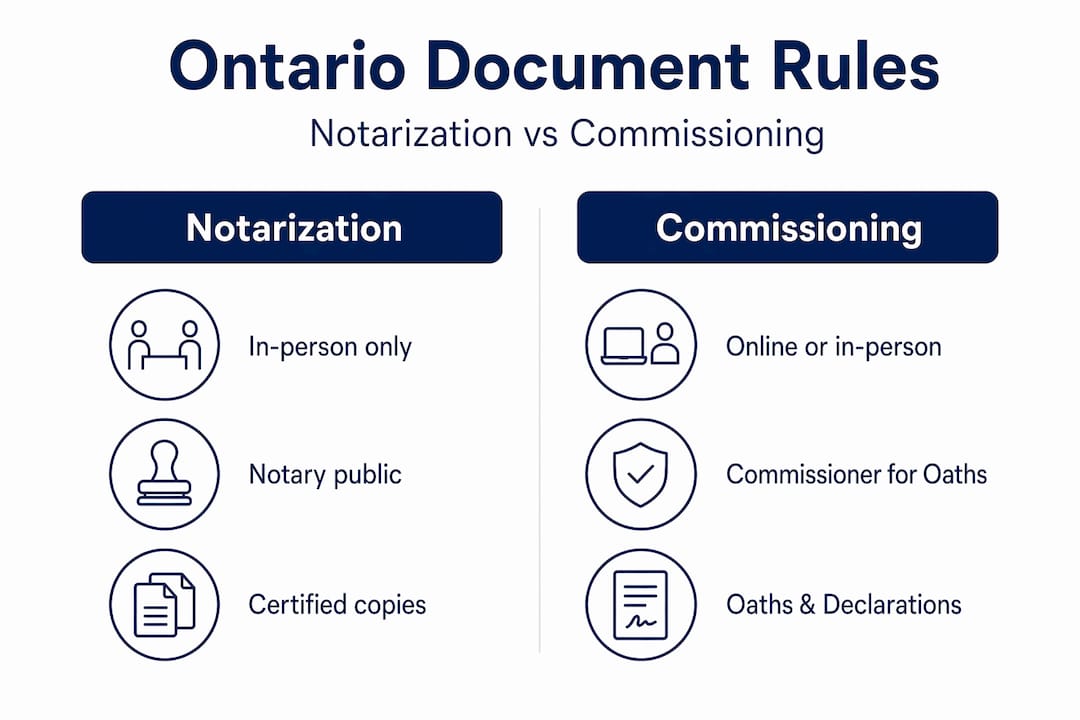
Remote commissioning of oaths and declarations is a different story. Under O. Reg. 431/20, commissioners of oaths are permitted to administer oaths and take declarations through real-time audio-visual communication. This is a meaningful legal pathway, but it comes with strict conditions and only applies to specific document types.
Here is a quick comparison to make this clear:
| Document type | Can it be done remotely? | Who can do it? |
|---|---|---|
| Notarized documents (e.g., certified copies, powers of attorney for foreign use) | No, in-person only | Notary public |
| Statutory declarations | Yes, via remote commissioning | Licensed commissioner of oaths |
| Affidavits | Yes, via remote commissioning | Licensed commissioner of oaths |
| Solemn declarations | Yes, via remote commissioning | Licensed commissioner of oaths |
| Invitation letters (supporting documents) | Depends on requirements | Varies by recipient country |
Understanding Ontario online notary legalities means knowing which category your document falls into before you book any service. Documents that genuinely require notarization cannot be substituted with remote commissioning, and attempting to do so risks invalidation by the receiving institution.
Key takeaways for matching your document to the right service:
- Affidavits, statutory declarations, and solemn declarations are eligible for remote commissioning under O. Reg. 431/20.
- Certified true copies, authentication for foreign use, and notarized powers of attorney require a notary public in person.
- Invitation letters typically need a commissioner or notary depending on the embassy or government body accepting them.
- Always confirm with the receiving institution what they specifically require before choosing a service type.
How secure is remote commissioning in Ontario?
With the legal distinctions clear, it is time to dig into security protocols and how Ontario ensures they work. The short answer is that remote commissioning under O. Reg. 431/20 is actually quite rigorous, and in some respects more verifiable than traditional paper-based processes.
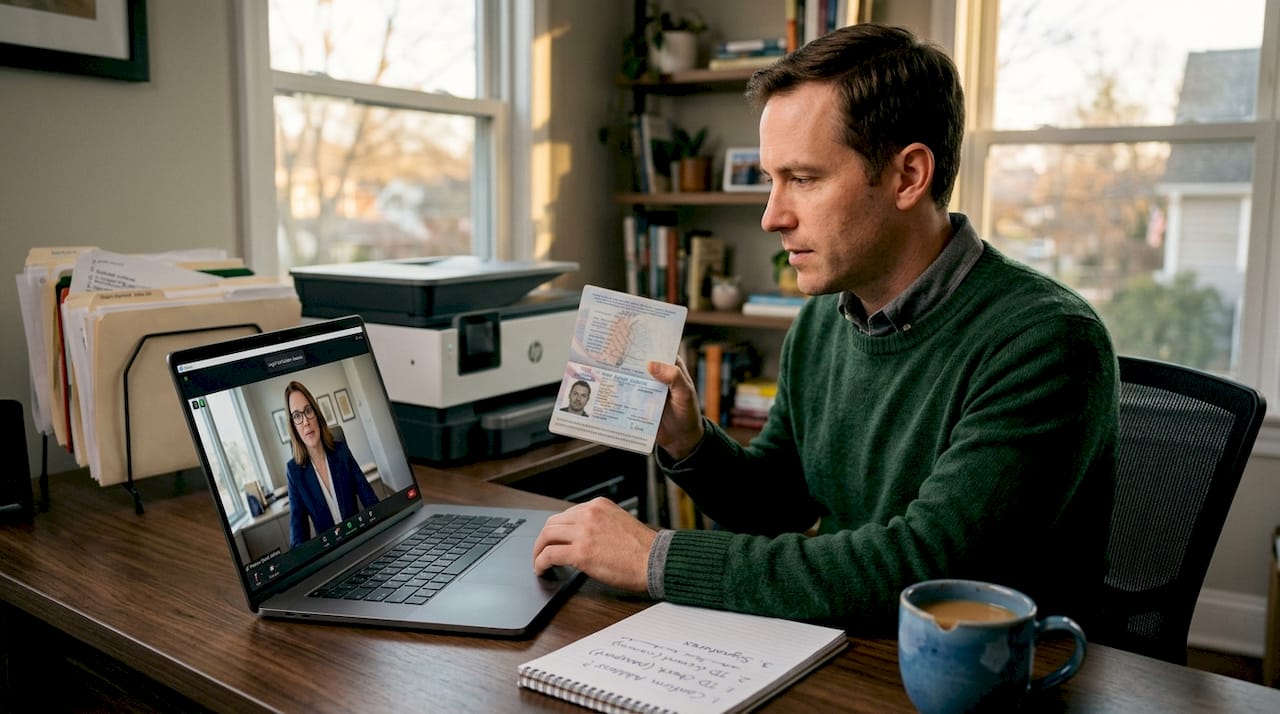
The security mechanics for remote commissioning include several non-negotiable steps. Both the commissioner and the declarant must be visible and audible to each other throughout the session. The commissioner must verify the identity of the person, typically by asking them to hold a government-issued photo ID up to the camera. The document must include a modified jurat, which is the closing clause of an affidavit or declaration that confirms how the oath was administered. This modified jurat must specify that the oath was taken remotely and note both the commissioner’s and declarant’s locations. The commissioner is also required to take reasonable precautions against interference and keep records of the transaction.
Here is a breakdown of how the remote process compares to traditional in-person commissioning:
| Security feature | Remote commissioning (O. Reg. 431/20) | Traditional in-person commissioning |
|---|---|---|
| Identity verification | Government ID shown on camera, visually confirmed | ID presented in person |
| Real-time confirmation | Mandatory live audio-visual | In-person presence |
| Transaction records | Required by regulation | Not always mandated |
| Modified jurat | Required, notes remote method | Standard jurat |
| Interference safeguards | Explicitly required | Implicitly expected |
“The requirement for a modified jurat and record retention actually creates a more auditable process than many traditional paper-based signings, which leave little to no documentation trail.”
The modified jurat is worth a closer look. It is not just a formality. It signals to any institution receiving the document that the oath was administered compliantly under Ontario law. If a document arrives without this specific language, it may be flagged as non-compliant even if the remote session itself went perfectly.
Ontario digital notary security also depends heavily on the platform being used. An encrypted video call through a professional legal platform is far more secure than an unrecorded in-person meeting where no records are kept.
Pro Tip: Before booking any remote commissioning service, ask the provider two questions. First, are they licensed by the Law Society of Ontario as a commissioner of oaths? Second, does their platform use end-to-end encryption and retain session records? If they cannot answer both questions clearly, keep looking.
Common pitfalls when securing online document services
Even with secure platforms, mistakes can happen, especially if Ontario-specific rules are ignored. The problems usually fall into a few predictable categories, and most of them are avoidable with a little upfront research.
Confusing commissioning with notarization is the single biggest pitfall. Many services marketed as “online notarization” in Ontario are actually offering remote commissioning. For many documents, this is perfectly fine. But if your document specifically requires a notary public, no amount of secure video commissioning will make it legally valid. The LSO has explicitly warned that online notary services purporting to notarize documents are invalid and may be subject to regulatory action.
Skipping identity verification is another common error, often made in haste. Some platforms allow users to proceed without rigorously confirming their identity through proper government-issued documentation. This creates serious compliance risk. A declaration taken without proper ID verification can be challenged and invalidated, leaving you back at square one, often at a critical moment.
Using US-style RON platforms is a trap that catches businesses in particular. Many enterprise organizations assume that because a platform is legal and widely used in, say, Texas or Florida, it will be accepted in Ontario. It will not. Ontario does not recognize Remote Online Notarization as practiced in US states, and online notarization compliance requires strict adherence to Ontario-specific regulations, not American ones.
Not checking for LSO licensing is a surprisingly common oversight. A commissioner of oaths must be licensed and in good standing. Checking this is straightforward but often skipped in the rush to get a document signed quickly.
Here are the key risks to avoid:
- Using a service that calls itself an “online notary” without confirming whether it is operating as a commissioner or a notary.
- Allowing document execution through a platform without encryption or session logging.
- Accepting a jurat that does not include the remote commissioning language required under O. Reg. 431/20.
- Assuming that documents produced for use abroad only need remote commissioning when they may also require apostille or consular authentication.
The LSO has drawn a clear line between services that are compliant and those that are not. Service providers who claim their remote commissioning is legal under O. Reg. 431/20 for eligible documents are correct. But those claiming to offer full remote notarization are not.
Pro Tip: Always ask for a copy of the completed document before your session ends. This gives you an immediate record showing the modified jurat language, the commissioner’s name, and the date, which you can verify against Ontario law.
Security beyond compliance: Enterprise and emerging threats
Beyond basic security, some organizations face even greater risks and requirements. Enterprise clients and high-volume users need to think beyond simple regulatory compliance and consider the full threat landscape.
Advanced platforms now offer features like detailed audit trails, multi-factor authentication (MFA), and session recordings stored in encrypted archives. These go well beyond what Ontario law requires but represent best practice for any organization handling sensitive legal documents at scale. Enterprise notarization platforms increasingly offer these features, though they must still comply with Ontario’s local rules rather than defaulting to US RON standards.
One emerging threat deserves special attention: deepfakes. As AI-generated video becomes more convincing, the risk of someone impersonating another person during a remote commissioning session is growing. Globally, deepfake fraud in identity verification is rising sharply, and legal technology platforms are beginning to incorporate liveness detection and AI-powered identity checks to counter this. Ontario’s framework does not yet specifically address deepfake threats, but organizations using remote commissioning for high-value documents should be asking their platform providers directly what safeguards they have in place.
Here is a practical checklist for enterprise-level security in remote document services:
- Confirm the platform uses end-to-end encryption for all sessions.
- Verify that audit trails are generated automatically for every transaction.
- Check that multi-factor authentication is required for both the commissioner and the declarant.
- Ask whether the platform uses liveness detection or AI-based ID verification to counter deepfake risks.
- Ensure session recordings are stored in a secure, access-controlled environment.
- Confirm that all Ontario-specific legal requirements, including the modified jurat, are built into the platform’s workflow.
Virtual notary security in Ontario is not just a compliance checkbox. It is a real risk management issue, and businesses that treat it that way will be far better protected against document fraud, rejected filings, and legal disputes down the line.
Why Ontario’s cautious digital approach protects you best
Stepping back, here is why Ontario’s strict approach may actually be a blessing in disguise, even if it feels like a frustrating limitation at first.
The US moved aggressively toward Remote Online Notarization, and the results have been mixed. Several states that introduced RON legislation quickly discovered gaps in fraud prevention, inconsistent platform standards, and documents that were challenged in court because the remote session did not meet minimum security standards. Ontario, by contrast, has drawn a hard line: notarization requires physical presence, and remote commissioning requires verified, regulated compliance. That clarity, while sometimes inconvenient, is also extremely protective.
When the LSO warns that online notary services are invalid, it is not being obstructionist. It is protecting you from documents that could be rejected by a court, an embassy, or a government agency, sometimes at the worst possible moment in an immigration process, a real estate transaction, or a legal proceeding.
The practical benefit to you as an individual or a business is real peace of mind. A document commissioned under O. Reg. 431/20 by a licensed commissioner using a compliant platform is a document you can submit with confidence. There is no ambiguity, no risk of a surprise rejection, and no need to redo the process. That is worth more than the convenience of a faster but legally questionable shortcut.
Explore the Ontario remote notary guide to understand the full landscape before committing to any service. Ontario’s approach is not perfect, and there is a genuine argument for modernizing the Notaries Act to allow properly regulated RON in the future. But until that happens, working within the current framework is the only path to documents that will actually hold up when it matters.
Next steps: Secure your document services in Ontario
Armed with knowledge and a healthy skepticism, here is how to move forward securely. Whether you need a statutory declaration for immigration, an affidavit for a legal proceeding, or a solemn declaration for a government application, the right service is available in Ontario right now.

The key is choosing a platform that is fully compliant with Ontario law, staffed by LSO-licensed commissioners, and built on encrypted, audit-ready technology. For documents requiring true notarization, an in-person appointment with a qualified notary public is still the only legal route. For everything else, remote commissioning through a trusted, regulated service is both legal and genuinely secure.
Visit trusted online notary services to see exactly what can be handled remotely and what requires an in-person appointment. You can also review the full breakdown of Ontario notary requirements to confirm what your specific document needs before booking. Taking fifteen minutes to verify the right service type now will save you hours of frustration later.
Frequently asked questions
Can I use a remote notary for legal documents in Ontario?
No, Ontario law requires notaries to be physically present with the person signing; online notarization is not permitted under the Notaries Act as of 2026, though remote commissioning of oaths is allowed for eligible documents.
What documents are eligible for remote commissioning in Ontario?
Oaths, affirmations, and statutory declarations can be commissioned remotely by a licensed commissioner of oaths via real-time audio-visual communication, but they cannot be notarized online.
What security measures are required for remote commissioning?
Under O. Reg. 431/20 requirements, the commissioner must confirm identity via government-issued ID on camera, use an encrypted platform, include a modified jurat noting the remote method, and retain transaction records.
What’s the difference between a notary public and a commissioner for oaths in online processes?
A notary public must act in person under the Notaries Act, while a commissioner of oaths can administer oaths remotely if licensed and compliant with Ontario’s remote commissioning regulations, including use of a modified jurat.
Are US-style remote online notary services valid in Ontario?
No. US RON services are not recognized in Ontario and documents produced through them may be rejected or declared invalid by courts, government agencies, and foreign institutions.
Recommended
- Secure Online Notarization in Ontario: Step-by-Step Guide – The Online Notary
- Step-by-step online notarization instructions for Ontario – The Online Notary
- Master the online notarization process in Ontario: guide – The Online Notary
- How to Notarize Online in Ontario 2025: Easy Guide – The Online Notary