
TL;DR:
- Proper notarization verifies a document’s authenticity and is legally required for many important processes in Ontario.
- Only authorized notaries or commissioners can notarize documents, depending on the document’s purpose and use.
- Planning ahead and confirming specific requirements prevent delays and rejection, especially for international or legal documents.
Many Ontario residents assume a signature alone makes a document legally binding. That assumption causes real problems, from rejected visa applications to delayed court filings. Notarization is a formal legal process that adds a layer of authenticity and accountability to important documents, and skipping it can have serious consequences. Whether you’re submitting an affidavit, sponsoring a visitor, or sending business contracts abroad, knowing which documents require notarization in Ontario protects you from costly mistakes. This guide breaks down every key document type, explains who can notarize, and shows you how to get it done correctly.
Table of Contents
- Understanding notarization: The basics and why it matters
- Documents commonly requiring notarization in Ontario
- Affidavits, statutory declarations, and legal forms: Key differences
- Notarization for international use and business documents
- Avoiding common notarization mistakes in Ontario
- Perspective: What most people miss about notarization in Ontario
- Get your documents notarized—quickly and online
- Frequently asked questions
Key Takeaways
| Point | Details |
|---|---|
| Know what needs notarization | Affidavits, statutory declarations, certified copies, and travel forms often require notarization in Ontario. |
| Legal validity matters | Only authorized notaries or commissioners of oaths can ensure your documents are legally recognized. |
| International use has extra steps | Documents going abroad may need additional legalization beyond notarization. |
| Prepare to avoid mistakes | Check document requirements, bring valid ID, and verify instructions to prevent costly rejections. |
Understanding notarization: The basics and why it matters
Notarization is the process by which an authorized official verifies the identity of a document signer, witnesses the signing, and applies an official seal or signature to confirm the document’s authenticity. It is not just a formality. Courts, government agencies, banks, and foreign institutions rely on notarization to confirm that a document is genuine and that the person who signed it is who they claim to be.
In Ontario, who can notarize documents is strictly regulated. Only a public notary or commissioner of oaths is authorized to notarize documents in Ontario, and each role carries specific powers and limitations. A public notary can handle a broader range of documents, including those intended for international use, while a commissioner of oaths is typically limited to domestic sworn statements.
Understanding when notarization is required helps you avoid submitting incomplete paperwork. Here are the most common situations where notarization is legally necessary:
- Submitting documents to a court or tribunal
- Applying for immigration or travel documents
- Transferring property or signing real estate agreements
- Executing a power of attorney
- Sending legal documents to foreign governments or institutions
The risks of skipping notarization are real. Documents without proper notarization are often rejected outright, which can delay legal proceedings, stall immigration applications, or invalidate business contracts. As Ontario notary public info confirms, the notarization process exists to protect all parties involved by ensuring documents are authentic and legally enforceable.
“A document that looks official but lacks proper notarization may have zero legal standing in court or before a government body.”
Documents commonly requiring notarization in Ontario
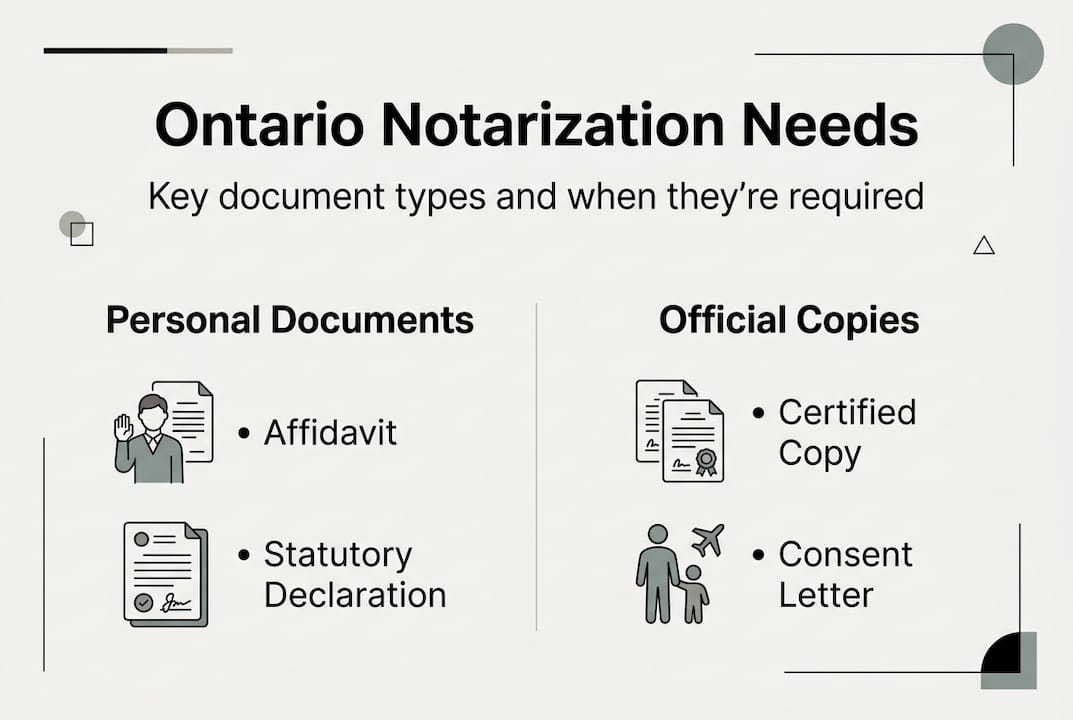
With a clear foundation in place, it helps to know exactly which documents typically require notarization in Ontario. Common documents needing notarization include affidavits, statutory declarations, certified true copies, consent letters, and invitations, along with a range of other legal and personal forms.
Here is a breakdown by category:
- Affidavits: Sworn written statements used in court proceedings, family law matters, or immigration cases. See types of affidavits to understand which format applies to your situation.
- Statutory declarations: Formal written statements declared true before a notary, often used for name changes, lost documents, or business purposes. Review statutory declaration samples for practical examples.
- Certified true copies: Notarized copies of original documents like passports, diplomas, or birth certificates, confirming the copy matches the original.
- Consent letters: Used when a minor is traveling without both parents or guardians, required by Canadian border services.
- Invitation letters: Often required for visa applications to confirm a host’s identity and relationship to the applicant.
Some documents only require notarization in specific contexts. A standard lease agreement, for example, does not always need notarization unless a foreign institution or court requests it. The Government of Canada guide provides additional context for immigration-related document requirements.
| Document type | Typical use case | Notarization required? |
|---|---|---|
| Affidavit | Court filings, immigration | Yes |
| Statutory declaration | Government applications | Yes |
| Certified true copy | Credential verification | Yes |
| Consent letter | Child travel | Yes |
| Standard lease | Rental agreement | Usually no |
| Invitation letter | Visitor visa support | Often yes |
For documents going abroad, the rules change significantly. Learn more about notarizing documents online if you need a faster, more flexible option.
Pro Tip: Always confirm notarization requirements directly with the receiving institution before your appointment. Requirements vary by country, court, and government agency.
Affidavits, statutory declarations, and legal forms: Key differences
Many people use the terms affidavit and statutory declaration interchangeably, but they are not the same thing. Affidavits and statutory declarations serve different legal purposes and follow distinct formal requirements in Ontario. Choosing the wrong form can result in rejection or require you to start over.
Here is a simple comparison:
| Form type | Sworn under oath? | Used in court? | Common use |
|---|---|---|---|
| Affidavit | Yes | Yes | Legal proceedings, immigration |
| Statutory declaration | No (affirmed) | Sometimes | Government records, business |
| Sworn statement | Yes | Yes | Witness accounts, depositions |
An affidavit is a written statement of facts that the signer swears is true under oath before a notary or commissioner. It is commonly used in court cases, family law matters, and immigration hearings. Review the distinction between an affidavit vs sworn statement to avoid confusion when filling out legal forms.

A statutory declaration does not involve swearing an oath but instead involves a solemn affirmation. It is widely used for administrative purposes, such as declaring a lost document or confirming a business relationship. Understanding the purpose of statutory declaration helps you use it correctly in the right context.
Follow these steps to choose the right form:
- Identify who is requesting the document (court, government agency, bank, or foreign institution).
- Ask whether the document must be sworn under oath or simply affirmed.
- Check whether the document will be used in legal proceedings or for administrative purposes.
- Confirm the required format with the Ontario affidavits guide before drafting anything.
- Have the completed document reviewed by your notary before signing.
Getting this right the first time saves significant time and stress, especially when deadlines are involved.
Notarization for international use and business documents
When documents cross borders, the notarization requirements become more complex. Documents for use abroad or involving foreign institutions almost always require notarization, and sometimes legalization or apostille. Canada is not a signatory to the Hague Apostille Convention, which means Canadian documents often require a multi-step authentication process before they are accepted internationally.
Business documents that frequently require notarization include:
- Powers of attorney for international transactions
- Incorporation papers and corporate resolutions
- Contracts with foreign partners or clients
- Bank account opening documents for overseas institutions
- Employment verification letters for foreign work permits
The process for international use typically involves notarization first, followed by authentication through Global Affairs Canada, and then legalization by the destination country’s embassy or consulate. This sequential process takes time, so planning ahead is critical. Notarial services abroad provides guidance for Canadians dealing with document needs outside the country.
For domestic business purposes, when a notary is required depends on the type of transaction and the institutions involved. Real estate deals, shareholder agreements, and certain financial instruments routinely require notarized signatures.
“Skipping the legalization step after notarization is one of the most common reasons international business documents are rejected abroad.”
Pro Tip: If your document is heading to a country that requires an apostille, contact Global Affairs Canada early. The authentication process can take several weeks, and delays can affect contract timelines or visa approvals.
Avoiding common notarization mistakes in Ontario
Even when people know they need notarization, they often arrive unprepared and face delays or outright rejection. Ontario notarization is only valid with proper identification presented and the document signed in the notary’s presence. That single requirement trips up more people than you might expect.
Here are the most frequent mistakes to avoid:
- Signing the document before the appointment. Never sign a document that requires notarization before you are in front of the notary. A pre-signed document cannot be notarized.
- Bringing insufficient identification. You need government-issued photo ID. A health card alone is not always accepted. Bring your passport or driver’s license.
- Using the wrong document type. Submitting a statutory declaration when an affidavit is required, or vice versa, will result in rejection.
- Missing supporting documents. Some notarizations require additional paperwork, such as the original document for a certified copy.
- Not confirming recipient requirements in advance. Different courts, agencies, and institutions have specific formatting and wording requirements.
Follow the Ontario notarization steps to prepare correctly before your appointment. The official Ontario notary rules also outline what notaries are legally permitted to do and what falls outside their authority.
Pro Tip: Call or email the receiving institution before your notary appointment and ask for their exact requirements in writing. This one step eliminates most rejection scenarios.
Perspective: What most people miss about notarization in Ontario
Here is something most articles won’t tell you: the biggest notarization problem in Ontario is not fraud or forgery. It is timing. People consistently underestimate how early they need to start the process, especially when international use or multiple institutions are involved.
We see it regularly. Someone needs a notarized document for a visa application or a real estate closing, and they contact us two days before the deadline. Sometimes that works out. Often it does not, particularly when the document also needs authentication or legalization.
The other thing people miss is that a signature alone carries almost no legal weight in high-stakes situations. A bank, a court, or a foreign government does not care how sincere you are. They care whether the document meets their formal requirements. Assuming your signature is enough is the kind of mistake that costs people visa approvals, business deals, and court deadlines.
Knowing key legal notarization moments before you need them puts you in control of the process instead of scrambling at the last minute. Start early, confirm requirements, and treat notarization as a planned step, not an afterthought.
Get your documents notarized—quickly and online
Now that you understand which documents require notarization and how to avoid the most common mistakes, the next step is straightforward. Getting your documents notarized does not have to mean taking time off work or traveling across the city.

Our Ontario notary services make it easy to handle affidavits, statutory declarations, invitation letters, solemn declarations, and more from wherever you are in Ontario. We are a licensed online notary service, fully compliant with provincial requirements. Learn more about the notary role in Ontario and review the notary requirements in Ontario to confirm we cover your document type. Book your appointment online today and get it done right the first time.
Frequently asked questions
Which documents require notarization in Ontario?
In Ontario, affidavits, statutory declarations, certified true copies, consent letters, and many legal forms typically require notarization before use in legal or government matters.
Can I notarize documents online in Ontario?
Yes, Ontario allows online notarization for many documents. Legal professionals can now notarize documents online using approved technology, provided you use a licensed online notary service.
What identification do I need for notarization in Ontario?
You must present government-issued photo ID, such as a driver’s license or passport. Ontario notarization is only valid with proper identification presented and the document signed in the notary’s presence.
Is there a difference between certified true copies and notarized copies?
Certified copies are verified by a notary as authentic reflections of original documents, while notarization can also involve witnessing signatures or declarations depending on the document type.