
TL;DR:
- Many Ontario school applications require notarized documents such as transcripts, affidavits, and custodian declarations to prevent delays or rejection. Only authorized professionals like notaries public, commissioners of oaths, or lawyers can validly notarize these documents, with online services offering convenient options. Properly understanding the specific document types and authorization processes ensures smooth submission and compliance with legal requirements.
Whether you’re enrolling an international student or applying for OSAP funding, notarized documents for school can stop an otherwise complete application in its tracks. Many Ontario parents and students spend weeks gathering transcripts, consent forms, and identity records, only to discover at the last minute that a notary’s seal was required all along. This guide cuts through that confusion. You’ll learn exactly which documents need notarization, who can do it, how the process works, and what legal details matter most for Ontario’s educational context.
Table of Contents
- Key takeaways
- Common notarized documents for school in Ontario
- Who can notarize school documents in Ontario
- How to get your school documents notarized
- Legal considerations for Ontario educational documents
- My perspective on getting this right
- Simplify the process with Theonlinenotary
- FAQ
Key takeaways
| Point | Details |
|---|---|
| Know which documents need notarization | Transcripts, custodian declarations, affidavits, and consent forms are the most common school documents requiring notarization in Ontario. |
| Understand who can notarize | Only a notary public, commissioner of oaths, or lawyer is authorized to notarize school documents in Ontario. |
| Plan well ahead of deadlines | Schools and funding bodies can reject applications if notarized documents are missing, delaying admissions or OSAP approval. |
| Online notarization is available | Ontario residents can access flexible, remote notary services without visiting an office in person. |
| Legal document types are not interchangeable | Affidavits, statutory declarations, and notarized copies each serve different legal functions and cannot substitute for one another. |
Common notarized documents for school in Ontario
The term “notarized” gets used loosely in school communications, which creates real problems. A notarized copy of a birth certificate is not the same thing as an affidavit. Knowing the specific document your school actually needs saves you significant time.
Here are the most common school-related documents that require notarization in Ontario:
- Transcripts and diplomas. When applying to graduate programs, transferring between institutions, or submitting credentials to a foreign school, you often need a notarized transcript. The notary certifies the registrar’s signature as authentic, not the content of the transcript itself.
- Custodian Declaration forms. For international students studying in Ontario, this form is mandatory. This form requires notarization in two separate parts: once in the student’s home country and once in Canada. Missing either notarization will disqualify the application.
- Affidavits. These are sworn statements used when official records are unavailable. For example, OSAP applications may require an affidavit when a student cannot produce a marriage certificate, tax slip, or other formal document to verify financial or personal information.
- Notarized parent consent forms. Younger students attending school without a parent or guardian in Ontario may require a notarized letter confirming parental consent for a custodian arrangement.
- Identity verification documents. Certified true copies of passports, birth certificates, or permanent resident cards are often requested during school enrollment for student identity verification purposes.
The distinction between domestic and international student requirements matters enormously here. For a domestic Ontario student, notarization is most commonly needed for OSAP-related affidavits or certified document copies. For international students, the requirements multiply: notarized custodian declarations, notarized transcripts from foreign institutions, and sometimes notarized translations of records not originally in English or French. You can get a fuller picture of which Ontario documents require notarization across different contexts before starting your application package.
Who can notarize school documents in Ontario
Not every official-looking stamp counts as notarization. Ontario has specific rules about who is authorized to perform this function, and submitting a document certified by the wrong person is the same as submitting nothing at all.
In Ontario, the following professionals are authorized to notarize documents:
- Notaries public. These are the most commonly used professionals for educational document notarization. They hold a specific commission from the province and can certify documents, administer oaths, and authenticate signatures.
- Commissioners of oaths. These professionals can witness and certify sworn statements and declarations, though their authority is more limited than a notary public’s.
- Lawyers. Licensed lawyers in Ontario can also perform notarizations, particularly for affidavits and statutory declarations.
One fact that surprises many families is that some schools have a notary on staff who can handle transcripts and diplomas directly, but this varies widely across institutions. Most secondary schools do not provide this service. Post-secondary institutions are more likely to, but you should call ahead rather than assume.
For families who cannot easily reach a walk-in notary office, online notarization is now a legitimate and growing option in Ontario. Remote notarization services allow you to complete the process via video call, which is particularly convenient for parents managing work schedules or students who have already relocated. Before booking any service, verify that the notary holds a valid Ontario commission. You can check credentials through the Law Society of Ontario’s public directory.

Pro Tip: Never bring a school badge or student card as your primary ID to a notarization appointment. Government-issued photo ID is required by law for identity verification, meaning your driver’s license or passport.
If you are unsure whether a specific professional is qualified to notarize your school documents, the article on who can notarize in Ontario lays out the authorization rules clearly.
How to get your school documents notarized
The process is more straightforward than most people expect, but small mistakes early on can mean starting over. Follow these steps to get it right the first time.
Identify exactly what the school requires. Read the admissions checklist carefully. Schools often specify not just that a document must be notarized, but what type of notarization is needed (certified true copy, jurat, or acknowledgement). When in doubt, call the admissions office directly.
Gather your original documents. You need originals, not photocopies, to present at your appointment. A notary certifying a copy needs to see the authentic original document to confirm the copy is accurate.
Bring valid government-issued photo ID. Your passport, Ontario driver’s license, or permanent resident card will work. Student cards will not.
Schedule your notarization appointment. Book either in-person or online. For a clear walkthrough of the full procedure, the guide on how to notarize documents in Ontario is a practical resource.
Attend the appointment and sign in front of the notary. Do not pre-sign documents that require a jurat. The notary must witness your signature. If you sign beforehand, the notary cannot complete the process and you will need a new document.
Review the completed document before leaving. Check that the notary’s seal is clear, the date is correct, and the notary’s name and commission number appear on the document.
Submit promptly. Missing notarized documents can delay admissions or OSAP approvals significantly. Submit well before the deadline, not on the day of.
Pro Tip: If the school is abroad and requires authentication beyond notarization, ask your notary about apostille or consular legalization at the time of your appointment. These are separate steps that add time and should not be left until the last minute. The guide to Canada consulate notarization explains this process for Ontario residents.
Legal considerations for Ontario educational documents
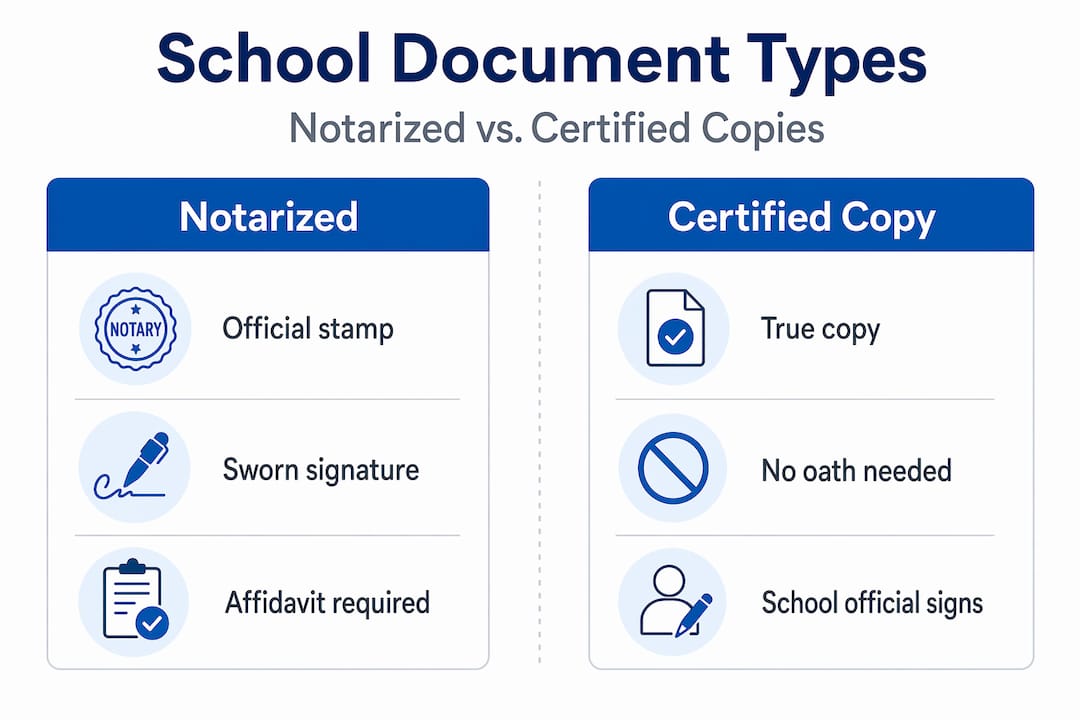
This is where things get genuinely nuanced, and where most families make their most costly mistakes. The words “affidavit,” “statutory declaration,” and “notarized document” sound interchangeable. They are not.
These three document types serve distinct legal functions and are required in specific scenarios. Submitting the wrong type, even with a valid notary seal, will result in rejection.
| Document type | What it does | When schools need it |
|---|---|---|
| Notarized copy | Certifies a copy is a true reproduction of an original | Transcripts, passports, diplomas for admissions |
| Affidavit | Sworn statement of facts, signed under oath | OSAP applications when official records are unavailable |
| Statutory declaration | Solemn statement without an oath, used for formal purposes | Custodian arrangements, name change confirmations |
Beyond document type, there is the question of authentication. Notarization alone is sometimes not enough. If your school documents are going to be used outside Canada, or if a foreign institution is sending certified records to Ontario, notarization may need to be followed by an apostille or consular legalization. The type of notarization required (acknowledgement vs. jurat) also depends on the destination school’s jurisdiction.
For international student applications specifically, the layered requirements are real. The Custodian Declaration form requires notarization in two countries. Transcripts from foreign institutions may need both a notarized translation and a notarized copy of the original. Understanding affidavit use for students in Ontario can help clarify when an affidavit is genuinely required versus when a simpler certified copy will do.
One nuance worth knowing: jurats require the signer to swear to the truth of the document’s contents, while acknowledgements only confirm the signer’s identity and willingness to sign. Schools in different jurisdictions may specify one over the other without explaining why. Asking your notary which form of notarization a specific school requires is always the right move.
My perspective on getting this right
I’ve worked with enough Ontario families navigating notarization for education to spot the pattern clearly. The mistake almost everyone makes is treating notarization as the last step, something to handle in the final days before a deadline. It never works out well.
What I’ve learned is that the real problem isn’t the notarization itself. It’s the upstream confusion about what type of notarization the school actually needs. I’ve seen families arrive with a beautifully notarized affidavit when the school needed a certified true copy. Both had a notary’s seal. Only one was accepted. That kind of mismatch costs weeks.
My advice is to contact the admissions office before you book a single appointment. Ask them specifically: what type of notarization, what documents in original form, and whether the destination jurisdiction requires anything beyond the notary’s seal. Get that confirmation in writing if you can.
The other thing I’d push back on is the assumption that online notarization is somehow less legitimate than in-person. In Ontario, remote notarization by a commissioned notary public carries the same legal weight. For busy parents, it’s often the only realistic option. Don’t dismiss it.
— Ken
Simplify the process with Theonlinenotary
Getting notarized documents for school sorted on a tight timeline is stressful enough without adding an inconvenient office visit to the list. Theonlinenotary provides professional notary services for Ontario families entirely online, including certified true copies, affidavits, statutory declarations, and custodian declaration support for school applications.

Whether you need a notarized transcript for a university application, an affidavit for OSAP, or a custodian declaration for an international student, you can book a session and complete the process via secure video call at a time that works for you. Theonlinenotary’s Ontario notary services are available 24/7, so a deadline the next morning doesn’t have to mean a scramble tonight. If you want to compare your options before committing, the best online notary guide for 2025 walks through what to look for in a qualified provider.
FAQ
What notarized documents do schools typically require in Ontario?
The most common notarized documents for school in Ontario include certified true copies of transcripts or diplomas, custodian declaration forms for international students, notarized parent consent letters, and affidavits for OSAP applications when standard records are unavailable.
Can a commissioner of oaths notarize school documents in Ontario?
Yes, a commissioner of oaths can witness and certify sworn statements and declarations, but their authority is more limited than a notary public’s. For certified true copies of transcripts or complex school documents, a notary public is generally the safer choice.
How long does the notarization process take for school documents?
With an online notary service, the process can often be completed in under an hour once you have your original documents and valid government-issued photo ID ready. In-person appointments may vary depending on availability.
Do international students need notarization in two countries?
Yes. The Custodian Declaration form required for Ontario international student applications must be notarized in two jurisdictions, once in the student’s home country and once in Canada, to meet provincial admissions requirements.
Is online notarization legally valid for school documents in Ontario?
Yes. Remote notarization performed by a commissioned Ontario notary public carries the same legal validity as in-person notarization, making it a fully accepted option for educational document notarization across the province.