
TL;DR:
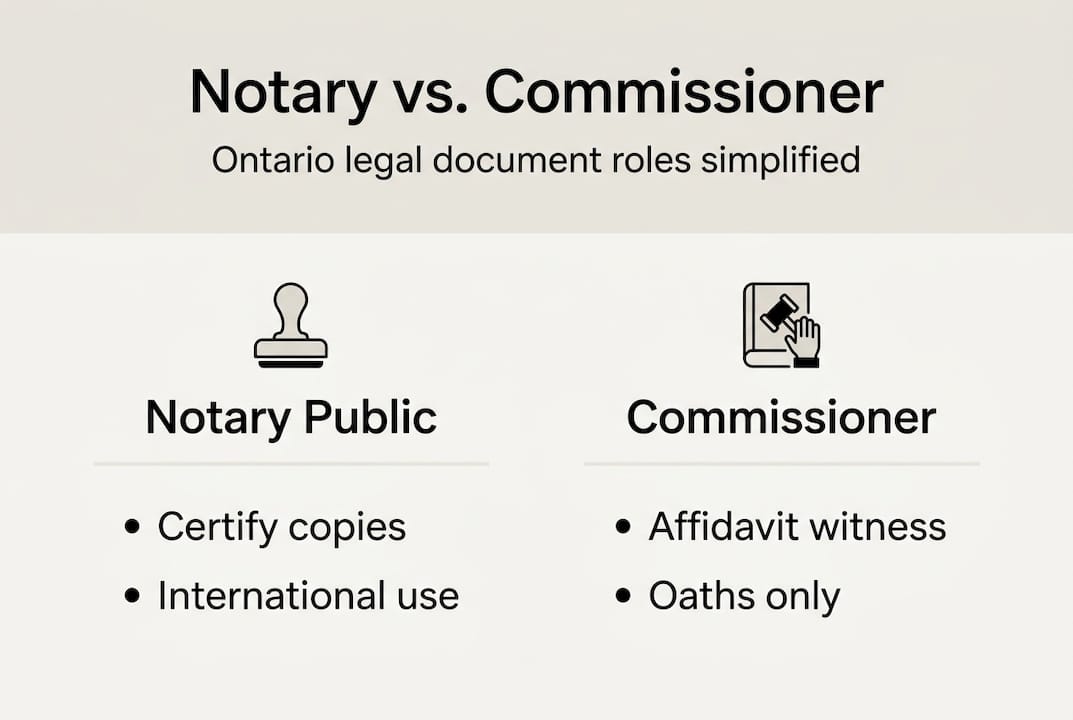
- Notaries have broader legal powers, including certifying copies and authenticating documents for international use.
- Commissioners mainly witness affidavits and administer oaths within Ontario, but cannot certify copies or handle foreign authentication.
- Always verify specific requirements with the document recipient to avoid rejection or delays.
Choosing between a notary public and a commissioner for affidavits in Ontario sounds simple until your document gets rejected. A visa application delayed by weeks, a bank refusing to accept your power of attorney, or a court filing sent back for the wrong signature — these are real consequences of mixing up two roles that look similar on the surface. Ontario law draws a clear line between what each official can do, and that line matters every time you prepare a legal document. This guide gives you a practical framework, real examples, and a clear decision checklist so you never have to guess again.
Table of Contents
- Notary public vs. commissioner for affidavits: Key differences
- Situations when a notary public is required in Ontario
- Common documents needing notarization vs. commissioning
- Special and international cases: Authentication, apostille, and beyond
- Our perspective: Avoid the costly notary confusion trap
- Need notary services in Ontario? Get fast, reliable help
- Frequently asked questions
Key Takeaways
| Point | Details |
|---|---|
| Notary vs commissioner | Notaries can do everything commissioners can, plus certify true copies and handle international documents. |
| When notary is required | Notaries are necessary for certified copies, international documents, and when an official body specifies notarization. |
| Document use determines requirements | Check where and for what purpose your document will be used to avoid costly mistakes. |
| Authentication for global use | International documents often require notarization first, then authentication or apostille. |
Notary public vs. commissioner for affidavits: Key differences
With this confusion in mind, let’s unpack exactly what each official does and why it matters for your legal or business paperwork.
A notary public in Ontario is a lawyer or, in some cases, a non-lawyer appointed by the provincial government with a broad set of legal powers. A notary can witness signatures, administer oaths, certify copies of original documents, and authenticate paperwork for use in other countries. The Notaries Act RSO 1990 confirms that notaries hold all commissioner powers plus the ability to certify copies and authenticate for international use. That extra reach is what makes notaries essential for cross-border transactions.
A commissioner for affidavits, by contrast, has a narrower role. Commissioners are authorized to witness the signing of affidavits and statutory declarations and to administer oaths, but they cannot certify copies or authenticate documents for use abroad. As Ontario’s official guidance explains, affidavits and statutory declarations for use within the province are typically commissioned rather than notarized. For most local Ontario legal matters, a commissioner is perfectly sufficient and often easier to find.
Here is a side-by-side comparison to make the distinction concrete:
| Function | Commissioner for affidavits | Notary public |
|---|---|---|
| Witness signatures on affidavits | Yes | Yes |
| Administer oaths and declarations | Yes | Yes |
| Certify true copies of documents | No | Yes |
| Authenticate for international use | No | Yes |
| Handle powers of attorney for overseas use | No | Yes |
| Typical appointment | Non-lawyers, paralegals, lawyers | Lawyers or appointed non-lawyers |
Documents each professional typically handles:
- Commissioner: Local court affidavits, Ontario statutory declarations, solemn declarations, domestic sworn statements
- Notary: Certified true copies, international business contracts, immigration documents, powers of attorney for foreign use, academic credential verification for overseas institutions
When in doubt about when a notary is required, always contact the organization receiving your document before you book an appointment. Different institutions have different standards, and confirming upfront saves you from a second trip. You can also review notary public requirements to understand the full scope of what each role covers in Ontario.
Situations when a notary public is required in Ontario
Now that you understand who does what, let’s focus on exactly when a notary — not just a commissioner — is legally or practically required.
Some situations make the choice obvious. Others are trickier. Here are the most common scenarios where only a notary will do:
- Bank requirements: Many Canadian banks require notarized copies of identification or notarized powers of attorney before processing certain transactions, especially for clients acting on behalf of another person.
- Certified true copies: If you need a copy of a passport, degree, or corporate document certified as an accurate reproduction of the original, only a notary can provide that certification in Ontario.
- Immigration and visa applications: Documents submitted to foreign embassies or immigration authorities almost always require notarization. Global Affairs Canada confirms that a notary public is needed for international documents, certified true copies, and when explicitly required by banks, immigration, or for certain powers of attorney.
- Real estate and property transactions: Deeds and title transfers involving parties outside Canada, or where a foreign registry is involved, typically require notarized documentation.
- International business contracts: Foreign companies and government agencies often require notarized signatures before recognizing a contract as legally binding.
- Academic submissions abroad: Universities and licensing bodies in other countries routinely ask for notarized copies of transcripts, diplomas, and professional certificates.
- Statutory requirements: Some Ontario statutes and many foreign laws explicitly name a notary as the required witness. If the law says notary, a commissioner is not a substitute.
Pro Tip: Before booking any appointment, email or call the receiving organization and ask specifically whether they require a notary public or whether a commissioner for affidavits is acceptable. Getting this in writing protects you if there is ever a dispute later.
Understanding who needs a notary in Ontario is not just about following rules. It is about making sure your document is accepted the first time. The Ontario affidavit guide walks through specific document scenarios in even more detail if you need help with a particular form.
Common documents needing notarization vs. commissioning
To help you see clearer, here is a straightforward chart and walkthrough for specific document types.
The Notaries Act RSO 1990 is clear: notaries can certify copies, authenticate signatures for international use, and handle all commissioner tasks, while commissioners are limited to domestic witnessing and oath-taking.
| Document type | Commissioner | Notary | Either |
|---|---|---|---|
| Ontario court affidavit | Yes | Yes | Yes |
| Statutory declaration (local use) | Yes | Yes | Yes |
| Certified true copy of passport | No | Yes | No |
| Power of attorney (international) | No | Yes | No |
| Immigration document for foreign use | No | Yes | No |
| Solemn declaration (Ontario only) | Yes | Yes | Yes |
| Academic transcript for overseas | No | Yes | No |
| Business contract for foreign registry | No | Yes | No |
Here is a step-by-step process for figuring out who should sign your specific document:
- Identify where the document will be used. If it stays within Ontario, a commissioner is usually enough. If it goes outside Canada, you almost certainly need a notary.
- Check the receiving organization’s requirements. Ask directly. Do not assume.
- Determine whether a certified copy is needed. If yes, only a notary can help.
- Confirm whether authentication or apostille is required after notarization. Some countries need an extra layer beyond the notary’s seal.
- Book the appropriate professional. Booking the wrong one wastes time and money.
For specific forms like a statutory declaration or if you want to understand the full range of types of affidavits used in Ontario courts and government offices, reviewing those resources before your appointment will help you arrive prepared.
Special and international cases: Authentication, apostille, and beyond
Some document situations have a few extra steps — here is what you need to know about more complex, international or special cases.

Notarization is often just the first step when a document needs to work across borders. Two terms come up repeatedly: authentication and apostille. Authentication is a process where a government authority confirms that the notary’s signature and seal are genuine. An apostille is a simplified form of authentication accepted between countries that have signed the Hague Convention. Canada is not a member of the Hague Apostille Convention, so Canadian documents going abroad typically require full authentication rather than a simple apostille.
Here is a checklist for international document preparation:
- Get the document notarized by a qualified Ontario notary public
- Have the notary’s signature authenticated by the relevant provincial or federal authority
- Check whether the destination country requires additional legalization through their embassy or consulate
- Confirm the final accepted format with the receiving institution before submitting
A statutory declaration, for example, may need to be notarized first and then sent through the full authentication chain before a foreign government will accept it. Skipping a step means starting over.
“For international use, notary is often required first, then further authentication such as apostille or equivalent. For Ontario-based uses, a commissioner may suffice.” — Global Affairs Canada
Understanding document authentication in Ontario and knowing how to legalize a document in Ontario are two separate but connected skills. Notarization gets you started. Authentication gets you across the finish line for international submissions.
Our perspective: Avoid the costly notary confusion trap
After helping thousands of clients navigate Ontario notarial law, we have seen one pattern repeat itself more than any other: people assume a commissioner is always enough, and they find out otherwise only when a document is rejected.
Standard legal guides tend to be either too technical for everyday use or too vague to be actionable. They list the rules but skip the practical reality. The truth is that the receiving party, not Ontario law, often makes the final call. A foreign university, a bank in Germany, or an immigration office in the Philippines may have internal policies that go beyond what Ontario statutes require. Local rules are a floor, not a ceiling.
The edge case most guides miss entirely is this: international authorities frequently require both notarization and authentication, regardless of what Ontario law says about the document. Knowing the Ontario rules is necessary but not sufficient. Always verify with the end destination.
For anyone navigating these decisions, reviewing real Ontario notary scenarios based on actual client situations gives you a much clearer picture than reading statutes alone.
Need notary services in Ontario? Get fast, reliable help
Ready to act on what you’ve learned? Here’s how to make notarization stress-free.
Whether you need an affidavit commissioned, a statutory declaration witnessed, or a certified true copy for an international submission, getting the right professional matters. We provide fast, reliable notary services in Ontario online and in-person, so you can get your documents handled without unnecessary delays.

From invitation letters and solemn declarations to powers of attorney and types of notarized documents for overseas use, we cover every common scenario with step-by-step guidance. If your document needs to go further and requires document legalization in Ontario, we can walk you through that process too. Book online today and get your paperwork done right the first time.
Frequently asked questions
Do all affidavits in Ontario need to be notarized?
No. Most affidavits within Ontario can be commissioned rather than notarized unless the receiving authority specifically requires a notary public.
When do banks in Ontario require a notary?
Banks typically require a notary for certified true copies, powers of attorney, or any document intended for international use.
Who can certify a true copy of a document in Ontario?
Only a notary public has the authority to certify a document as a true copy in Ontario. The Notaries Act RSO 1990 does not grant this power to commissioners.
Can I use a commissioner for documents sent outside Ontario?
Usually not. For international document use, a notary is typically required first, and additional authentication may also be necessary depending on the destination country.